[English] 日本語
Yorodumi
- PDB-3a9e: Crystal structure of a mixed agonist-bound RAR-alpha and antagoni... -

+
Open data


ID or keywords:

Loading...

-
Basic information

Entry
Database: PDB / ID: 3a9e
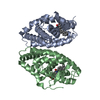
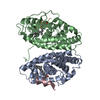
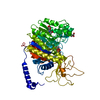
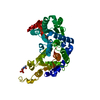
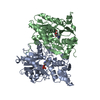
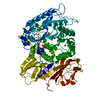
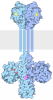
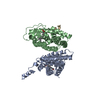
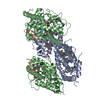
TitleCrystal structure of a mixed agonist-bound RAR-alpha and antagonist-bound RXR-alpha heterodimer ligand binding domains
Components
  • (Retinoic acid receptor ...) x 2
  • 13-mer (LXXLL motif) from Nuclear receptor coactivator 2
KeywordsTRANSCRIPTION / Nucleus / Receptor / Transcription regulation / Structural Genomics / SPINE2-complexes / Structural Proteomics in Europe
Function / homology
Function and homology information


regulation of branching involved in prostate gland morphogenesis / Transcriptional regulation of granulopoiesis / Carnitine shuttle / Transcriptional regulation of white adipocyte differentiation / positive regulation of translational initiation by iron / Signaling by Retinoic Acid / maternal placenta development / Sertoli cell fate commitment / positive regulation of binding / NR1H2 & NR1H3 regulate gene expression to control bile acid homeostasis ...regulation of branching involved in prostate gland morphogenesis / Transcriptional regulation of granulopoiesis / Carnitine shuttle / Transcriptional regulation of white adipocyte differentiation / positive regulation of translational initiation by iron / Signaling by Retinoic Acid / maternal placenta development / Sertoli cell fate commitment / positive regulation of binding / NR1H2 & NR1H3 regulate gene expression to control bile acid homeostasis / NR1H3 & NR1H2 regulate gene expression linked to cholesterol transport and efflux / ventricular cardiac muscle cell differentiation / secretory columnal luminar epithelial cell differentiation involved in prostate glandular acinus development / SUMOylation of intracellular receptors / Recycling of bile acids and salts / Synthesis of bile acids and bile salts / Nuclear Receptor transcription pathway / visceral serous pericardium development / Synthesis of bile acids and bile salts via 7alpha-hydroxycholesterol / Synthesis of bile acids and bile salts via 27-hydroxycholesterol / Endogenous sterols / MLL4 and MLL3 complexes regulate expression of PPARG target genes in adipogenesis and hepatic steatosis / protein kinase B binding / negative regulation of granulocyte differentiation / mesenchyme development / positive regulation of T-helper 2 cell differentiation / prostate gland development / angiogenesis involved in coronary vascular morphogenesis / Regulation of lipid metabolism by PPARalpha / retinoic acid-responsive element binding / Cytoprotection by HMOX1 / nuclear protein quality control by the ubiquitin-proteasome system / positive regulation of thyroid hormone receptor signaling pathway / camera-type eye development / cardiac muscle cell differentiation / positive regulation of interleukin-5 production / positive regulation of interleukin-13 production / regulation of myelination / germ cell development / response to vitamin A / retinoic acid binding / nuclear retinoic acid receptor binding / positive regulation of vitamin D receptor signaling pathway / TGFBR3 expression / nuclear vitamin D receptor binding / apoptotic cell clearance / heterocyclic compound binding / Signaling by Retinoic Acid / nuclear thyroid hormone receptor binding / RNA polymerase II intronic transcription regulatory region sequence-specific DNA binding / DNA-binding transcription repressor activity / DNA binding domain binding / positive regulation of interleukin-4 production / ventricular cardiac muscle tissue morphogenesis / positive regulation of bone mineralization / LBD domain binding / nuclear steroid receptor activity / locomotor rhythm / positive regulation of lipoprotein transport / cell maturation / negative regulation of type II interferon production / aryl hydrocarbon receptor binding / protein kinase A binding / regulation of glucose metabolic process / Synthesis of bile acids and bile salts / monocyte differentiation / cardiac muscle cell proliferation / alpha-actinin binding / heart morphogenesis / cellular response to estrogen stimulus / negative regulation of tumor necrosis factor production / regulation of lipid metabolic process / Synthesis of bile acids and bile salts via 27-hydroxycholesterol / Endogenous sterols / Synthesis of bile acids and bile salts via 7alpha-hydroxycholesterol / cellular response to low-density lipoprotein particle stimulus / response to retinoic acid / placenta development / positive regulation of neuron differentiation / retinoic acid receptor signaling pathway / Recycling of bile acids and salts / transcription regulator inhibitor activity / embryo implantation / cellular response to retinoic acid / hormone-mediated signaling pathway / cellular response to hormone stimulus / peroxisome proliferator activated receptor signaling pathway / Regulation of lipid metabolism by PPARalpha / positive regulation of adipose tissue development / bile acid and bile salt transport / peptide binding / response to cytokine / BMAL1:CLOCK,NPAS2 activates circadian expression / regulation of cellular response to insulin stimulus / positive regulation of cell cycle / in utero embryonic development / RORA,B,C and NR1D1 (REV-ERBA) regulate gene expression / gene expression / Activation of gene expression by SREBF (SREBP) / SUMOylation of transcription cofactors
Similarity search - Function
: / : / Retinoic acid receptor / Nuclear/hormone receptor activator site AF-1 / Nuclear/hormone receptor activator site AF-1 / Retinoid X receptor/HNF4 / : / Nuclear receptor coactivator 2 / Nuclear receptor coactivator 2/3, DUF4927 / Domain of unknown function (DUF4927) ...: / : / Retinoic acid receptor / Nuclear/hormone receptor activator site AF-1 / Nuclear/hormone receptor activator site AF-1 / Retinoid X receptor/HNF4 / : / Nuclear receptor coactivator 2 / Nuclear receptor coactivator 2/3, DUF4927 / Domain of unknown function (DUF4927) / Nuclear receptor coactivator, DUF1518 / Nuclear receptor coactivator, Ncoa-type, interlocking / Nuclear receptor coactivator, Ncoa-type, interlocking domain superfamily / Nuclear receptor coactivator, DUF1518 / Nuclear receptor coactivator / DUF1518 / Nuclear receptor coactivator, receptor-binding domain / Nuclear receptor coactivator / : / Steroid receptor coactivator / Unstructured region on nuclear receptor coactivator protein / Nuclear receptor coactivators bHLH domain / PAS domain / Nuclear receptor coactivator, interlocking / helix loop helix domain / Myc-type, basic helix-loop-helix (bHLH) domain / Myc-type, basic helix-loop-helix (bHLH) domain profile. / Helix-loop-helix DNA-binding domain superfamily / PAS fold / PAS fold / PAS domain / PAS repeat profile. / PAS domain / Retinoid X Receptor / Retinoid X Receptor / PAS domain superfamily / Nuclear hormone receptor / Nuclear hormones receptors DNA-binding region signature. / Zinc finger, nuclear hormone receptor-type / Double treble clef zinc finger, C4 type / Nuclear hormone receptors DNA-binding domain profile. / c4 zinc finger in nuclear hormone receptors / Nuclear hormone receptor, ligand-binding domain / Nuclear hormone receptor-like domain superfamily / Ligand-binding domain of nuclear hormone receptor / Nuclear receptor (NR) ligand-binding (LBD) domain profile. / Ligand binding domain of hormone receptors / Zinc finger, NHR/GATA-type / Orthogonal Bundle / Mainly Alpha
Similarity search - Domain/homology
Chem-754 / RETINOIC ACID / Retinoic acid receptor alpha / Retinoic acid receptor RXR-alpha / Nuclear receptor coactivator 2
Similarity search - Component
Biological speciesMus musculus (house mouse)
Homo sapiens (human)
HOMO SAPIENS (human)
MethodX-RAY DIFFRACTION / SYNCHROTRON / MOLECULAR REPLACEMENT / Resolution: 2.75 Å
AuthorsSato, Y. / Duclaud, S. / Peluso-Iltis, C. / Poussin, P. / Moras, D. / Rochel, N. / Structural Proteomics in Europe (SPINE)
CitationJournal: Plos One / Year: 2010
Title: The Phantom Effect of the Rexinoid LG100754: structural and functional insights
Authors: Sato, Y. / Ramalanjaona, N. / Huet, T. / Potier, N. / Osz, J. / Antony, P. / Peluso-Iltis, C. / Poussin-Courmontagne, P. / Ennifar, E. / Mely, Y. / Dejaegere, A. / Moras, D. / Rochel, N.
History
DepositionOct 24, 2009Deposition site: PDBJ / Processing site: PDBJ
Revision 1.0Oct 6, 2010Provider: repository / Type: Initial release
Revision 1.1Jul 13, 2011Group: Version format compliance
Revision 1.2Oct 30, 2013Group: Database references
Revision 1.3Nov 1, 2023Group: Data collection / Database references ...Data collection / Database references / Derived calculations / Refinement description
Category: chem_comp_atom / chem_comp_bond ...chem_comp_atom / chem_comp_bond / database_2 / pdbx_initial_refinement_model / struct_site
Item: _database_2.pdbx_DOI / _database_2.pdbx_database_accession ..._database_2.pdbx_DOI / _database_2.pdbx_database_accession / _struct_site.pdbx_auth_asym_id / _struct_site.pdbx_auth_comp_id / _struct_site.pdbx_auth_seq_id

-
Structure visualization

Structure viewerMolecule:
MolmilJmol/JSmol

Downloads & links

-
Assembly

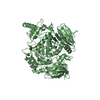
Deposited unit
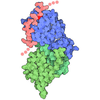
A: Retinoic acid receptor RXR-alpha
B: Retinoic acid receptor alpha
I: 13-mer (LXXLL motif) from Nuclear receptor coactivator 2
hetero molecules


Theoretical massNumber of molelcules
Total (without water)59,5495
Polymers58,8523
Non-polymers6972
Water2,072115
1


  • Idetical with deposited unit
  • defined by author
TypeNameSymmetry operationNumber
identity operation1_555x,y,z1
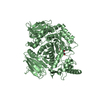
2
A: Retinoic acid receptor RXR-alpha
B: Retinoic acid receptor alpha
I: 13-mer (LXXLL motif) from Nuclear receptor coactivator 2
hetero molecules

A: Retinoic acid receptor RXR-alpha
B: Retinoic acid receptor alpha
I: 13-mer (LXXLL motif) from Nuclear receptor coactivator 2
hetero molecules


Theoretical massNumber of molelcules
Total (without water)119,09810
Polymers117,7046
Non-polymers1,3944
Water1086
TypeNameSymmetry operationNumber
identity operation1_555x,y,z1
crystal symmetry operation7_555y,x,-z1
Buried area10900 Å2
ΔGint-72 kcal/mol
Surface area39920 Å2
MethodPISA
Unit cell
Length a, b, c (Å)105.300, 105.300, 111.338
Angle α, β, γ (deg.)90.00, 90.00, 90.00
Int Tables number96
Space group name H-MP43212

-
Components

-
Retinoic acid receptor ... , 2 types, 2 molecules AB

#1: Protein Retinoic acid receptor RXR-alpha / Retinoid X receptor alpha / Nuclear receptor subfamily 2 group B member 1


Mass: 26767.908 Da / Num. of mol.: 1 / Fragment: Ligand Binding Domain
Source method: isolated from a genetically manipulated source
Source: (gene. exp.) Mus musculus (house mouse) / Gene: Rxra, Nr2b1 / Plasmid: pET3a / Production host: Escherichia coli (E. coli) / Strain (production host): BL21 (DE3) / References: UniProt: P28700
#2: Protein Retinoic acid receptor alpha / RAR-alpha / Nuclear receptor subfamily 1 group B member 1


Mass: 30504.383 Da / Num. of mol.: 1 / Fragment: Ligand Binding Domain
Source method: isolated from a genetically manipulated source
Source: (gene. exp.) Homo sapiens (human) / Gene: RARA, NR1B1 / Plasmid: pET15b / Production host: Escherichia coli (E. coli) / Strain (production host): BL21 (DE3) / References: UniProt: P10276

-
Protein/peptide , 1 types, 1 molecules I

#3: Protein/peptide 13-mer (LXXLL motif) from Nuclear receptor coactivator 2


Mass: 1579.866 Da / Num. of mol.: 1 / Source method: obtained synthetically / Details: The peptide was chemically synthesized. / Source: (synth.) HOMO SAPIENS (human) / References: UniProt: Q15596

-
Non-polymers , 3 types, 117 molecules

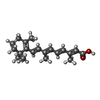
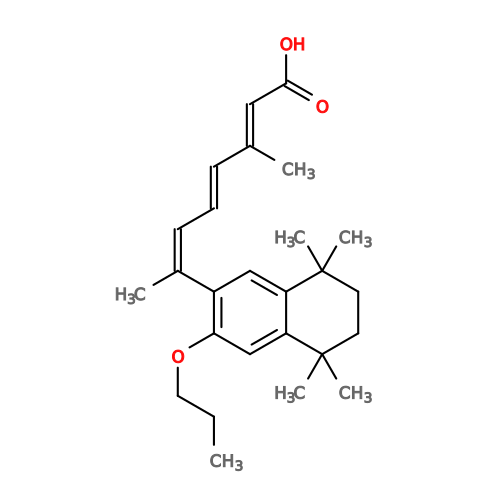
#4: Chemical ChemComp-754 / (2E,4E,6Z)-3-methyl-7-(5,5,8,8-tetramethyl-3-propoxy-5,6,7,8-tetrahydronaphthalen-2-yl)octa-2,4,6-trienoic acid


Mass: 396.562 Da / Num. of mol.: 1 / Source method: obtained synthetically / Formula: C26H36O3
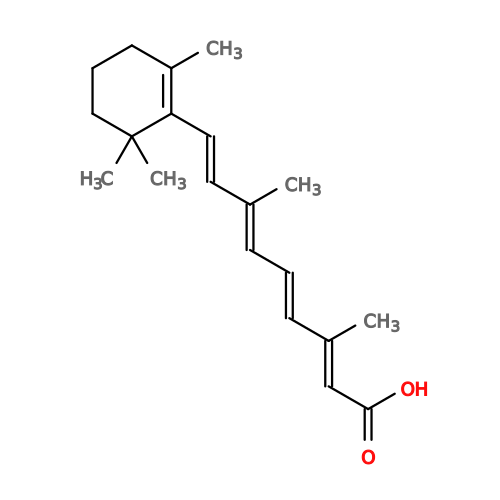
#5: Chemical ChemComp-REA / RETINOIC ACID


Mass: 300.435 Da / Num. of mol.: 1 / Source method: obtained synthetically / Formula: C20H28O2
#6: Water ChemComp-HOH / water


Mass: 18.015 Da / Num. of mol.: 115 / Source method: isolated from a natural source / Formula: H2O

-
Experimental details

-
Experiment

ExperimentMethod: X-RAY DIFFRACTION / Number of used crystals: 1

-
Sample preparation

CrystalDensity Matthews: 2.62 Å3/Da / Density % sol: 53.09 %
Crystal growTemperature: 290 K / Method: vapor diffusion, sitting drop / pH: 8
Details: 200mM potassium thiocyanate, 20% PEG 3350, pH 8.0, VAPOR DIFFUSION, SITTING DROP, temperature 290K

-
Data collection

DiffractionMean temperature: 100 K
Diffraction sourceSource: SYNCHROTRON / Site: ESRF / Beamline: ID23-1 / Wavelength: 1.0723 Å
DetectorType: ADSC QUANTUM 315r / Detector: CCD / Date: Oct 29, 2008
RadiationMonochromator: Si(111) / Protocol: SINGLE WAVELENGTH / Monochromatic (M) / Laue (L): M / Scattering type: x-ray
Radiation wavelengthWavelength: 1.0723 Å / Relative weight: 1
ReflectionResolution: 2.75→20 Å / Num. all: 16968 / Num. obs: 15407 / % possible obs: 90.8 % / Redundancy: 6.7 % / Biso Wilson estimate: 68.7 Å2 / Rmerge(I) obs: 0.097 / Rsym value: 0.097 / Net I/σ(I): 15.2
Reflection shellResolution: 2.75→2.85 Å / Redundancy: 7.6 % / Rmerge(I) obs: 0.333 / Mean I/σ(I) obs: 5.5 / Num. unique all: 1662 / Rsym value: 0.333 / % possible all: 99.6

-
Processing

Software
NameVersionClassification
MxCuBEdata collection
AMoREphasing
PHENIX(phenix.refine)refinement
HKL-2000data reduction
HKL-2000data scaling
RefinementMethod to determine structure: MOLECULAR REPLACEMENT
Starting model: PDB ENTRY 1DKF
Resolution: 2.75→19.882 Å / SU ML: 0.63 / Isotropic thermal model: Isotropic / Cross valid method: THROUGHOUT / σ(F): 1.33 / Phase error: 26.39 / Stereochemistry target values: ML
RfactorNum. reflection% reflectionSelection details
Rfree0.2639 737 4.86 %RANDOM
Rwork0.2014 ---
obs0.2045 15179 90.37 %-
all-16797 --
Solvent computationShrinkage radii: 0.9 Å / VDW probe radii: 1.11 Å / Solvent model: FLAT BULK SOLVENT MODEL / Bsol: 39.729 Å2 / ksol: 0.266 e/Å3
Displacement parametersBiso mean: 56 Å2
Baniso -1Baniso -2Baniso -3
1--1.086 Å20 Å20 Å2
2---1.086 Å20 Å2
3---2.1721 Å2
Refinement stepCycle: LAST / Resolution: 2.75→19.882 Å
ProteinNucleic acidLigandSolventTotal
Num. atoms3701 0 51 115 3867
Refine LS restraints
Refine-IDTypeDev idealNumber
X-RAY DIFFRACTIONf_bond_d0.0023833
X-RAY DIFFRACTIONf_angle_d0.5425188
X-RAY DIFFRACTIONf_dihedral_angle_d12.2911473
X-RAY DIFFRACTIONf_chiral_restr0.034600
X-RAY DIFFRACTIONf_plane_restr0.002663
LS refinement shell

Refine-ID: X-RAY DIFFRACTION / Total num. of bins used: 5

Resolution (Å)Rfactor RfreeNum. reflection RfreeRfactor RworkNum. reflection Rwork% reflection obs (%)
2.7501-2.96180.30151510.22763125100
2.9618-3.25870.29851700.21963118100
3.2587-3.72760.2821300.2251226172
3.7276-4.68620.2251210.1802266583
4.6862-19.88250.24331650.1877327398
Refinement TLS params.Method: refined / Origin x: 34.103 Å / Origin y: 62.162 Å / Origin z: 7.2991 Å
111213212223313233
T0.1329 Å20.0226 Å2-0.0205 Å2-0.0319 Å2-0.0129 Å2--0.104 Å2
L1.2469 °20.59 °2-0.1421 °2-1.4068 °2-0.3309 °2--1.1789 °2
S0.0839 Å °-0.1236 Å °0.0012 Å °0.0236 Å °-0.0551 Å °-0.1078 Å °-0.051 Å °-0.0769 Å °-0.0318 Å °
Refinement TLS groupSelection details: ALL

+
About Yorodumi

-
News

-
Feb 9, 2022. New format data for meta-information of EMDB entries

New format data for meta-information of EMDB entries

  • Version 3 of the EMDB header file is now the official format.
  • The previous official version 1.9 will be removed from the archive.

Related info.:EMDB header

External links:wwPDB to switch to version 3 of the EMDB data model

-
Aug 12, 2020. Covid-19 info

Covid-19 info

URL: https://pdbj.org/emnavi/covid19.php

New page: Covid-19 featured information page in EM Navigator.

Related info.:Covid-19 info / Mar 5, 2020. Novel coronavirus structure data

+
Mar 5, 2020. Novel coronavirus structure data

Novel coronavirus structure data

Related info.:Yorodumi Speices / Aug 12, 2020. Covid-19 info

External links:COVID-19 featured content - PDBj / Molecule of the Month (242):Coronavirus Proteases

+
Jan 31, 2019. EMDB accession codes are about to change! (news from PDBe EMDB page)

EMDB accession codes are about to change! (news from PDBe EMDB page)

  • The allocation of 4 digits for EMDB accession codes will soon come to an end. Whilst these codes will remain in use, new EMDB accession codes will include an additional digit and will expand incrementally as the available range of codes is exhausted. The current 4-digit format prefixed with “EMD-” (i.e. EMD-XXXX) will advance to a 5-digit format (i.e. EMD-XXXXX), and so on. It is currently estimated that the 4-digit codes will be depleted around Spring 2019, at which point the 5-digit format will come into force.
  • The EM Navigator/Yorodumi systems omit the EMD- prefix.

Related info.:Q: What is EMD? / ID/Accession-code notation in Yorodumi/EM Navigator

External links:EMDB Accession Codes are Changing Soon! / Contact to PDBj

+
Jul 12, 2017. Major update of PDB

Major update of PDB

  • wwPDB released updated PDB data conforming to the new PDBx/mmCIF dictionary.
  • This is a major update changing the version number from 4 to 5, and with Remediation, in which all the entries are updated.
  • In this update, many items about electron microscopy experimental information are reorganized (e.g. em_software).
  • Now, EM Navigator and Yorodumi are based on the updated data.

External links:wwPDB Remediation / Enriched Model Files Conforming to OneDep Data Standards Now Available in the PDB FTP Archive

-
Yorodumi

Thousand views of thousand structures

  • Yorodumi is a browser for structure data from EMDB, PDB, SASBDB, etc.
  • This page is also the successor to EM Navigator detail page, and also detail information page/front-end page for Omokage search.
  • The word "yorodu" (or yorozu) is an old Japanese word meaning "ten thousand". "mi" (miru) is to see.

Related info.:EMDB / PDB / SASBDB / Comparison of 3 databanks / Yorodumi Search / Aug 31, 2016. New EM Navigator & Yorodumi / Yorodumi Papers / Jmol/JSmol / Function and homology information / Changes in new EM Navigator and Yorodumi

Read more