 Movie
Movie Controller

[English] 日本語
 Yorodumi
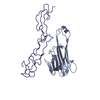
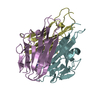
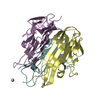
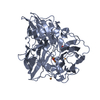
- PDB-2e7a: TNF Receptor Subtype One-selective TNF Mutant with Antagonistic A... -
+ Open data

- Basic information
| Entry | Database: PDB / ID: 2e7a | ||||||
|---|---|---|---|---|---|---|---|
| Title | TNF Receptor Subtype One-selective TNF Mutant with Antagonistic Activity | ||||||
 Components Components | Tumor necrosis factor | ||||||
 Keywords Keywords | CYTOKINE / Tumor necrosis factor / Trimer / antagonistic activity / TNFR1 specific / phage display system | ||||||
| Function / homology |  Function and homology information Function and homology informationresponse to Gram-negative bacterium / negative regulation of L-glutamate import across plasma membrane / negative regulation of bile acid secretion / positive regulation of interleukin-33 production / positive regulation of neutrophil activation / response to quercetin / negative regulation of branching involved in lung morphogenesis / positive regulation of fractalkine production / positive regulation of blood microparticle formation / response to 3,3',5-triiodo-L-thyronine ...response to Gram-negative bacterium / negative regulation of L-glutamate import across plasma membrane / negative regulation of bile acid secretion / positive regulation of interleukin-33 production / positive regulation of neutrophil activation / response to quercetin / negative regulation of branching involved in lung morphogenesis / positive regulation of fractalkine production / positive regulation of blood microparticle formation / response to 3,3',5-triiodo-L-thyronine / positive regulation of protein transport / positive regulation of vitamin D biosynthetic process / chronic inflammatory response to antigenic stimulus / regulation of endothelial cell apoptotic process / endothelial cell apoptotic process / response to macrophage colony-stimulating factor / negative regulation of myelination / positive regulation of leukocyte adhesion to arterial endothelial cell / response to gold nanoparticle / negative regulation of vascular wound healing / Differentiation of naive CD4+ T cells to T helper 1 cells (Th1 cells) / negative regulation of cytokine production involved in immune response / negative regulation of amyloid-beta clearance / positive regulation of podosome assembly / response to resveratrol / positive regulation of hair follicle development / inflammatory response to wounding / positive regulation of interleukin-18 production / positive regulation of hepatocyte proliferation / positive regulation of action potential / toll-like receptor 3 signaling pathway / TNF signaling / embryonic digestive tract development / negative regulation of D-glucose import across plasma membrane / vascular endothelial growth factor production / positive regulation of fever generation / positive regulation of calcineurin-NFAT signaling cascade / positive regulation of protein localization to cell surface / response to fructose / negative regulation of mitotic cell cycle / leukocyte tethering or rolling / necroptotic signaling pathway / positive regulation of synoviocyte proliferation / regulation of establishment of endothelial barrier / positive regulation of mononuclear cell migration / negative regulation of oxidative phosphorylation / macrophage activation involved in immune response / response to hydrogen sulfide / positive regulation of glial cell proliferation / positive regulation of protein-containing complex disassembly / positive regulation of osteoclast differentiation / cellular response to toxic substance / positive regulation of macrophage derived foam cell differentiation / regulation of fat cell differentiation / positive regulation of chemokine (C-X-C motif) ligand 2 production / tumor necrosis factor receptor binding / positive regulation of heterotypic cell-cell adhesion / positive regulation of membrane protein ectodomain proteolysis / negative regulation of systemic arterial blood pressure / response to L-glutamate / positive regulation of extrinsic apoptotic signaling pathway / positive regulation of leukocyte adhesion to vascular endothelial cell / regulation of canonical NF-kappaB signal transduction / TNFR1-induced proapoptotic signaling / negative regulation of fat cell differentiation / regulation of reactive oxygen species metabolic process / positive regulation of cytokine production involved in inflammatory response / TNFR1-mediated ceramide production / positive regulation of programmed cell death / negative regulation of heart rate / negative regulation of viral genome replication / positive regulation of DNA biosynthetic process / positive regulation of neuroinflammatory response / positive regulation of amyloid-beta formation / extrinsic apoptotic signaling pathway via death domain receptors / negative regulation of endothelial cell proliferation / negative regulation of interleukin-6 production / positive regulation of immunoglobulin production / negative regulation of bicellular tight junction assembly / response to isolation stress / Interleukin-10 signaling / regulation of synapse organization / negative regulation of apoptotic signaling pathway / regulation of insulin secretion / histone H3K9ac reader activity / negative regulation of blood vessel endothelial cell migration / negative regulation of lipid storage / response to salt stress / negative regulation of extrinsic apoptotic signaling pathway in absence of ligand / detection of mechanical stimulus involved in sensory perception of pain / negative regulation of osteoblast differentiation / negative regulation of lipid catabolic process / extrinsic apoptotic signaling pathway / positive regulation of synaptic transmission / positive regulation of vascular associated smooth muscle cell proliferation / regulation of synaptic transmission, glutamatergic / cellular response to retinoic acid / cell surface receptor signaling pathway via JAK-STAT / positive regulation of chemokine production / phagocytic cup Similarity search - Function | ||||||
| Biological species |  Homo sapiens (human) Homo sapiens (human) | ||||||
| Method |  X-RAY DIFFRACTION / SYNCHROTRON / MOLECULAR REPLACEMENT / Resolution: 1.8 Å X-RAY DIFFRACTION / SYNCHROTRON / MOLECULAR REPLACEMENT / Resolution: 1.8 Å | ||||||
 Authors Authors | Mukai, Y. / Yamagata, Y. / Tsutsumi, Y. | ||||||
 Citation Citation | Journal: J.Biol.Chem. / Year: 2008 Title: Creation and X-ray structure analysis of the tumor necrosis factor receptor-1-selective mutant of a tumor necrosis factor-alpha antagonist Authors: Shibata, H. / Yoshioka, Y. / Ohkawa, A. / Minowa, K. / Mukai, Y. / Abe, Y. / Taniai, M. / Nomura, T. / Kayamuro, H. / Nabeshi, H. / Sugita, T. / Imai, S. / Nagano, K. / Yoshikawa, T. / ...Authors: Shibata, H. / Yoshioka, Y. / Ohkawa, A. / Minowa, K. / Mukai, Y. / Abe, Y. / Taniai, M. / Nomura, T. / Kayamuro, H. / Nabeshi, H. / Sugita, T. / Imai, S. / Nagano, K. / Yoshikawa, T. / Fujita, T. / Nakagawa, S. / Yamamoto, A. / Ohta, T. / Hayakawa, T. / Mayumi, T. / Vandenabeele, P. / Aggarwal, B.B. / Nakamura, T. / Yamagata, Y. / Tsunoda, S. / Kamada, H. / Tsutsumi, Y. | ||||||
| History |
|
- Structure visualization
| Structure viewer | Molecule: MolmilJmol/JSmol |
|---|
- Downloads & links
-Download
| PDBx/mmCIF format | 2e7a.cif.gz | 99.7 KB | Display | PDBx/mmCIF format |
|---|---|---|---|---|
| PDB format | pdb2e7a.ent.gz | 76.8 KB | Display | PDB format |
| PDBx/mmJSON format | 2e7a.json.gz | Tree view | PDBx/mmJSON format | |
| Others |  Other downloads Other downloads |
-Validation report
| Arichive directory | https://data.pdbj.org/pub/pdb/validation_reports/e7/2e7aftp://data.pdbj.org/pub/pdb/validation_reports/e7/2e7a | HTTPS FTP |
|---|
-Related structure data
| Related structure data |  1tnfS S: Starting model for refinement |
|---|---|
| Similar structure data |




-Links
 PDBj
PDBj
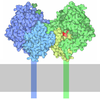
- Assembly
| Deposited unit | 
| ||||||||
|---|---|---|---|---|---|---|---|---|---|
| 1 |
| ||||||||
| Unit cell |
|
-Components
| #1: Protein | Mass: 17299.348 Da / Num. of mol.: 3 Mutation: K11M, K65S, A84S, V85T, S86T, Y87H, Q88N, T89Q, K90P, K98R, K112N, K128P Source method: isolated from a genetically manipulated source Source: (gene. exp.) Homo sapiens (human)Description: This mutant was created by phage display system Plasmid: pYas(modified from pUC18) / Species (production host): Escherichia coli / Production host:   Escherichia coli BL21(DE3) (bacteria) / Strain (production host): BL21(DE3) / References: UniProt: P01375 Escherichia coli BL21(DE3) (bacteria) / Strain (production host): BL21(DE3) / References: UniProt: P01375#2: Water | ChemComp-HOH / |  Mass: 18.015 Da / Num. of mol.: 237 / Source method: isolated from a natural source / Formula: H2O Mass: 18.015 Da / Num. of mol.: 237 / Source method: isolated from a natural source / Formula: H2OHas protein modification | Y | |
|---|
-Experimental details
-Experiment
| Experiment | Method: X-RAY DIFFRACTION / Number of used crystals: 1 |
|---|
- Sample preparation
| Crystal | Density Matthews: 2.16 Å3/Da / Density % sol: 42.93 % |
|---|---|
| Crystal grow | Temperature: 293 K / Method: vapor diffusion, hanging drop / pH: 7.5 Details: 0.05M HEPES pH7.5, 1.5%(w/v) 1,2,3-Heptanetriol, 12.5% PEG 3350, VAPOR DIFFUSION, HANGING DROP, temperature 293K |
-Data collection
| Diffraction | Mean temperature: 100 K |
|---|---|
| Diffraction source | Source: SYNCHROTRON / Site: SPring-8  / Beamline: BL41XU / Beamline: BL41XU |
| Detector | Detector: CCD / Date: Mar 25, 2006 |
| Radiation | Protocol: SINGLE WAVELENGTH / Monochromatic (M) / Laue (L): M / Scattering type: x-ray |
| Radiation wavelength | Relative weight: 1 |
| Reflection | Resolution: 1.8→50 Å / Num. obs: 42227 / % possible obs: 99.6 % / Redundancy: 7.1 % / Rmerge(I) obs: 0.063 |
| Reflection shell | Resolution: 1.8→1.86 Å / Redundancy: 6 % / Rmerge(I) obs: 0.484 / Mean I/σ(I) obs: 2.71 / Num. unique all: 4031 / % possible all: 96.1 |
- Processing
| Software |
| ||||||||||||||||||
|---|---|---|---|---|---|---|---|---|---|---|---|---|---|---|---|---|---|---|---|
| Refinement | Method to determine structure: MOLECULAR REPLACEMENT Starting model: PDB ENTRY 1TNF Resolution: 1.8→41 Å /
| ||||||||||||||||||
| Refinement step | Cycle: LAST / Resolution: 1.8→41 Å
|
