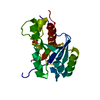
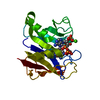
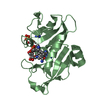
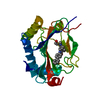
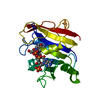
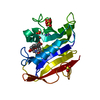
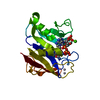
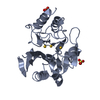
- PDB-2e6l: structure of mouse WRN exonuclease domain -
+
Open data
ID or keywords:
Loading...
-
Basic information
Entry
Database: PDB / ID: 2e6l
Title
structure of mouse WRN exonuclease domain
Components
Werner syndrome ATP-dependent helicase homolog
Keywords
HYDROLASE / Zn-protein complex
Function / homology
Function and homology information
Processive synthesis on the C-strand of the telomere / Removal of the Flap Intermediate from the C-strand / positive regulation of hydrolase activity / Presynaptic phase of homologous DNA pairing and strand exchange / Homologous DNA Pairing and Strand Exchange / Resolution of D-loop Structures through Holliday Junction Intermediates / G2/M DNA damage checkpoint / HDR through Single Strand Annealing (SSA) / regulation of growth rate / 3'-flap-structured DNA binding ...Processive synthesis on the C-strand of the telomere / Removal of the Flap Intermediate from the C-strand / positive regulation of hydrolase activity / Presynaptic phase of homologous DNA pairing and strand exchange / Homologous DNA Pairing and Strand Exchange / Resolution of D-loop Structures through Holliday Junction Intermediates / G2/M DNA damage checkpoint / HDR through Single Strand Annealing (SSA) / regulation of growth rate / 3'-flap-structured DNA binding / positive regulation of strand invasion / HDR through Homologous Recombination (HRR) / forked DNA-dependent helicase activity / telomeric G-quadruplex DNA binding / Processing of DNA double-strand break ends / 8-hydroxy-2'-deoxyguanosine DNA binding / telomeric D-loop binding / DNA geometric change / Y-form DNA binding / telomeric D-loop disassembly / Regulation of TP53 Activity through Phosphorylation / four-way junction helicase activity / G-quadruplex DNA binding / bubble DNA binding / MutLalpha complex binding / protein localization to nucleolus / response to UV-C / exonuclease activity / DNA metabolic process / DNA synthesis involved in DNA repair / replicative senescence / DNA 3'-5' helicase / replication fork processing / 3'-5' DNA helicase activity / mismatch repair / four-way junction DNA binding / determination of adult lifespan / 3'-5' exonuclease activity / telomere maintenance / DNA helicase activity / cellular response to starvation / replication fork / cellular response to gamma radiation / base-excision repair / double-strand break repair via homologous recombination / cellular senescence / double-strand break repair / manganese ion binding / chromosome / response to oxidative stress / regulation of apoptotic process / Hydrolases; Acting on ester bonds / chromosome, telomeric region / DNA replication / nuclear speck / centrosome / chromatin binding / DNA damage response / nucleolus / protein-containing complex binding / magnesium ion binding / protein homodimerization activity / ATP hydrolysis activity / DNA binding / nucleoplasm / ATP binding / nucleus / cytoplasm Similarity search - Function
In the structure databanks used in Yorodumi, some data are registered as the other names, "COVID-19 virus" and "2019-nCoV". Here are the details of the virus and the list of structure data.
Jan 31, 2019. EMDB accession codes are about to change! (news from PDBe EMDB page)
EMDB accession codes are about to change! (news from PDBe EMDB page)
The allocation of 4 digits for EMDB accession codes will soon come to an end. Whilst these codes will remain in use, new EMDB accession codes will include an additional digit and will expand incrementally as the available range of codes is exhausted. The current 4-digit format prefixed with “EMD-” (i.e. EMD-XXXX) will advance to a 5-digit format (i.e. EMD-XXXXX), and so on. It is currently estimated that the 4-digit codes will be depleted around Spring 2019, at which point the 5-digit format will come into force.
The EM Navigator/Yorodumi systems omit the EMD- prefix.
Related info.:Q: What is EMD? / ID/Accession-code notation in Yorodumi/EM Navigator
Yorodumi is a browser for structure data from EMDB, PDB, SASBDB, etc.
This page is also the successor to EM Navigator detail page, and also detail information page/front-end page for Omokage search.
The word "yorodu" (or yorozu) is an old Japanese word meaning "ten thousand". "mi" (miru) is to see.
Related info.:EMDB / PDB / SASBDB / Comparison of 3 databanks / Yorodumi Search / Aug 31, 2016. New EM Navigator & Yorodumi / Yorodumi Papers / Jmol/JSmol / Function and homology information / Changes in new EM Navigator and Yorodumi
 Movie
Movie Controller


 Open data
 Basic information
 Components
 Keywords
 Function and homology information
 Mus musculus (house mouse)
 X-RAY DIFFRACTION /
  Authors
 Citation
 Structure visualization
 Downloads & links
 Other downloads


 PDBj
PDBj
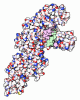
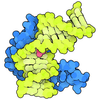
 Assembly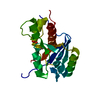

 Escherichia coli BL21(DE3) (bacteria) / Strain (production host): BL21(DE3)
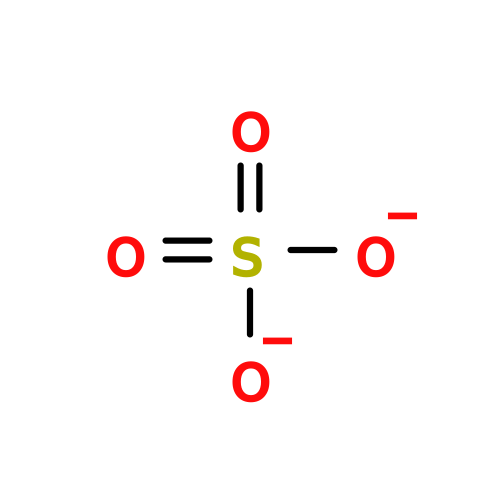 Mass: 96.063 Da / Num. of mol.: 1 / Source method: obtained synthetically / Formula: SO4
 Mass: 65.409 Da / Num. of mol.: 2 / Source method: obtained synthetically / Formula: Zn
 Mass: 18.015 Da / Num. of mol.: 150 / Source method: isolated from a natural source / Formula: H2O
 Sample preparation
 Processing