GENE REGULATION/ANTITUMOR PROTEIN / TUMOR SUPPRESSOR / BREAST CANCER SUSCEPTIBILITY / DNA-BINDING / GENE REGULATION-ANTITUMOR PROTEIN COMPLEX
Function / homology
Function and homology information
HDR through MMEJ (alt-NHEJ) / Resolution of D-loop Structures through Holliday Junction Intermediates / Homologous DNA Pairing and Strand Exchange / Presynaptic phase of homologous DNA pairing and strand exchange / HDR through Homologous Recombination (HRR) / homologous chromosome orientation in meiotic metaphase I / inner cell mass cell proliferation / BRCA2-MAGE-D1 complex / negative regulation of mammary gland epithelial cell proliferation / establishment of protein localization to telomere ...HDR through MMEJ (alt-NHEJ) / Resolution of D-loop Structures through Holliday Junction Intermediates / Homologous DNA Pairing and Strand Exchange / Presynaptic phase of homologous DNA pairing and strand exchange / HDR through Homologous Recombination (HRR) / homologous chromosome orientation in meiotic metaphase I / inner cell mass cell proliferation / BRCA2-MAGE-D1 complex / negative regulation of mammary gland epithelial cell proliferation / establishment of protein localization to telomere / mammary gland development / chordate embryonic development / mitotic recombination-dependent replication fork processing / oocyte maturation / double-strand break repair involved in meiotic recombination / DNA recombinase assembly / female gonad development / lateral element / gamma-tubulin binding / Impaired BRCA2 translocation to the nucleus / Impaired BRCA2 binding to SEM1 (DSS1) / male meiosis I / integrator complex / telomere maintenance via recombination / response to UV-C / transcription export complex 2 / proteasome regulatory particle, lid subcomplex / response to X-ray / chromosome organization / molecular function inhibitor activity / multicellular organism growth / Regulation of ornithine decarboxylase (ODC) / Proteasome assembly / cellular response to type I interferon / Cross-presentation of soluble exogenous antigens (endosomes) / Somitogenesis / Homologous DNA Pairing and Strand Exchange / Defective homologous recombination repair (HRR) due to BRCA1 loss of function / Defective HDR through Homologous Recombination Repair (HRR) due to PALB2 loss of BRCA1 binding function / Defective HDR through Homologous Recombination Repair (HRR) due to PALB2 loss of BRCA2/RAD51/RAD51C binding function / Resolution of D-loop Structures through Synthesis-Dependent Strand Annealing (SDSA) / hemopoiesis / Resolution of D-loop Structures through Holliday Junction Intermediates / intrinsic apoptotic signaling pathway in response to DNA damage by p53 class mediator / Impaired BRCA2 binding to RAD51 / Presynaptic phase of homologous DNA pairing and strand exchange / centrosome duplication / proteasome assembly / mRNA export from nucleus / proteasome complex / positive regulation of mitotic cell cycle / response to gamma radiation / response to nutrient / secretory granule / replication fork processing / Activation of STAT3 by cadherin engagement / regulation of proteasomal protein catabolic process / cellular response to ionizing radiation / regulation of cytokinesis / DNA damage response, signal transduction by p53 class mediator / brain development / intrinsic apoptotic signaling pathway in response to DNA damage / ubiquitin binding / Regulation of activated PAK-2p34 by proteasome mediated degradation / proteasomal protein catabolic process / Autodegradation of Cdh1 by Cdh1:APC/C / APC/C:Cdc20 mediated degradation of Securin / Asymmetric localization of PCP proteins / Ubiquitin-dependent degradation of Cyclin D / SCF-beta-TrCP mediated degradation of Emi1 / AUF1 (hnRNP D0) binds and destabilizes mRNA / NIK-->noncanonical NF-kB signaling / TNFR2 non-canonical NF-kB pathway / Assembly of the pre-replicative complex / Vpu mediated degradation of CD4 / Cdc20:Phospho-APC/C mediated degradation of Cyclin A / double-strand break repair via homologous recombination / Dectin-1 mediated noncanonical NF-kB signaling / Degradation of DVL / Degradation of AXIN / Degradation of CRY and PER proteins / nucleotide-excision repair / Hh mutants are degraded by ERAD / Activation of NF-kappaB in B cells / G2/M Checkpoints / Degradation of GLI1 by the proteasome / Hedgehog ligand biogenesis / Regulation of RUNX3 expression and activity / Autodegradation of the E3 ubiquitin ligase COP1 / Defective CFTR causes cystic fibrosis / GSK3B and BTRC:CUL1-mediated-degradation of NFE2L2 / Negative regulation of NOTCH4 signaling / AMPK-induced ERAD and lysosome mediated degradation of PD-L1(CD274) / Hedgehog 'on' state / APC/C:Cdh1 mediated degradation of Cdc20 and other APC/C:Cdh1 targeted proteins in late mitosis/early G1 / Vif-mediated degradation of APOBEC3G / FBXL7 down-regulates AURKA during mitotic entry and in early mitosis / Degradation of GLI2 by the proteasome / GLI3 is processed to GLI3R by the proteasome / cellular senescence Similarity search - Function
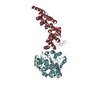
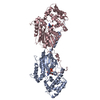
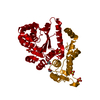
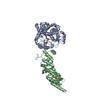
A: Deleted in split hand/split foot protein 1 B: breast cancer susceptibility C: Deleted in split hand/split foot protein 1 D: breast cancer susceptibility
In the structure databanks used in Yorodumi, some data are registered as the other names, "COVID-19 virus" and "2019-nCoV". Here are the details of the virus and the list of structure data.
Jan 31, 2019. EMDB accession codes are about to change! (news from PDBe EMDB page)
EMDB accession codes are about to change! (news from PDBe EMDB page)
The allocation of 4 digits for EMDB accession codes will soon come to an end. Whilst these codes will remain in use, new EMDB accession codes will include an additional digit and will expand incrementally as the available range of codes is exhausted. The current 4-digit format prefixed with “EMD-” (i.e. EMD-XXXX) will advance to a 5-digit format (i.e. EMD-XXXXX), and so on. It is currently estimated that the 4-digit codes will be depleted around Spring 2019, at which point the 5-digit format will come into force.
The EM Navigator/Yorodumi systems omit the EMD- prefix.
Related info.:Q: What is EMD? / ID/Accession-code notation in Yorodumi/EM Navigator
Yorodumi is a browser for structure data from EMDB, PDB, SASBDB, etc.
This page is also the successor to EM Navigator detail page, and also detail information page/front-end page for Omokage search.
The word "yorodu" (or yorozu) is an old Japanese word meaning "ten thousand". "mi" (miru) is to see.
Related info.:EMDB / PDB / SASBDB / Comparison of 3 databanks / Yorodumi Search / Aug 31, 2016. New EM Navigator & Yorodumi / Yorodumi Papers / Jmol/JSmol / Function and homology information / Changes in new EM Navigator and Yorodumi
 Movie
Movie Controller


 Open data
 Basic information
 Components
 Keywords
 Function and homology information
 Homo sapiens (human)
 Rattus norvegicus (Norway rat)
 X-RAY DIFFRACTION /
  Authors
 Citation
 Structure visualization
 Downloads & links
 Other downloads




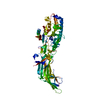
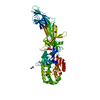

 PDBj
PDBj
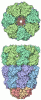

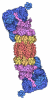
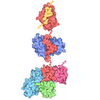
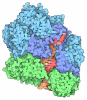
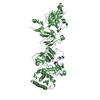
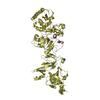
 Assembly

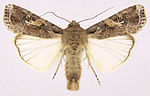 Spodoptera frugiperda (fall armyworm) / References: UniProt: P60896
 Sample preparation
 / Beamline: F1 / Wavelength: 0.95 Å
 Processing