Movie
 Controller


[English] 日本語
 Yorodumi
- EMDB-70437: GluN1/GluN3A in complex with glycine, LBD focused, in desensitize... -
+ Open data

- Basic information
| Entry |  | |||||||||
|---|---|---|---|---|---|---|---|---|---|---|
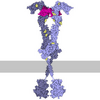
| Title | GluN1/GluN3A in complex with glycine, LBD focused, in desensitized conformation | |||||||||
 Map data | GluN1/GluN3A in complex with glycine, LBD focused, in desensitized conformation | |||||||||
 Sample |
| |||||||||
 Keywords | ligand-gated ion channel / agonist / TRANSPORT PROTEIN | |||||||||
| Function / homology |  Function and homology information negative regulation of dendritic spine development / serine binding / mesencephalic trigeminal nucleus development / trigeminal motor nucleus development / pons maturation / EPHB-mediated forward signaling / positive regulation of Schwann cell migration / Assembly and cell surface presentation of NMDA receptors / protein localization to postsynaptic membrane / regulation of cell communication ...negative regulation of dendritic spine development / serine binding / mesencephalic trigeminal nucleus development / trigeminal motor nucleus development / pons maturation / EPHB-mediated forward signaling / positive regulation of Schwann cell migration / Assembly and cell surface presentation of NMDA receptors / protein localization to postsynaptic membrane / regulation of cell communication / conditioned taste aversion / suckling behavior / olfactory learning / dendritic branch / positive regulation of mitochondrial calcium ion concentration / response to glycoside / transmitter-gated monoatomic ion channel activity / regulation of respiratory gaseous exchange / propylene metabolic process / response to glycine / neurotransmitter receptor complex / RAF/MAP kinase cascade / response to amine / Synaptic adhesion-like molecules / negative regulation of dendritic spine maintenance / glutamate receptor activity / NMDA glutamate receptor activity / regulation of monoatomic cation transmembrane transport / neuromuscular process / NMDA selective glutamate receptor complex / glutamate binding / regulation of axonogenesis / ligand-gated sodium channel activity / startle response / voltage-gated monoatomic cation channel activity / regulation of synapse assembly / calcium ion transmembrane import into cytosol / response to morphine / positive regulation of reactive oxygen species biosynthetic process / male mating behavior / protein heterotetramerization / regulation of dendrite morphogenesis / dendrite development / glycine binding / parallel fiber to Purkinje cell synapse / positive regulation of calcium ion transport into cytosol / associative learning / hypothalamus development / social behavior / regulation of neuronal synaptic plasticity / monoatomic cation transmembrane transport / positive regulation of dendritic spine maintenance / cellular response to glycine / Unblocking of NMDA receptors, glutamate binding and activation / response to fungicide / monoatomic cation transport / calcium ion homeostasis / glutamate receptor binding / prepulse inhibition / long-term memory / adult locomotory behavior / phosphatase binding / regulation of long-term neuronal synaptic plasticity / monoatomic cation channel activity / response to amphetamine / glutamate-gated receptor activity / cellular response to manganese ion / sensory perception of pain / positive regulation of synaptic transmission, glutamatergic / glutamate-gated calcium ion channel activity / presynaptic active zone membrane / visual learning / hippocampus development / synaptic cleft / presynaptic modulation of chemical synaptic transmission / regulation of neuron apoptotic process / excitatory synapse / ionotropic glutamate receptor signaling pathway / protein phosphatase 2A binding / ligand-gated monoatomic ion channel activity involved in regulation of presynaptic membrane potential / learning / dendrite membrane / excitatory postsynaptic potential / hippocampal mossy fiber to CA3 synapse / positive regulation of excitatory postsynaptic potential / brain development / sodium ion transmembrane transport / synaptic membrane / synaptic transmission, glutamatergic / cerebral cortex development / transmitter-gated monoatomic ion channel activity involved in regulation of postsynaptic membrane potential / regulation of membrane potential / memory / response to calcium ion / regulation of synaptic plasticity / postsynaptic density membrane / modulation of chemical synaptic transmission / intracellular calcium ion homeostasis / calcium channel activity / calcium ion transmembrane transport Similarity search - Function | |||||||||
| Biological species |   Rattus norvegicus (Norway rat) | |||||||||
| Method | single particle reconstruction / cryo EM / Resolution: 4.04 Å | |||||||||
 Authors | Kim J / Gouaux E | |||||||||
| Funding support |  United States, 1 items
| |||||||||
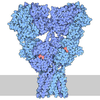
 Citation | Journal: Nat Struct Mol Biol / Year: 2026 Title: Structural and mechanistic insights into gating and allosteric modulation of GluN1-GluN3A NMDA receptors. Authors: Junhoe Kim / Avery J Benton / James S Lotti / Nirvan Rouzbeh / Kasper B Hansen / Eric Gouaux / Abstract: N-methyl-D-aspartate receptors (NMDARs) mediate excitatory signaling essential for synaptic plasticity and memory. Unlike GluN2-containing NMDARs, GluN3-containing receptors are activated solely by ...N-methyl-D-aspartate receptors (NMDARs) mediate excitatory signaling essential for synaptic plasticity and memory. Unlike GluN2-containing NMDARs, GluN3-containing receptors are activated solely by glycine and exhibit profound desensitization and paradoxical potentiation by GluN1-selective antagonists, including CGP-78608 (CGP). Although GluN3A-containing NMDARs regulate synapse pruning and excitotoxicity, and are associated with schizophrenia, autism and stroke, their native stoichiometry and gating mechanism are poorly defined. Here, using single-molecule pull-down analysis, we show that native GluN3A-containing receptors are diheteromeric assemblies. Cryogenic-electron microscopy analysis of GluN1-GluN3A receptors in antagonist-bound, preactive, active and desensitized states, augmented by electrophysiology and pharmacology experiments, show how glycine activates the receptor solely via GluN3A-dependent conformational changes, opening the gate with two-fold symmetry, and induces a roughly four-fold symmetric desensitized state. CGP-bound GluN1 restricts GluN3A rotation, promoting glycine-induced activation by blocking desensitization. These findings illuminate how CGP potentiates GluN1-GluN3A receptor activity, place the receptor gating mechanism on a structural foundation and define the molecular basis for pharmacological modulation. | |||||||||
| History |
|
- Structure visualization
| Supplemental images |
|---|

- Downloads & links
-EMDB archive
| Map data | emd_70437.map.gz | 483.1 MB | EMDB map data format | |
|---|---|---|---|---|
| Header (meta data) | emd-70437-v30.xmlemd-70437.xml | 23.9 KB 23.9 KB | Display Display | EMDB header |
| FSC (resolution estimation) | emd_70437_fsc.xml | 17 KB | Display | FSC data file |
| Images |  emd_70437.png | 23.6 KB | ||
| Filedesc metadata | emd-70437.cif.gz | 7.5 KB | ||
| Others | emd_70437_additional_1.map.gzemd_70437_half_map_1.map.gzemd_70437_half_map_2.map.gz | 253.3 MB 474.8 MB 474.8 MB | ||
| Archive directory |  https://data.pdbj.org/pub/emdb/structures/EMD-70437ftp://data.pdbj.org/pub/emdb/structures/EMD-70437 | HTTPS FTP |
-Related structure data
| Related structure data |  9ofmMC  9oehC  9oemC  9oenC  9oeoC  9ofiC  9ofyC  9ofzC C: citing same article ( M: atomic model generated by this map |
|---|---|
| Similar structure data |


-Links
| EMDB pages | EMDB (EBI/PDBe) / EMDataResource |
|---|---|
| Related items in Molecule of the Month |
-Map
| File | Download / File: emd_70437.map.gz / Format: CCP4 / Size: 512 MB / Type: IMAGE STORED AS FLOATING POINT NUMBER (4 BYTES) | ||||||||||||||||||||||||||||||||||||
|---|---|---|---|---|---|---|---|---|---|---|---|---|---|---|---|---|---|---|---|---|---|---|---|---|---|---|---|---|---|---|---|---|---|---|---|---|---|
| Annotation | GluN1/GluN3A in complex with glycine, LBD focused, in desensitized conformation | ||||||||||||||||||||||||||||||||||||
| Projections & slices | Image control
Images are generated by Spider. | ||||||||||||||||||||||||||||||||||||
| Voxel size | X=Y=Z: 0.83 Å | ||||||||||||||||||||||||||||||||||||
| Density |
| ||||||||||||||||||||||||||||||||||||
| Symmetry | Space group: 1 | ||||||||||||||||||||||||||||||||||||
| Details | EMDB XML:
|
 Z (Sec.)
 Y (Row.)
 X (Col.)


-Supplemental data
-Additional map: unsharp map
| File | emd_70437_additional_1.map | ||||||||||||
|---|---|---|---|---|---|---|---|---|---|---|---|---|---|
| Annotation | unsharp map | ||||||||||||
| Projections & Slices |
| ||||||||||||
| Density Histograms |


-Half map: Half map A
| File | emd_70437_half_map_1.map | ||||||||||||
|---|---|---|---|---|---|---|---|---|---|---|---|---|---|
| Annotation | Half map A | ||||||||||||
| Projections & Slices |
| ||||||||||||
| Density Histograms |


-Half map: Half map B
| File | emd_70437_half_map_2.map | ||||||||||||
|---|---|---|---|---|---|---|---|---|---|---|---|---|---|
| Annotation | Half map B | ||||||||||||
| Projections & Slices |
| ||||||||||||
| Density Histograms |


- Sample components
-Entire : GluN1/GluN3A in complex with glycine, LBD focused, in desensitize...
| Entire | Name: GluN1/GluN3A in complex with glycine, LBD focused, in desensitized conformation |
|---|---|
| Components |
|
-Supramolecule #1: GluN1/GluN3A in complex with glycine, LBD focused, in desensitize...
| Supramolecule | Name: GluN1/GluN3A in complex with glycine, LBD focused, in desensitized conformation type: complex / ID: 1 / Parent: 0 / Macromolecule list: #1-#2 |
|---|---|
| Source (natural) | Organism: Rattus norvegicus (Norway rat) |
| Molecular weight | Theoretical: 411 KDa |
-Macromolecule #1: Isoform E of Glutamate receptor ionotropic, NMDA 1
| Macromolecule | Name: Isoform E of Glutamate receptor ionotropic, NMDA 1 / type: protein_or_peptide / ID: 1 / Number of copies: 2 / Enantiomer: LEVO |
|---|---|
| Source (natural) | Organism: Rattus norvegicus (Norway rat) |
| Molecular weight | Theoretical: 97.873969 KDa |
| Recombinant expression | Organism:  Homo sapiens (human) |
| Sequence | String: MSTMHLLTFA LLFSCSFARA ACDPKIVNIG AVLSTRKHEQ MFREAVNQAN KRHGSWKIQL NATSVTHKPN AIQMALSVCE DLISSQVYA ILVSHPPTPN DHFTPTPVSY TAGFYRIPVL GLTTRMSIYS DKSIHLSFLR TVPPYSHQSS VWFEMMRVYN W NHIILLVS ...String: MSTMHLLTFA LLFSCSFARA ACDPKIVNIG AVLSTRKHEQ MFREAVNQAN KRHGSWKIQL NATSVTHKPN AIQMALSVCE DLISSQVYA ILVSHPPTPN DHFTPTPVSY TAGFYRIPVL GLTTRMSIYS DKSIHLSFLR TVPPYSHQSS VWFEMMRVYN W NHIILLVS DDHEGRAAQK RLETLLEERE SKAEKVLQFD PGTKNVTALL MEARELEARV IILSASEDDA ATVYRAAAML NM TGSGYVW LVGEREISGN ALRYAPDGII GLQLINGKNE SAHISDAVGV VAQAVHELLE KENITDPPRG CVGNTNIWKT GPL FKRVLM SSKYADGVTG RVEFNEDGDR KFANYSIMNL QNRKLVQVGI YNGTHVIPND RKIIWPGGET EKPRGYQMST RLKI VTIHQ EPFVYVKPTM SDGTCKEEFT VNGDPVKKVI CTGPNDTSPG SPRHTVPQCC YGFCIDLLIK LARTMNFTYE VHLVA DGKF GTQERVNNSN KKEWNGMMGE LLSGQADMIV APLTINNERA QYIEFSKPFK YQGLTILVKK EIPRSTLDSF MQPFQS TLW LLVGLSVHVV AVMLYLLDRF SPFGRFKVNS EEEEEDALTL SSAMWFSWGV LLNSGIGEGA PRSFSARILG MVWAGFA MI IVASYTANLA AFLVLDRPEE RITGINDPRL RNPSDKFIYA TVKQSSVDIY FRRQVELSTM YRHMEKHNYE SAAEAIQA V RDNKLHAFIW DSAVLEFEAS QKCDLVTTGE LFFRSGFGIG MRKDSPWKQN VSLSILKSHE NGFMEDLDKT WVRYQECDS RSNAPATLTF ENMAGVFMLV AGGIVAGIFL IFIEIAYKRH KDARRKQLVP RGSAAAASGL RSHHHHHHHH UniProtKB: Glutamate receptor ionotropic, NMDA 1 |
-Macromolecule #2: Glutamate receptor ionotropic, NMDA 3A
| Macromolecule | Name: Glutamate receptor ionotropic, NMDA 3A / type: protein_or_peptide / ID: 2 / Number of copies: 2 / Enantiomer: LEVO |
|---|---|
| Source (natural) | Organism: Rattus norvegicus (Norway rat) |
| Molecular weight | Theoretical: 108.280352 KDa |
| Recombinant expression | Organism: Homo sapiens (human) |
| Sequence | String: MRRLSLWWLL SRVCLLLPPP CALVLAGVPS SSSHPQPCQI LKRIGHAVRV GAVHLQPWTT APRAASRAQE GGRAGAQRDD PESGTWRPP APSQGARWLG SALHGRGPPG SRKLGEGAGA ETLWPRDALL FAVENLNRVE GLLPYNLSLE VVMAIEAGLG D LPLMPFSS ...String: MRRLSLWWLL SRVCLLLPPP CALVLAGVPS SSSHPQPCQI LKRIGHAVRV GAVHLQPWTT APRAASRAQE GGRAGAQRDD PESGTWRPP APSQGARWLG SALHGRGPPG SRKLGEGAGA ETLWPRDALL FAVENLNRVE GLLPYNLSLE VVMAIEAGLG D LPLMPFSS PSSPWSSDPF SFLQSVCHTV VVQGVSALLA FPQSQGEMME LDLVSSVLHI PVLSIVRHEF PRESQNPLHL QL SLENSLS SDADVTVSIL TMNNWYNFSL LLCQEDWNIT DFLLLTENNS KFHLESVINI TANLSSTKDL LSFLQVQMDN IRN STPTMV MFGCDMDSIR QIFEMSTQFG LSPPELHWVL GDSQNVEELR TEGLPLGLIA HGKTTQSVFE YYVQDAMELV ARAV ATATM IQPELALLPS TMNCMDVKTT NLTSGQYLSR FLANTTFRGL SGSIKVKGST IISSENNFFI WNLQHDPMGK PMWTR LGSW QGGRIVMDSG IWPEQAQRHK THFQHPNKLH LRVVTLIEHP FVFTREVDDE GLCPAGQLCL DPMTNDSSML DRLFSS LHS SNDTVPIKFK KCCYGYCIDL LEQLAEDMNF DFDLYIVGDG KYGAWKNGHW TGLVGDLLSG TANMAVTSFS INTARSQ VI DFTSPFFSTS LGILVRTRDT AAPIGAFMWP LHWTMWLGIF VALHITAIFL TLYEWKSPFG MTPKGRNRNK VFSFSSAL N VCYALLFGRT AAIKPPKCWT GRFLMNLWAI FCMFCLSTYT ANLAAVMVGE KIYEELSGIH DPKLHHPSQG FRFGTVRES SAEDYVRQSF PEMHEYMRRY NVPATPDGVQ YLKNDPEKLD AFIMDKALLD YEVSIDADCK LLTVGKPFAI EGYGIGLPPN SPLTSNISE LISQYKSHGF MDVLHDKWYK VVPCGKRSFA VTETLQMGIK HFSGLFVLLC IGFGLSILTT IGEHIVHRLL L PRIKNKSK LQ UniProtKB: Glutamate receptor ionotropic, NMDA 3A |
-Macromolecule #3: 2-acetamido-2-deoxy-beta-D-glucopyranose
| Macromolecule | Name: 2-acetamido-2-deoxy-beta-D-glucopyranose / type: ligand / ID: 3 / Number of copies: 10 / Formula: NAG |
|---|---|
| Molecular weight | Theoretical: 221.208 Da |
| Chemical component information | 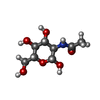 ChemComp-NAG: |
-Experimental details
-Structure determination
| Method | cryo EM |
|---|---|
 Processing | single particle reconstruction |
| Aggregation state | particle |
-Sample preparation
| Buffer | pH: 8 |
|---|---|
| Grid | Model: Quantifoil R2/1 / Material: GOLD / Mesh: 200 |
| Vitrification | Cryogen name: ETHANE / Chamber humidity: 100 % / Chamber temperature: 290 K / Instrument: FEI VITROBOT MARK IV |
- Electron microscopy
| Microscope | TFS KRIOS |
|---|---|
| Specialist optics | Energy filter - Slit width: 20 eV |
| Image recording | Film or detector model: GATAN K3 BIOCONTINUUM (6k x 4k) / Number real images: 14848 / Average electron dose: 50.0 e/Å2 |
| Electron beam | Acceleration voltage: 300 kV / Electron source:  FIELD EMISSION GUN |
| Electron optics | Illumination mode: FLOOD BEAM / Imaging mode: BRIGHT FIELD / Nominal defocus max: 2.4 µm / Nominal defocus min: 1.0 µm |
| Experimental equipment |  Model: Titan Krios / Image courtesy: FEI Company |