 Movie
Movie Controller

[English] 日本語
 Yorodumi
- PDB-9ofi: GluN1/GluN3A in complex with CGP and DCKA, LBD-focused, in antago... -
+ Open data

- Basic information
| Entry | Database: PDB / ID: 9ofi | |||||||||
|---|---|---|---|---|---|---|---|---|---|---|
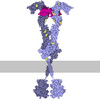
| Title | GluN1/GluN3A in complex with CGP and DCKA, LBD-focused, in antagonist-bound conformation | |||||||||
 Components Components |
| |||||||||
 Keywords Keywords | TRANSPORT PROTEIN / ligand-gated ion channel / NMDA / inhibitor | |||||||||
| Function / homology |  Function and homology information Function and homology informationnegative regulation of dendritic spine development / serine binding / mesencephalic trigeminal nucleus development / trigeminal motor nucleus development / pons maturation / EPHB-mediated forward signaling / positive regulation of Schwann cell migration / Assembly and cell surface presentation of NMDA receptors / regulation of cell communication / protein localization to postsynaptic membrane ...negative regulation of dendritic spine development / serine binding / mesencephalic trigeminal nucleus development / trigeminal motor nucleus development / pons maturation / EPHB-mediated forward signaling / positive regulation of Schwann cell migration / Assembly and cell surface presentation of NMDA receptors / regulation of cell communication / protein localization to postsynaptic membrane / conditioned taste aversion / suckling behavior / olfactory learning / dendritic branch / positive regulation of mitochondrial calcium ion concentration / response to glycoside / transmitter-gated monoatomic ion channel activity / regulation of respiratory gaseous exchange / propylene metabolic process / response to glycine / neurotransmitter receptor complex / RAF/MAP kinase cascade / response to amine / Synaptic adhesion-like molecules / negative regulation of dendritic spine maintenance / glutamate receptor activity / NMDA glutamate receptor activity / regulation of monoatomic cation transmembrane transport / neuromuscular process / NMDA selective glutamate receptor complex / glutamate binding / regulation of axonogenesis / ligand-gated sodium channel activity / startle response / voltage-gated monoatomic cation channel activity / regulation of synapse assembly / calcium ion transmembrane import into cytosol / response to morphine / positive regulation of reactive oxygen species biosynthetic process / male mating behavior / protein heterotetramerization / regulation of dendrite morphogenesis / dendrite development / glycine binding / parallel fiber to Purkinje cell synapse / positive regulation of calcium ion transport into cytosol / associative learning / hypothalamus development / regulation of neuronal synaptic plasticity / social behavior / monoatomic cation transmembrane transport / positive regulation of dendritic spine maintenance / cellular response to glycine / Unblocking of NMDA receptors, glutamate binding and activation / response to fungicide / monoatomic cation transport / calcium ion homeostasis / glutamate receptor binding / prepulse inhibition / phosphatase binding / long-term memory / adult locomotory behavior / regulation of long-term neuronal synaptic plasticity / monoatomic cation channel activity / response to amphetamine / glutamate-gated receptor activity / sensory perception of pain / cellular response to manganese ion / positive regulation of synaptic transmission, glutamatergic / glutamate-gated calcium ion channel activity / presynaptic active zone membrane / visual learning / hippocampus development / synaptic cleft / presynaptic modulation of chemical synaptic transmission / regulation of neuron apoptotic process / ionotropic glutamate receptor signaling pathway / excitatory synapse / protein phosphatase 2A binding / ligand-gated monoatomic ion channel activity involved in regulation of presynaptic membrane potential / learning / dendrite membrane / excitatory postsynaptic potential / hippocampal mossy fiber to CA3 synapse / positive regulation of excitatory postsynaptic potential / brain development / sodium ion transmembrane transport / synaptic membrane / synaptic transmission, glutamatergic / cerebral cortex development / transmitter-gated monoatomic ion channel activity involved in regulation of postsynaptic membrane potential / regulation of membrane potential / memory / response to calcium ion / regulation of synaptic plasticity / postsynaptic density membrane / modulation of chemical synaptic transmission / intracellular calcium ion homeostasis / calcium channel activity / calcium ion transmembrane transport Similarity search - Function | |||||||||
| Biological species |   Rattus norvegicus (Norway rat) Rattus norvegicus (Norway rat) | |||||||||
| Method | ELECTRON MICROSCOPY / single particle reconstruction / cryo EM / Resolution: 3.41 Å | |||||||||
 Authors Authors | Kim, J. / Gouaux, E. | |||||||||
| Funding support |  United States, 1items United States, 1items
| |||||||||
 Citation Citation | Journal: To Be Published Title: GluN1/GluN3A in complex with CGP and DCKA, LBD-focused, in antagonist-bound conformation Authors: Kim, J. / Gouaux, E. | |||||||||
| History |
|
- Structure visualization
| Structure viewer | Molecule: MolmilJmol/JSmol |
|---|
- Downloads & links
-Download
| PDBx/mmCIF format | 9ofi.cif.gz | 256 KB | Display | PDBx/mmCIF format |
|---|---|---|---|---|
| PDB format | pdb9ofi.ent.gz | 174 KB | Display | PDB format |
| PDBx/mmJSON format | 9ofi.json.gz | Tree view | PDBx/mmJSON format | |
| Others |  Other downloads Other downloads |
-Validation report
| Arichive directory | https://data.pdbj.org/pub/pdb/validation_reports/of/9ofiftp://data.pdbj.org/pub/pdb/validation_reports/of/9ofi | HTTPS FTP |
|---|
-Related structure data
| Related structure data |  70433MC M: map data used to model this data C: citing same article ( |
|---|---|
| Similar structure data |

-Links
 PDBj
PDBj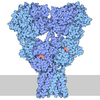
- Assembly
| Deposited unit | 
|
|---|---|
| 1 |
|
-Components
| #1: Protein | Mass: 97873.969 Da / Num. of mol.: 2 Source method: isolated from a genetically manipulated source Source: (gene. exp.) Rattus norvegicus (Norway rat) / Gene: Grin1, Nmdar1 / Production host:  Homo sapiens (human) / References: UniProt: P35439 Homo sapiens (human) / References: UniProt: P35439#2: Protein | Mass: 108280.352 Da / Num. of mol.: 2 Source method: isolated from a genetically manipulated source Source: (gene. exp.) Rattus norvegicus (Norway rat) / Gene: Grin3a / Production host: Homo sapiens (human) / References: UniProt: Q9R1M7#3: Polysaccharide | Source method: isolated from a genetically manipulated source #4: Sugar | ChemComp-NAG / 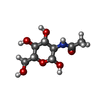 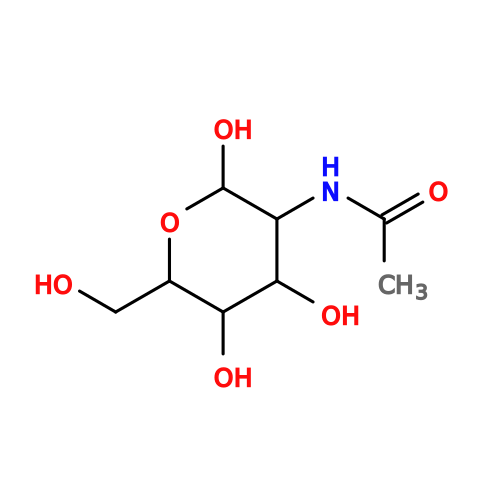 Type: D-saccharide, beta linking / Mass: 221.208 Da / Num. of mol.: 6 / Source method: obtained synthetically / Formula: C8H15NO6 / Feature type: SUBJECT OF INVESTIGATION Type: D-saccharide, beta linking / Mass: 221.208 Da / Num. of mol.: 6 / Source method: obtained synthetically / Formula: C8H15NO6 / Feature type: SUBJECT OF INVESTIGATION#5: Chemical |   Mass: 378.116 Da / Num. of mol.: 2 / Source method: obtained synthetically / Formula: C11H13BrN3O5P Mass: 378.116 Da / Num. of mol.: 2 / Source method: obtained synthetically / Formula: C11H13BrN3O5PHas ligand of interest | Y | Has protein modification | Y | |
|---|
-Experimental details
-Experiment
| Experiment | Method: ELECTRON MICROSCOPY |
|---|---|
| EM experiment | Aggregation state: PARTICLE / 3D reconstruction method: single particle reconstruction |
- Sample preparation
| Component | Name: di-heteromeric GluN1/GluN3A in complex with CGP and DCKA, LBD-focused, in antagonist-bound conformation Type: COMPLEX / Entity ID: #1-#2 / Source: RECOMBINANT |
|---|---|
| Source (natural) | Organism: Rattus norvegicus (Norway rat) |
| Source (recombinant) | Organism: Homo sapiens (human) |
| Buffer solution | pH: 7.4 |
| Specimen | Embedding applied: NO / Shadowing applied: NO / Staining applied: NO / Vitrification applied: YES |
| Vitrification | Cryogen name: ETHANE / Humidity: 100 % / Chamber temperature: 290 K |
- Electron microscopy imaging
| Experimental equipment |  Model: Titan Krios / Image courtesy: FEI Company |
|---|---|
| Microscopy | Model: TFS KRIOS |
| Electron gun | Electron source:  FIELD EMISSION GUN / Accelerating voltage: 300 kV / Illumination mode: FLOOD BEAM FIELD EMISSION GUN / Accelerating voltage: 300 kV / Illumination mode: FLOOD BEAM |
| Electron lens | Mode: BRIGHT FIELD / Nominal defocus max: 2200 nm / Nominal defocus min: 800 nm |
| Image recording | Electron dose: 50 e/Å2 / Film or detector model: GATAN K3 BIOCONTINUUM (6k x 4k) |
- Processing
| EM software | Name: PHENIX / Version: 1.20.1-4487 / Category: model refinement |
|---|---|
| CTF correction | Type: NONE |
| Symmetry | Point symmetry: C1 (asymmetric) |
| 3D reconstruction | Resolution: 3.41 Å / Resolution method: FSC 0.143 CUT-OFF / Num. of particles: 80690 / Symmetry type: POINT |
| Refinement | Highest resolution: 3.41 Å Stereochemistry target values: REAL-SPACE (WEIGHTED MAP SUM AT ATOM CENTERS) |
