[English] 日本語
Yorodumi
- EMDB-70433: GluN1/GluN3A in complex with CGP and DCKA, LBD-focused, in antago... -

+
Open data


ID or keywords:

Loading...

-
Basic information

Entry
Database: EMDB / ID: EMD-70433
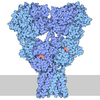
TitleGluN1/GluN3A in complex with CGP and DCKA, LBD-focused, in antagonist-bound conformation
Map dataGluN1/GluN3A in complex with CGP and DCKA, LBD-focused, in antagonist-bound conformation
Sample
  • Complex: di-heteromeric GluN1/GluN3A in complex with CGP and DCKA, LBD-focused, in antagonist-bound conformation
    • Protein or peptide: Isoform E of Glutamate receptor ionotropic, NMDA 1
    • Protein or peptide: Glutamate receptor ionotropic, NMDA 3A
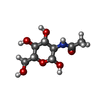
  • Ligand: 2-acetamido-2-deoxy-beta-D-glucopyranose
  • Ligand: [(1S)-1-[[7-bromanyl-2,3-bis(oxidanylidene)-1,4-dihydroquinoxalin-5-yl]methylamino]ethyl]phosphonic acid
Keywordsligand-gated ion channel / NMDA / inhibitor / TRANSPORT PROTEIN
Function / homology
Function and homology information


negative regulation of dendritic spine development / serine binding / mesencephalic trigeminal nucleus development / trigeminal motor nucleus development / pons maturation / EPHB-mediated forward signaling / positive regulation of Schwann cell migration / Assembly and cell surface presentation of NMDA receptors / regulation of cell communication / protein localization to postsynaptic membrane ...negative regulation of dendritic spine development / serine binding / mesencephalic trigeminal nucleus development / trigeminal motor nucleus development / pons maturation / EPHB-mediated forward signaling / positive regulation of Schwann cell migration / Assembly and cell surface presentation of NMDA receptors / regulation of cell communication / protein localization to postsynaptic membrane / conditioned taste aversion / suckling behavior / olfactory learning / dendritic branch / positive regulation of mitochondrial calcium ion concentration / response to glycoside / transmitter-gated monoatomic ion channel activity / regulation of respiratory gaseous exchange / propylene metabolic process / response to glycine / neurotransmitter receptor complex / RAF/MAP kinase cascade / response to amine / Synaptic adhesion-like molecules / negative regulation of dendritic spine maintenance / glutamate receptor activity / NMDA glutamate receptor activity / regulation of monoatomic cation transmembrane transport / neuromuscular process / NMDA selective glutamate receptor complex / glutamate binding / regulation of axonogenesis / ligand-gated sodium channel activity / startle response / voltage-gated monoatomic cation channel activity / regulation of synapse assembly / calcium ion transmembrane import into cytosol / response to morphine / positive regulation of reactive oxygen species biosynthetic process / male mating behavior / protein heterotetramerization / regulation of dendrite morphogenesis / dendrite development / glycine binding / parallel fiber to Purkinje cell synapse / positive regulation of calcium ion transport into cytosol / associative learning / hypothalamus development / regulation of neuronal synaptic plasticity / social behavior / monoatomic cation transmembrane transport / positive regulation of dendritic spine maintenance / cellular response to glycine / Unblocking of NMDA receptors, glutamate binding and activation / response to fungicide / monoatomic cation transport / calcium ion homeostasis / glutamate receptor binding / prepulse inhibition / phosphatase binding / long-term memory / adult locomotory behavior / regulation of long-term neuronal synaptic plasticity / monoatomic cation channel activity / response to amphetamine / glutamate-gated receptor activity / sensory perception of pain / cellular response to manganese ion / positive regulation of synaptic transmission, glutamatergic / glutamate-gated calcium ion channel activity / presynaptic active zone membrane / visual learning / hippocampus development / synaptic cleft / presynaptic modulation of chemical synaptic transmission / regulation of neuron apoptotic process / ionotropic glutamate receptor signaling pathway / excitatory synapse / protein phosphatase 2A binding / ligand-gated monoatomic ion channel activity involved in regulation of presynaptic membrane potential / learning / dendrite membrane / excitatory postsynaptic potential / hippocampal mossy fiber to CA3 synapse / positive regulation of excitatory postsynaptic potential / brain development / sodium ion transmembrane transport / synaptic membrane / synaptic transmission, glutamatergic / cerebral cortex development / transmitter-gated monoatomic ion channel activity involved in regulation of postsynaptic membrane potential / regulation of membrane potential / memory / response to calcium ion / regulation of synaptic plasticity / postsynaptic density membrane / modulation of chemical synaptic transmission / intracellular calcium ion homeostasis / calcium channel activity / calcium ion transmembrane transport
Similarity search - Function
: / : / Ionotropic glutamate receptor, metazoa / Ligated ion channel L-glutamate- and glycine-binding site / Ligand-gated ion channel / Ionotropic glutamate receptor, L-glutamate and glycine-binding domain / Ligated ion channel L-glutamate- and glycine-binding site / : / Ionotropic glutamate receptor / Eukaryotic homologues of bacterial periplasmic substrate binding proteins. ...: / : / Ionotropic glutamate receptor, metazoa / Ligated ion channel L-glutamate- and glycine-binding site / Ligand-gated ion channel / Ionotropic glutamate receptor, L-glutamate and glycine-binding domain / Ligated ion channel L-glutamate- and glycine-binding site / : / Ionotropic glutamate receptor / Eukaryotic homologues of bacterial periplasmic substrate binding proteins. / Receptor, ligand binding region / Receptor family ligand binding region / Periplasmic binding protein-like I
Similarity search - Domain/homology
Glutamate receptor ionotropic, NMDA 1 / Glutamate receptor ionotropic, NMDA 3A
Similarity search - Component
Biological speciesRattus norvegicus (Norway rat)
Methodsingle particle reconstruction / cryo EM / Resolution: 3.41 Å
AuthorsKim J / Gouaux E
Funding support United States, 1 items
OrganizationGrant numberCountry
National Institutes of Health/National Institute of Neurological Disorders and Stroke (NIH/NINDS) United States
CitationJournal: To Be Published
Title: GluN1/GluN3A in complex with CGP and DCKA, LBD-focused, in antagonist-bound conformation
Authors: Kim J / Gouaux E
History
DepositionApr 29, 2025-
Header (metadata) releaseAug 26, 2026-
Map releaseAug 26, 2026-
UpdateAug 26, 2026-
Current statusAug 26, 2026Processing site: RCSB / Status: Released

-
Structure visualization

Supplemental images

Downloads & links

-
Map

FileDownload / File: emd_70433.map.gz / Format: CCP4 / Size: 421.9 MB / Type: IMAGE STORED AS FLOATING POINT NUMBER (4 BYTES)
AnnotationGluN1/GluN3A in complex with CGP and DCKA, LBD-focused, in antagonist-bound conformation
Projections & slices

Image control

Size
Brightness
Contrast
Others
AxesZ (Sec.)Y (Row.)X (Col.)
0.84 Å/pix.
x 480 pix.
= 405.216 Å
0.84 Å/pix.
x 480 pix.
= 405.216 Å
0.84 Å/pix.
x 480 pix.
= 405.216 Å

Surface

Projections

Slices (1/3)

Slices (1/2)

Slices (2/3)

Images are generated by Spider.

Voxel sizeX=Y=Z: 0.8442 Å
Density
Contour LevelBy AUTHOR: 0.12
Minimum - Maximum-0.65497375 - 1.046488
Average (Standard dev.)0.0007744425 (±0.02036812)
SymmetrySpace group: 1
Details

EMDB XML:

Map geometry
Axis orderXYZ
Origin000
Dimensions480480480
Spacing480480480
CellA=B=C: 405.216 Å
α=β=γ: 90.0 °

-
Supplemental data

-
Additional map: unsharp map

Fileemd_70433_additional_1.map
Annotationunsharp map
Projections & Slices
AxesZYX

Projections

Slices (1/2)
Density Histograms

-
Half map: Half map A

Fileemd_70433_half_map_1.map
AnnotationHalf map A
Projections & Slices
AxesZYX

Projections

Slices (1/2)
Density Histograms

-
Half map: Half map B

Fileemd_70433_half_map_2.map
AnnotationHalf map B
Projections & Slices
AxesZYX

Projections

Slices (1/2)
Density Histograms

-
Sample components

-
Entire : di-heteromeric GluN1/GluN3A in complex with CGP and DCKA, LBD-foc...

EntireName: di-heteromeric GluN1/GluN3A in complex with CGP and DCKA, LBD-focused, in antagonist-bound conformation
Components
  • Complex: di-heteromeric GluN1/GluN3A in complex with CGP and DCKA, LBD-focused, in antagonist-bound conformation
    • Protein or peptide: Isoform E of Glutamate receptor ionotropic, NMDA 1
    • Protein or peptide: Glutamate receptor ionotropic, NMDA 3A
  • Ligand: 2-acetamido-2-deoxy-beta-D-glucopyranose
  • Ligand: [(1S)-1-[[7-bromanyl-2,3-bis(oxidanylidene)-1,4-dihydroquinoxalin-5-yl]methylamino]ethyl]phosphonic acid

-
Supramolecule #1: di-heteromeric GluN1/GluN3A in complex with CGP and DCKA, LBD-foc...

SupramoleculeName: di-heteromeric GluN1/GluN3A in complex with CGP and DCKA, LBD-focused, in antagonist-bound conformation
type: complex / ID: 1 / Parent: 0 / Macromolecule list: #1-#2
Source (natural)Organism: Rattus norvegicus (Norway rat)

-
Macromolecule #1: Isoform E of Glutamate receptor ionotropic, NMDA 1

MacromoleculeName: Isoform E of Glutamate receptor ionotropic, NMDA 1 / type: protein_or_peptide / ID: 1 / Number of copies: 2 / Enantiomer: LEVO
Source (natural)Organism: Rattus norvegicus (Norway rat)
Molecular weightTheoretical: 97.873969 KDa
Recombinant expressionOrganism: Homo sapiens (human)
SequenceString: MSTMHLLTFA LLFSCSFARA ACDPKIVNIG AVLSTRKHEQ MFREAVNQAN KRHGSWKIQL NATSVTHKPN AIQMALSVCE DLISSQVYA ILVSHPPTPN DHFTPTPVSY TAGFYRIPVL GLTTRMSIYS DKSIHLSFLR TVPPYSHQSS VWFEMMRVYN W NHIILLVS ...String:
MSTMHLLTFA LLFSCSFARA ACDPKIVNIG AVLSTRKHEQ MFREAVNQAN KRHGSWKIQL NATSVTHKPN AIQMALSVCE DLISSQVYA ILVSHPPTPN DHFTPTPVSY TAGFYRIPVL GLTTRMSIYS DKSIHLSFLR TVPPYSHQSS VWFEMMRVYN W NHIILLVS DDHEGRAAQK RLETLLEERE SKAEKVLQFD PGTKNVTALL MEARELEARV IILSASEDDA ATVYRAAAML NM TGSGYVW LVGEREISGN ALRYAPDGII GLQLINGKNE SAHISDAVGV VAQAVHELLE KENITDPPRG CVGNTNIWKT GPL FKRVLM SSKYADGVTG RVEFNEDGDR KFANYSIMNL QNRKLVQVGI YNGTHVIPND RKIIWPGGET EKPRGYQMST RLKI VTIHQ EPFVYVKPTM SDGTCKEEFT VNGDPVKKVI CTGPNDTSPG SPRHTVPQCC YGFCIDLLIK LARTMNFTYE VHLVA DGKF GTQERVNNSN KKEWNGMMGE LLSGQADMIV APLTINNERA QYIEFSKPFK YQGLTILVKK EIPRSTLDSF MQPFQS TLW LLVGLSVHVV AVMLYLLDRF SPFGRFKVNS EEEEEDALTL SSAMWFSWGV LLNSGIGEGA PRSFSARILG MVWAGFA MI IVASYTANLA AFLVLDRPEE RITGINDPRL RNPSDKFIYA TVKQSSVDIY FRRQVELSTM YRHMEKHNYE SAAEAIQA V RDNKLHAFIW DSAVLEFEAS QKCDLVTTGE LFFRSGFGIG MRKDSPWKQN VSLSILKSHE NGFMEDLDKT WVRYQECDS RSNAPATLTF ENMAGVFMLV AGGIVAGIFL IFIEIAYKRH KDARRKQLVP RGSAAAASGL RSHHHHHHHH

UniProtKB: Glutamate receptor ionotropic, NMDA 1

-
Macromolecule #2: Glutamate receptor ionotropic, NMDA 3A

MacromoleculeName: Glutamate receptor ionotropic, NMDA 3A / type: protein_or_peptide / ID: 2 / Number of copies: 2 / Enantiomer: LEVO
Source (natural)Organism: Rattus norvegicus (Norway rat)
Molecular weightTheoretical: 108.280352 KDa
Recombinant expressionOrganism: Homo sapiens (human)
SequenceString: MRRLSLWWLL SRVCLLLPPP CALVLAGVPS SSSHPQPCQI LKRIGHAVRV GAVHLQPWTT APRAASRAQE GGRAGAQRDD PESGTWRPP APSQGARWLG SALHGRGPPG SRKLGEGAGA ETLWPRDALL FAVENLNRVE GLLPYNLSLE VVMAIEAGLG D LPLMPFSS ...String:
MRRLSLWWLL SRVCLLLPPP CALVLAGVPS SSSHPQPCQI LKRIGHAVRV GAVHLQPWTT APRAASRAQE GGRAGAQRDD PESGTWRPP APSQGARWLG SALHGRGPPG SRKLGEGAGA ETLWPRDALL FAVENLNRVE GLLPYNLSLE VVMAIEAGLG D LPLMPFSS PSSPWSSDPF SFLQSVCHTV VVQGVSALLA FPQSQGEMME LDLVSSVLHI PVLSIVRHEF PRESQNPLHL QL SLENSLS SDADVTVSIL TMNNWYNFSL LLCQEDWNIT DFLLLTENNS KFHLESVINI TANLSSTKDL LSFLQVQMDN IRN STPTMV MFGCDMDSIR QIFEMSTQFG LSPPELHWVL GDSQNVEELR TEGLPLGLIA HGKTTQSVFE YYVQDAMELV ARAV ATATM IQPELALLPS TMNCMDVKTT NLTSGQYLSR FLANTTFRGL SGSIKVKGST IISSENNFFI WNLQHDPMGK PMWTR LGSW QGGRIVMDSG IWPEQAQRHK THFQHPNKLH LRVVTLIEHP FVFTREVDDE GLCPAGQLCL DPMTNDSSML DRLFSS LHS SNDTVPIKFK KCCYGYCIDL LEQLAEDMNF DFDLYIVGDG KYGAWKNGHW TGLVGDLLSG TANMAVTSFS INTARSQ VI DFTSPFFSTS LGILVRTRDT AAPIGAFMWP LHWTMWLGIF VALHITAIFL TLYEWKSPFG MTPKGRNRNK VFSFSSAL N VCYALLFGRT AAIKPPKCWT GRFLMNLWAI FCMFCLSTYT ANLAAVMVGE KIYEELSGIH DPKLHHPSQG FRFGTVRES SAEDYVRQSF PEMHEYMRRY NVPATPDGVQ YLKNDPEKLD AFIMDKALLD YEVSIDADCK LLTVGKPFAI EGYGIGLPPN SPLTSNISE LISQYKSHGF MDVLHDKWYK VVPCGKRSFA VTETLQMGIK HFSGLFVLLC IGFGLSILTT IGEHIVHRLL L PRIKNKSK LQ

UniProtKB: Glutamate receptor ionotropic, NMDA 3A

-
Macromolecule #4: 2-acetamido-2-deoxy-beta-D-glucopyranose

MacromoleculeName: 2-acetamido-2-deoxy-beta-D-glucopyranose / type: ligand / ID: 4 / Number of copies: 6 / Formula: NAG
Molecular weightTheoretical: 221.208 Da
Chemical component information

ChemComp-NAG:
2-acetamido-2-deoxy-beta-D-glucopyranose

-
Macromolecule #5: [(1S)-1-[[7-bromanyl-2,3-bis(oxidanylidene)-1,4-dihydroquinoxalin...

MacromoleculeName: [(1S)-1-[[7-bromanyl-2,3-bis(oxidanylidene)-1,4-dihydroquinoxalin-5-yl]methylamino]ethyl]phosphonic acid
type: ligand / ID: 5 / Number of copies: 2 / Formula: J86
Molecular weightTheoretical: 378.116 Da
Chemical component information

ChemComp-J86:
[(1S)-1-[[7-bromanyl-2,3-bis(oxidanylidene)-1,4-dihydroquinoxalin-5-yl]methylamino]ethyl]phosphonic acid

-
Experimental details

-
Structure determination

Methodcryo EM
Processingsingle particle reconstruction
Aggregation stateparticle

-
Sample preparation

BufferpH: 7.4
VitrificationCryogen name: ETHANE / Chamber humidity: 100 % / Chamber temperature: 290 K

-
Electron microscopy

MicroscopeTFS KRIOS
Image recordingFilm or detector model: GATAN K3 BIOCONTINUUM (6k x 4k) / Average electron dose: 50.0 e/Å2
Electron beamAcceleration voltage: 300 kV / Electron source: FIELD EMISSION GUN
Electron opticsIllumination mode: FLOOD BEAM / Imaging mode: BRIGHT FIELD / Nominal defocus max: 2.2 µm / Nominal defocus min: 0.8 µm
Experimental equipment
Model: Titan Krios / Image courtesy: FEI Company

+
Image processing

CTF correctionType: NONE
Startup modelType of model: INSILICO MODEL
Final reconstructionApplied symmetry - Point group: C1 (asymmetric) / Resolution.type: BY AUTHOR / Resolution: 3.41 Å / Resolution method: FSC 0.143 CUT-OFF / Number images used: 80690
Initial angle assignmentType: MAXIMUM LIKELIHOOD
Final angle assignmentType: MAXIMUM LIKELIHOOD
FSC plot (resolution estimation)

+
About Yorodumi

-
News

-
Feb 9, 2022. New format data for meta-information of EMDB entries

New format data for meta-information of EMDB entries

  • Version 3 of the EMDB header file is now the official format.
  • The previous official version 1.9 will be removed from the archive.

Related info.:EMDB header

External links:wwPDB to switch to version 3 of the EMDB data model

-
Aug 12, 2020. Covid-19 info

Covid-19 info

URL: https://pdbj.org/emnavi/covid19.php

New page: Covid-19 featured information page in EM Navigator.

Related info.:Covid-19 info / Mar 5, 2020. Novel coronavirus structure data

+
Mar 5, 2020. Novel coronavirus structure data

Novel coronavirus structure data

Related info.:Yorodumi Speices / Aug 12, 2020. Covid-19 info

External links:COVID-19 featured content - PDBj / Molecule of the Month (242):Coronavirus Proteases

+
Jan 31, 2019. EMDB accession codes are about to change! (news from PDBe EMDB page)

EMDB accession codes are about to change! (news from PDBe EMDB page)

  • The allocation of 4 digits for EMDB accession codes will soon come to an end. Whilst these codes will remain in use, new EMDB accession codes will include an additional digit and will expand incrementally as the available range of codes is exhausted. The current 4-digit format prefixed with “EMD-” (i.e. EMD-XXXX) will advance to a 5-digit format (i.e. EMD-XXXXX), and so on. It is currently estimated that the 4-digit codes will be depleted around Spring 2019, at which point the 5-digit format will come into force.
  • The EM Navigator/Yorodumi systems omit the EMD- prefix.

Related info.:Q: What is EMD? / ID/Accession-code notation in Yorodumi/EM Navigator

External links:EMDB Accession Codes are Changing Soon! / Contact to PDBj

+
Jul 12, 2017. Major update of PDB

Major update of PDB

  • wwPDB released updated PDB data conforming to the new PDBx/mmCIF dictionary.
  • This is a major update changing the version number from 4 to 5, and with Remediation, in which all the entries are updated.
  • In this update, many items about electron microscopy experimental information are reorganized (e.g. em_software).
  • Now, EM Navigator and Yorodumi are based on the updated data.

External links:wwPDB Remediation / Enriched Model Files Conforming to OneDep Data Standards Now Available in the PDB FTP Archive

-
Yorodumi

Thousand views of thousand structures

  • Yorodumi is a browser for structure data from EMDB, PDB, SASBDB, etc.
  • This page is also the successor to EM Navigator detail page, and also detail information page/front-end page for Omokage search.
  • The word "yorodu" (or yorozu) is an old Japanese word meaning "ten thousand". "mi" (miru) is to see.

Related info.:EMDB / PDB / SASBDB / Comparison of 3 databanks / Yorodumi Search / Aug 31, 2016. New EM Navigator & Yorodumi / Yorodumi Papers / Jmol/JSmol / Function and homology information / Changes in new EM Navigator and Yorodumi

Read more