National Institutes of Health/National Institute of Neurological Disorders and Stroke (NIH/NINDS)
United States
Citation
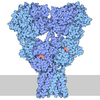
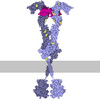
Journal: Nat Struct Mol Biol / Year: 2026 Title: Structural and mechanistic insights into gating and allosteric modulation of GluN1-GluN3A NMDA receptors. Authors: Junhoe Kim / Avery J Benton / James S Lotti / Nirvan Rouzbeh / Kasper B Hansen / Eric Gouaux / Abstract: N-methyl-D-aspartate receptors (NMDARs) mediate excitatory signaling essential for synaptic plasticity and memory. Unlike GluN2-containing NMDARs, GluN3-containing receptors are activated solely by ...N-methyl-D-aspartate receptors (NMDARs) mediate excitatory signaling essential for synaptic plasticity and memory. Unlike GluN2-containing NMDARs, GluN3-containing receptors are activated solely by glycine and exhibit profound desensitization and paradoxical potentiation by GluN1-selective antagonists, including CGP-78608 (CGP). Although GluN3A-containing NMDARs regulate synapse pruning and excitotoxicity, and are associated with schizophrenia, autism and stroke, their native stoichiometry and gating mechanism are poorly defined. Here, using single-molecule pull-down analysis, we show that native GluN3A-containing receptors are diheteromeric assemblies. Cryogenic-electron microscopy analysis of GluN1-GluN3A receptors in antagonist-bound, preactive, active and desensitized states, augmented by electrophysiology and pharmacology experiments, show how glycine activates the receptor solely via GluN3A-dependent conformational changes, opening the gate with two-fold symmetry, and induces a roughly four-fold symmetric desensitized state. CGP-bound GluN1 restricts GluN3A rotation, promoting glycine-induced activation by blocking desensitization. These findings illuminate how CGP potentiates GluN1-GluN3A receptor activity, place the receptor gating mechanism on a structural foundation and define the molecular basis for pharmacological modulation.
In the structure databanks used in Yorodumi, some data are registered as the other names, "COVID-19 virus" and "2019-nCoV". Here are the details of the virus and the list of structure data.
Jan 31, 2019. EMDB accession codes are about to change! (news from PDBe EMDB page)
EMDB accession codes are about to change! (news from PDBe EMDB page)
The allocation of 4 digits for EMDB accession codes will soon come to an end. Whilst these codes will remain in use, new EMDB accession codes will include an additional digit and will expand incrementally as the available range of codes is exhausted. The current 4-digit format prefixed with “EMD-” (i.e. EMD-XXXX) will advance to a 5-digit format (i.e. EMD-XXXXX), and so on. It is currently estimated that the 4-digit codes will be depleted around Spring 2019, at which point the 5-digit format will come into force.
The EM Navigator/Yorodumi systems omit the EMD- prefix.
Related info.:Q: What is EMD? / ID/Accession-code notation in Yorodumi/EM Navigator
Yorodumi is a browser for structure data from EMDB, PDB, SASBDB, etc.
This page is also the successor to EM Navigator detail page, and also detail information page/front-end page for Omokage search.
The word "yorodu" (or yorozu) is an old Japanese word meaning "ten thousand". "mi" (miru) is to see.
Related info.:EMDB / PDB / SASBDB / Comparison of 3 databanks / Yorodumi Search / Aug 31, 2016. New EM Navigator & Yorodumi / Yorodumi Papers / Jmol/JSmol / Function and homology information / Changes in new EM Navigator and Yorodumi
 Movie
Movie Controller


 Open data
 Basic information
 Map data
 Sample
 Keywords
 Function and homology information
 Rattus norvegicus (Norway rat)
 Authors
 United States, 1 items
  Citation
 Structure visualization
 Downloads & links
 emd_70399.png
 https://data.pdbj.org/pub/emdb/structures/EMD-70399


 Z (Sec.)
 Y (Row.)
 X (Col.)


 Sample components
 Homo sapiens (human)

 Processing
 Electron microscopy
 FIELD EMISSION GUN

