[English] 日本語
Yorodumi
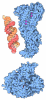
- EMDB-53008: Activated XauSPARDA filament assembly with bound dsDNA substrate -

+
Open data


ID or keywords:

Loading...

-
Basic information

Entry
Database: EMDB / ID: EMD-53008
TitleActivated XauSPARDA filament assembly with bound dsDNA substrate
Map dataCisTEM sharpened map used in refinement
Sample
  • Complex: Filament assembly of activated XauSPARDA binary monomers in the presence of dsDNA substrate
    • Complex: Activated XauSPARDA binary monomer containing bound 5'p-RNA guide and complementary DNA target
      • Protein or peptide: DUF4365 domain-containing protein
      • Protein or peptide: Protein argonaute
      • DNA: DNA (5'-D(*AP*TP*TP*CP*GP*GP*CP*CP*GP*TP*GP*TP*AP*CP*AP*AP*T)-3')
      • RNA: RNA (5'-R(P*AP*UP*UP*GP*UP*AP*CP*AP*CP*GP*GP*CP*CP*GP*AP*AP*U)-3')
    • Complex: DREN-domains tetramer with bound dsDNA substrate
      • DNA: dsDNA substrate, first strand
      • DNA: dsDNA substrate, second strand
  • Ligand: CALCIUM ION
Keywordsshort prokaryotic Argonaute / bacterial defence system / DREN domain / DREN-APAZ / RNA BINDING PROTEIN
Function / homologyDomain of unknown function DUF4365 / Domain of unknown function (DUF4365) / Piwi domain / Piwi / Ribonuclease H superfamily / nucleic acid binding / Ribonuclease H-like superfamily / DUF4365 domain-containing protein / Protein argonaute
Function and homology information
Biological speciesXanthobacter autotrophicus Py2 (bacteria) / Escherichia coli (E. coli)
Methodsingle particle reconstruction / cryo EM / Resolution: 3.0 Å
AuthorsManakova EN / Zaremba M / Jurgelaitis E
Funding support1 items
OrganizationGrant numberCountry
Not funded
CitationJournal: Cell Res / Year: 2025
Title: Activation of the SPARDA defense system by filament assembly using a beta-relay signaling mechanism widespread in prokaryotic Argonautes.
Authors: Edvinas Jurgelaitis / Evelina Zagorskaitė / Aurimas Kopūstas / Simonas Asmontas / Elena Manakova / Indrė Dalgėdienė / Ugnė Tylenytė / Arunas Silanskas / Paulius Toliusis / Algirdas ...Authors: Edvinas Jurgelaitis / Evelina Zagorskaitė / Aurimas Kopūstas / Simonas Asmontas / Elena Manakova / Indrė Dalgėdienė / Ugnė Tylenytė / Arunas Silanskas / Paulius Toliusis / Algirdas Grybauskas / Marijonas Tutkus / Česlovas Venclovas / Mindaugas Zaremba
Abstract: Present in all three domains of life, Argonaute proteins use short oligonucleotides as guides to recognize complementary nucleic acid targets. In eukaryotes, Argonautes are involved in RNA silencing, ...Present in all three domains of life, Argonaute proteins use short oligonucleotides as guides to recognize complementary nucleic acid targets. In eukaryotes, Argonautes are involved in RNA silencing, whereas in prokaryotes, they function in host defense against invading DNA. Here, we show that SPARDA (short prokaryotic Argonaute, DNase associated) systems from Xanthobacter autotrophicus (Xau) and Enhydrobacter aerosaccus (Eae) function in anti-plasmid defense. Upon activation, SPARDA nonspecifically degrades both invader and genomic DNA, causing host death, thereby preventing further spread of the invader in the population. X-ray structures of the apo Xau and EaeSPARDA complexes show that they are dimers, unlike other apo short pAgo systems, which are monomers. We show that dimerization in the apo state is essential for inhibition of XauSPARDA activity. We demonstrate by cryo-EM that activated XauSPARDA forms a filament. Upon activation, the recognition signal of the bound guide/target duplex is relayed to other functional XauSPARDA sites through a structural region that we termed the "beta-relay". Owing to dramatic conformational changes associated with guide/target binding, XauSPARDA undergoes a "dimer-monomer-filament" transition as the apo dimer dissociates into the guide/target-loaded monomers that subsequently assemble into the filament. Within the activated filament, the DREN nuclease domains form tetramers that are poised to cleave dsDNA. We show that other SPARDAs also form filaments during activation. Furthermore, we identify the presence of the beta-relay in pAgo from all clades, providing new insights into the structural mechanisms of pAgo proteins. Taken together, these findings reveal the detailed structural mechanism of SPARDA and highlight the importance of the beta-relay mechanism in signal transduction in Argonautes.
History
DepositionMar 4, 2025-
Header (metadata) releaseDec 17, 2025-
Map releaseDec 17, 2025-
UpdateDec 17, 2025-
Current statusDec 17, 2025Processing site: PDBe / Status: Released

-
Structure visualization

Supplemental images

Downloads & links

-
Map

FileDownload / File: emd_53008.map.gz / Format: CCP4 / Size: 512 MB / Type: IMAGE STORED AS FLOATING POINT NUMBER (4 BYTES)
AnnotationCisTEM sharpened map used in refinement
Projections & slices

Image control

Size
Brightness
Contrast
Others
AxesZ (Sec.)Y (Row.)X (Col.)
1.1 Å/pix.
x 512 pix.
= 563.2 Å
1.1 Å/pix.
x 512 pix.
= 563.2 Å
1.1 Å/pix.
x 512 pix.
= 563.2 Å

Surface

Projections

Slices (1/3)

Slices (1/2)

Slices (2/3)

Images are generated by Spider.

Voxel sizeX=Y=Z: 1.1 Å
Density
Contour LevelBy AUTHOR: 0.5
Minimum - Maximum-1.9598527 - 4.521767
Average (Standard dev.)0.00072150526 (±0.12633152)
SymmetrySpace group: 1
Details

EMDB XML:

Map geometry
Axis orderXYZ
Origin000
Dimensions512512512
Spacing512512512
CellA=B=C: 563.2 Å
α=β=γ: 90.0 °

-
Supplemental data

-
Mask #1

Fileemd_53008_msk_1.map
Projections & Slices
AxesZYX

Projections

Slices (1/2)
Density Histograms

-
Half map: #1

Fileemd_53008_half_map_1.map
Projections & Slices
AxesZYX

Projections

Slices (1/2)
Density Histograms

-
Half map: #2

Fileemd_53008_half_map_2.map
Projections & Slices
AxesZYX

Projections

Slices (1/2)
Density Histograms

-
Sample components

+
Entire : Filament assembly of activated XauSPARDA binary monomers in the p...

EntireName: Filament assembly of activated XauSPARDA binary monomers in the presence of dsDNA substrate
Components
  • Complex: Filament assembly of activated XauSPARDA binary monomers in the presence of dsDNA substrate
    • Complex: Activated XauSPARDA binary monomer containing bound 5'p-RNA guide and complementary DNA target
      • Protein or peptide: DUF4365 domain-containing protein
      • Protein or peptide: Protein argonaute
      • DNA: DNA (5'-D(*AP*TP*TP*CP*GP*GP*CP*CP*GP*TP*GP*TP*AP*CP*AP*AP*T)-3')
      • RNA: RNA (5'-R(P*AP*UP*UP*GP*UP*AP*CP*AP*CP*GP*GP*CP*CP*GP*AP*AP*U)-3')
    • Complex: DREN-domains tetramer with bound dsDNA substrate
      • DNA: dsDNA substrate, first strand
      • DNA: dsDNA substrate, second strand
  • Ligand: CALCIUM ION

+
Supramolecule #1: Filament assembly of activated XauSPARDA binary monomers in the p...

SupramoleculeName: Filament assembly of activated XauSPARDA binary monomers in the presence of dsDNA substrate
type: complex / ID: 1 / Parent: 0 / Macromolecule list: #1-#6
Details: SPARDA binary monomers are activated upon binding of guide 5'p-RNA and complementary DNA target (component 1). Activated monomers oligomerise into filament-like structure, that supports the ...Details: SPARDA binary monomers are activated upon binding of guide 5'p-RNA and complementary DNA target (component 1). Activated monomers oligomerise into filament-like structure, that supports the tetrameric assembly of DREN-domains (component 2) which unspecifically binds dsDNA substrate
Source (natural)Organism: Xanthobacter autotrophicus Py2 (bacteria)

+
Supramolecule #2: Activated XauSPARDA binary monomer containing bound 5'p-RNA guide...

SupramoleculeName: Activated XauSPARDA binary monomer containing bound 5'p-RNA guide and complementary DNA target
type: complex / ID: 2 / Parent: 1 / Macromolecule list: #1-#4
Details: XauSPARDA binary monomer binds 5'p-RNA guide and complementary DNA target strand in the presence of calcium ion
Source (natural)Organism: Xanthobacter autotrophicus Py2 (bacteria)

+
Supramolecule #3: DREN-domains tetramer with bound dsDNA substrate

SupramoleculeName: DREN-domains tetramer with bound dsDNA substrate / type: complex / ID: 3 / Parent: 1 / Macromolecule list: #1, #5-#6
Details: DREN-domains tetramer assembled upon oligomerization of activated binary monomers in the presence of dsDNA and calcium
Source (natural)Organism: Xanthobacter autotrophicus Py2 (bacteria)

+
Macromolecule #1: DUF4365 domain-containing protein

MacromoleculeName: DUF4365 domain-containing protein / type: protein_or_peptide / ID: 1 / Details: N-terminal purification His-tag / Number of copies: 8 / Enantiomer: LEVO
Source (natural)Organism: Xanthobacter autotrophicus Py2 (bacteria)
Molecular weightTheoretical: 52.420254 KDa
Recombinant expressionOrganism: Escherichia coli (E. coli)
SequenceString: MGGSHHHHHH GMASMSKRIT DSQVLGELGE TAIKKIVLET GFLYEQRGRL EAGTDGIIEL RDPKSGAPLG KLLGVQVKST ESGQYVREN DNSFEYLLKP DDLKYWRTSN IPVIIVLWRK SDETAYWKDV SDCVRGEERR LKFDKGTDVF DPRSADRIGA L TIDRRTPG ...String:
MGGSHHHHHH GMASMSKRIT DSQVLGELGE TAIKKIVLET GFLYEQRGRL EAGTDGIIEL RDPKSGAPLG KLLGVQVKST ESGQYVREN DNSFEYLLKP DDLKYWRTSN IPVIIVLWRK SDETAYWKDV SDCVRGEERR LKFDKGTDVF DPRSADRIGA L TIDRRTPG VFLPPLNKGE DAIINLLRIR LPDEIFISTS PFGSGRDAVP ELVKHGNVRF DWVIRKRRFV SFFDPREYGT RA IVDLDQV EAVDTKLIAF NDEQDDLNDT MDLLRRTVER QTATQLSFLR KDRLFHFKAV GVGKSRSYRY MSNVNETSAK VVS AYSSKK KDGWGYVRHH AARLRFERLA DEWFLVIDPD FHFTTDGFQP HRYPEALLAG KKRLERNAAV RGQVTMWQHL LVES GKHEV GLFDADKPAP LLQFERLPVI QLSQAVPESS WNRTDPRAKE MEAQDLFEEG GVG

UniProtKB: DUF4365 domain-containing protein

+
Macromolecule #2: Protein argonaute

MacromoleculeName: Protein argonaute / type: protein_or_peptide / ID: 2 / Number of copies: 8 / Enantiomer: LEVO
Source (natural)Organism: Xanthobacter autotrophicus Py2 (bacteria)
Molecular weightTheoretical: 53.589664 KDa
Recombinant expressionOrganism: Escherichia coli BL21(DE3) (bacteria)
SequenceString: MTFKAHVFDE PMLEFGDGGQ HCDPRQGLRE HGPLQPRSGD VIRVGVIGTD DTVAGFTEFL AETGRGIESG NKQLINLNPD FPGLGNQNP FRCKFEVPDG ATVTISRRQV NDITGIGRHD EAVRHAVELI SSQLSALVEG SAKPDVIVLA LPIPLIEKLV N AKSEGEDS ...String:
MTFKAHVFDE PMLEFGDGGQ HCDPRQGLRE HGPLQPRSGD VIRVGVIGTD DTVAGFTEFL AETGRGIESG NKQLINLNPD FPGLGNQNP FRCKFEVPDG ATVTISRRQV NDITGIGRHD EAVRHAVELI SSQLSALVEG SAKPDVIVLA LPIPLIEKLV N AKSEGEDS DDDVDGGDML NFRDLLKAKT LHLPVPTQIV WPDTWDDAAK IPRKIKRDSN RQTQVKATRA WNLLNALFYK AG KVPWRLL PDQAEYRTSF LGIGFYRDLD GQQLWTSTAQ MFDERGRGLI LRGARAQTET RGRHPYLTAK DAEDLVVQSI AAY KAHHRH VPARLVVLKT SRFRSEEAEG IDAALGKSGI EMSDLVWVQE SSPIAIFRDG NYPVLRGTFV DLDGKGLLYT RGSV PFYGT FPGLRVPRPL LLVPHENSDS TILTLAKDVL ALTKVNWNTT QFDQKLPAPI KAAREVGRIL KHVEFGTAVS SDFRR YT

UniProtKB: Protein argonaute

+
Macromolecule #3: DNA (5'-D(*AP*TP*TP*CP*GP*GP*CP*CP*GP*TP*GP*TP*AP*CP*AP*AP*T)-3')

MacromoleculeName: DNA (5'-D(*AP*TP*TP*CP*GP*GP*CP*CP*GP*TP*GP*TP*AP*CP*AP*AP*T)-3')
type: dna / ID: 3 / Details: DNA target strand / Number of copies: 8 / Classification: DNA
Source (natural)Organism: Escherichia coli (E. coli)
Molecular weightTheoretical: 5.202384 KDa
SequenceString:
(DA)(DT)(DT)(DC)(DG)(DG)(DC)(DC)(DG)(DT) (DG)(DT)(DA)(DC)(DA)(DA)(DT)

+
Macromolecule #5: dsDNA substrate, first strand

MacromoleculeName: dsDNA substrate, first strand / type: dna / ID: 5 / Details: first strand of dsDNA substrate / Number of copies: 1 / Classification: DNA
Source (natural)Organism: Escherichia coli (E. coli)
Molecular weightTheoretical: 12.994325 KDa
SequenceString:
(DA)(DT)(DA)(DA)(DT)(DG)(DG)(DT)(DT)(DT) (DC)(DT)(DT)(DA)(DG)(DA)(DC)(DG)(DT)(DC) (DG)(DT)(DT)(DT)(DT)(DA)(DG)(DA)(DG) (DC)(DT)(DG)(DT)(DG)(DT)(DT)(DG)(DT)(DT) (DT) (DC)(DG)

+
Macromolecule #6: dsDNA substrate, second strand

MacromoleculeName: dsDNA substrate, second strand / type: dna / ID: 6 / Details: complementary strand of dsDNA substrate / Number of copies: 1 / Classification: DNA
Source (natural)Organism: Escherichia coli (E. coli)
Molecular weightTheoretical: 12.862349 KDa
SequenceString:
(DC)(DG)(DA)(DA)(DA)(DC)(DA)(DA)(DC)(DA) (DC)(DA)(DG)(DC)(DT)(DC)(DT)(DA)(DA)(DA) (DA)(DC)(DG)(DA)(DC)(DG)(DT)(DC)(DT) (DA)(DA)(DG)(DA)(DA)(DA)(DC)(DC)(DA)(DT) (DT) (DA)(DT)

+
Macromolecule #4: RNA (5'-R(P*AP*UP*UP*GP*UP*AP*CP*AP*CP*GP*GP*CP*CP*GP*AP*AP*U)-3')

MacromoleculeName: RNA (5'-R(P*AP*UP*UP*GP*UP*AP*CP*AP*CP*GP*GP*CP*CP*GP*AP*AP*U)-3')
type: rna / ID: 4 / Details: 5'-P RNA guide strand / Number of copies: 8
Source (natural)Organism: Escherichia coli (E. coli)
Molecular weightTheoretical: 5.427286 KDa
SequenceString:
AUUGUACACG GCCGAAU

+
Macromolecule #7: CALCIUM ION

MacromoleculeName: CALCIUM ION / type: ligand / ID: 7 / Number of copies: 12 / Formula: CA
Molecular weightTheoretical: 40.078 Da

-
Experimental details

-
Structure determination

Methodcryo EM
Processingsingle particle reconstruction
Aggregation stateparticle

-
Sample preparation

Concentration1.96 mg/mL
BufferpH: 8
Component:
ConcentrationName
20.0 mMtris HCl
100.0 mMNaCl
2.0 mMCACl2
GridModel: Quantifoil R1.2/1.3 / Material: COPPER / Mesh: 300 / Support film - Material: CARBON / Support film - topology: HOLEY ARRAY / Pretreatment - Type: GLOW DISCHARGE / Pretreatment - Time: 45 sec. / Pretreatment - Atmosphere: AIR
VitrificationCryogen name: ETHANE / Chamber humidity: 95 % / Chamber temperature: 277 K / Instrument: FEI VITROBOT MARK IV
DetailsSolution containing activated XauSPARDA monomers was mixed with solution containing dsDNA substrate and centrifugated before applying on the grid.

-
Electron microscopy

MicroscopeTFS GLACIOS
Image recordingFilm or detector model: FEI FALCON III (4k x 4k) / Detector mode: COUNTING / Number grids imaged: 1 / Number real images: 1946 / Average exposure time: 46.33 sec. / Average electron dose: 30.0 e/Å2
Electron beamAcceleration voltage: 200 kV / Electron source: FIELD EMISSION GUN
Electron opticsC2 aperture diameter: 100.0 µm / Illumination mode: SPOT SCAN / Imaging mode: BRIGHT FIELD / Cs: 2.7 mm / Nominal defocus max: 2.0 µm / Nominal defocus min: 1.0 µm / Nominal magnification: 92000
Sample stageSpecimen holder model: OTHER / Cooling holder cryogen: NITROGEN

+
Image processing

Particle selectionNumber selected: 6077663 / Details: Template picking
CTF correctionSoftware - Name: cryoSPARC (ver. v.4.2.1) / Type: PHASE FLIPPING AND AMPLITUDE CORRECTION
Startup modelType of model: OTHER / Details: Ab-initio reconstruction after blob picking
Final reconstructionNumber classes used: 1 / Applied symmetry - Point group: C1 (asymmetric) / Algorithm: FOURIER SPACE / Resolution.type: BY AUTHOR / Resolution: 3.0 Å / Resolution method: FSC 0.143 CUT-OFF / Software - Name: cryoSPARC (ver. v.4.2.1) / Details: Local refinement within mask / Number images used: 204199
Initial angle assignmentType: MAXIMUM LIKELIHOOD / Software - Name: cryoSPARC (ver. v.4.2.1)
Final angle assignmentType: MAXIMUM LIKELIHOOD / Software - Name: cryoSPARC (ver. v.4.2.1)
Final 3D classificationNumber classes: 3 / Avg.num./class: 648 / Software - Name: cryoSPARC (ver. v.4.2.1) / Details: Heterogenous refinement
FSC plot (resolution estimation)

-
Atomic model buiding 1

Initial model
PDB IDChainDetails

chain_id: C, source_name: PDB, initial_model_type: experimental modelapo XauSPARDA DREN-APAZ subunit

chain_id: D, source_name: PDB, initial_model_type: experimental modelapo XauSPARDA Ago subunit
SoftwareName: UCSF Chimera (ver. 1.17) / Details: Fitting of monomrs into map
RefinementSpace: REAL / Protocol: RIGID BODY FIT / Overall B value: 131
Output model

PDB-9qcc:
Activated XauSPARDA filament assembly with bound dsDNA substrate

+
About Yorodumi

-
News

-
Feb 9, 2022. New format data for meta-information of EMDB entries

New format data for meta-information of EMDB entries

  • Version 3 of the EMDB header file is now the official format.
  • The previous official version 1.9 will be removed from the archive.

Related info.:EMDB header

External links:wwPDB to switch to version 3 of the EMDB data model

-
Aug 12, 2020. Covid-19 info

Covid-19 info

URL: https://pdbj.org/emnavi/covid19.php

New page: Covid-19 featured information page in EM Navigator.

Related info.:Covid-19 info / Mar 5, 2020. Novel coronavirus structure data

+
Mar 5, 2020. Novel coronavirus structure data

Novel coronavirus structure data

Related info.:Yorodumi Speices / Aug 12, 2020. Covid-19 info

External links:COVID-19 featured content - PDBj / Molecule of the Month (242):Coronavirus Proteases

+
Jan 31, 2019. EMDB accession codes are about to change! (news from PDBe EMDB page)

EMDB accession codes are about to change! (news from PDBe EMDB page)

  • The allocation of 4 digits for EMDB accession codes will soon come to an end. Whilst these codes will remain in use, new EMDB accession codes will include an additional digit and will expand incrementally as the available range of codes is exhausted. The current 4-digit format prefixed with “EMD-” (i.e. EMD-XXXX) will advance to a 5-digit format (i.e. EMD-XXXXX), and so on. It is currently estimated that the 4-digit codes will be depleted around Spring 2019, at which point the 5-digit format will come into force.
  • The EM Navigator/Yorodumi systems omit the EMD- prefix.

Related info.:Q: What is EMD? / ID/Accession-code notation in Yorodumi/EM Navigator

External links:EMDB Accession Codes are Changing Soon! / Contact to PDBj

+
Jul 12, 2017. Major update of PDB

Major update of PDB

  • wwPDB released updated PDB data conforming to the new PDBx/mmCIF dictionary.
  • This is a major update changing the version number from 4 to 5, and with Remediation, in which all the entries are updated.
  • In this update, many items about electron microscopy experimental information are reorganized (e.g. em_software).
  • Now, EM Navigator and Yorodumi are based on the updated data.

External links:wwPDB Remediation / Enriched Model Files Conforming to OneDep Data Standards Now Available in the PDB FTP Archive

-
Yorodumi

Thousand views of thousand structures

  • Yorodumi is a browser for structure data from EMDB, PDB, SASBDB, etc.
  • This page is also the successor to EM Navigator detail page, and also detail information page/front-end page for Omokage search.
  • The word "yorodu" (or yorozu) is an old Japanese word meaning "ten thousand". "mi" (miru) is to see.

Related info.:EMDB / PDB / SASBDB / Comparison of 3 databanks / Yorodumi Search / Aug 31, 2016. New EM Navigator & Yorodumi / Yorodumi Papers / Jmol/JSmol / Function and homology information / Changes in new EM Navigator and Yorodumi

Read more