[English] 日本語
Yorodumi
- PDB-9qbq: Crystal structure of apo SPARDA complex from Xanthobacter autotro... -

+
Open data


ID or keywords:

Loading...

-
Basic information

Entry
Database: PDB / ID: 9qbq
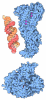
TitleCrystal structure of apo SPARDA complex from Xanthobacter autotrophicus
Components
  • DUF4365 domain-containing protein
  • Protein argonaute
KeywordsRNA BINDING PROTEIN / Protein-nucleic acid interactions / Argonaute / pAgo / guide and target specificity
Function / homologyDomain of unknown function DUF4365 / Domain of unknown function (DUF4365) / Piwi domain / Piwi / Ribonuclease H superfamily / nucleic acid binding / Ribonuclease H-like superfamily / DUF4365 domain-containing protein / Protein argonaute
Function and homology information
Biological speciesXanthobacter autotrophicus Py2 (bacteria)
MethodX-RAY DIFFRACTION / SYNCHROTRON / MOLECULAR REPLACEMENT / Resolution: 3 Å
AuthorsManakova, E.N. / Grazulis, S. / Zaremba, M.
Funding supportEuropean Union, 1items
OrganizationGrant numberCountry
iNEXTH2020 Grant # 653706European Union
CitationJournal: Cell Res / Year: 2025
Title: Activation of the SPARDA defense system by filament assembly using a beta-relay signaling mechanism widespread in prokaryotic Argonautes.
Authors: Edvinas Jurgelaitis / Evelina Zagorskaitė / Aurimas Kopūstas / Simonas Asmontas / Elena Manakova / Indrė Dalgėdienė / Ugnė Tylenytė / Arunas Silanskas / Paulius Toliusis / Algirdas ...Authors: Edvinas Jurgelaitis / Evelina Zagorskaitė / Aurimas Kopūstas / Simonas Asmontas / Elena Manakova / Indrė Dalgėdienė / Ugnė Tylenytė / Arunas Silanskas / Paulius Toliusis / Algirdas Grybauskas / Marijonas Tutkus / Česlovas Venclovas / Mindaugas Zaremba
Abstract: Present in all three domains of life, Argonaute proteins use short oligonucleotides as guides to recognize complementary nucleic acid targets. In eukaryotes, Argonautes are involved in RNA silencing, ...Present in all three domains of life, Argonaute proteins use short oligonucleotides as guides to recognize complementary nucleic acid targets. In eukaryotes, Argonautes are involved in RNA silencing, whereas in prokaryotes, they function in host defense against invading DNA. Here, we show that SPARDA (short prokaryotic Argonaute, DNase associated) systems from Xanthobacter autotrophicus (Xau) and Enhydrobacter aerosaccus (Eae) function in anti-plasmid defense. Upon activation, SPARDA nonspecifically degrades both invader and genomic DNA, causing host death, thereby preventing further spread of the invader in the population. X-ray structures of the apo Xau and EaeSPARDA complexes show that they are dimers, unlike other apo short pAgo systems, which are monomers. We show that dimerization in the apo state is essential for inhibition of XauSPARDA activity. We demonstrate by cryo-EM that activated XauSPARDA forms a filament. Upon activation, the recognition signal of the bound guide/target duplex is relayed to other functional XauSPARDA sites through a structural region that we termed the "beta-relay". Owing to dramatic conformational changes associated with guide/target binding, XauSPARDA undergoes a "dimer-monomer-filament" transition as the apo dimer dissociates into the guide/target-loaded monomers that subsequently assemble into the filament. Within the activated filament, the DREN nuclease domains form tetramers that are poised to cleave dsDNA. We show that other SPARDAs also form filaments during activation. Furthermore, we identify the presence of the beta-relay in pAgo from all clades, providing new insights into the structural mechanisms of pAgo proteins. Taken together, these findings reveal the detailed structural mechanism of SPARDA and highlight the importance of the beta-relay mechanism in signal transduction in Argonautes.
History
DepositionMar 3, 2025Deposition site: PDBE / Processing site: PDBE
Revision 1.0Dec 17, 2025Provider: repository / Type: Initial release
Revision 1.1Dec 24, 2025Group: Database references / Category: citation / citation_author
Item: _citation.journal_volume / _citation.page_first ..._citation.journal_volume / _citation.page_first / _citation.page_last / _citation_author.identifier_ORCID

-
Structure visualization

Structure viewerMolecule:
MolmilJmol/JSmol

Downloads & links

-
Assembly

Deposited unit
A: DUF4365 domain-containing protein
B: Protein argonaute
C: DUF4365 domain-containing protein
D: Protein argonaute
hetero molecules


Theoretical massNumber of molelcules
Total (without water)213,55720
Polymers212,0204
Non-polymers1,53716
Water1448
1


  • Idetical with deposited unit
  • defined by author
  • Evidence: gel filtration, electron microscopy, electron microscopy
TypeNameSymmetry operationNumber
identity operation1_555x,y,z1
Unit cell
Length a, b, c (Å)127.734, 73.290, 128.001
Angle α, β, γ (deg.)90.00, 115.17, 90.00
Int Tables number4
Space group name H-MP1211

-
Components

#1: Protein DUF4365 domain-containing protein


Mass: 52420.254 Da / Num. of mol.: 2 / Mutation: N-terminal His-tag
Source method: isolated from a genetically manipulated source
Source: (gene. exp.) Xanthobacter autotrophicus Py2 (bacteria)
Gene: Xaut_0433 / Plasmid: pBAD / Production host: Escherichia coli (E. coli) / Strain (production host): ER2566 / References: UniProt: A7ICE8
#2: Protein Protein argonaute


Mass: 53589.664 Da / Num. of mol.: 2
Source method: isolated from a genetically manipulated source
Source: (gene. exp.) Xanthobacter autotrophicus Py2 (bacteria)
Gene: Xaut_0434 / Plasmid: pBAD / Production host: Escherichia coli (E. coli) / Strain (production host): ER2566 / References: UniProt: A7ICE9
#3: Chemical
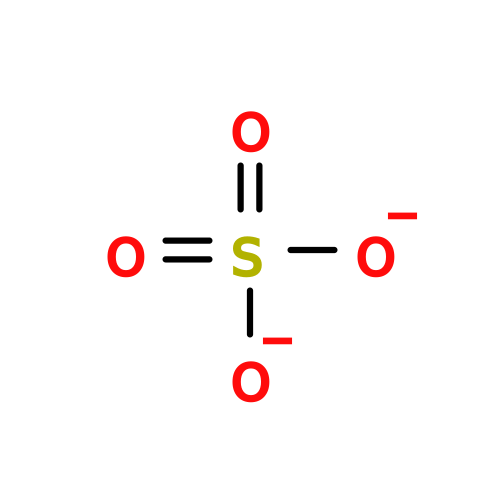
ChemComp-SO4 / SULFATE ION


Mass: 96.063 Da / Num. of mol.: 16 / Source method: obtained synthetically / Formula: SO4
#4: Water ChemComp-HOH / water


Mass: 18.015 Da / Num. of mol.: 8 / Source method: isolated from a natural source / Formula: H2O
Has ligand of interestN
Has protein modificationN

-
Experimental details

-
Experiment

ExperimentMethod: X-RAY DIFFRACTION / Number of used crystals: 1

-
Sample preparation

CrystalDensity Matthews: 2.56 Å3/Da / Density % sol: 51.99 %
Crystal growTemperature: 293 K / Method: vapor diffusion, sitting drop / pH: 6
Details: Reservoir buffer contained MES pH 6.0 0.1M, Ammonium sulfate 0.24M, PEG8000 11% (w/v).

-
Data collection

DiffractionMean temperature: 100 K / Serial crystal experiment: N
Diffraction sourceSource: SYNCHROTRON / Site: PETRA III, EMBL c/o DESY / Beamline: P13 (MX1) / Wavelength: 0.9797 Å
DetectorType: DECTRIS PILATUS 12M / Detector: PIXEL / Date: Nov 22, 2018
RadiationProtocol: SINGLE WAVELENGTH / Monochromatic (M) / Laue (L): M / Scattering type: x-ray
Radiation wavelengthWavelength: 0.9797 Å / Relative weight: 1
ReflectionResolution: 3→115.61 Å / Num. obs: 42973 / % possible obs: 99 % / Redundancy: 5.2 % / Biso Wilson estimate: 85.442 Å2 / CC1/2: 0.986 / Rmerge(I) obs: 0.302 / Rpim(I) all: 0.143 / Rrim(I) all: 0.335 / Χ2: 1 / Net I/av σ(I): 2 / Net I/σ(I): 3.1
Reflection shellResolution: 3→3.11 Å / Redundancy: 5 % / Rmerge(I) obs: 3.809 / Mean I/σ(I) obs: 0.4 / Num. unique obs: 4209 / CC1/2: 0.106 / Rpim(I) all: 2.481 / Rrim(I) all: 4.27 / Χ2: 1.05 / % possible all: 92.9

-
Processing

Software
NameVersionClassification
PHENIX(1.18.2_3874: ???)refinement
XDSdata reduction
Aimlessversion 0.7.2data scaling
MOLREPVers 11.7.02; 29.05.2019phasing
RefinementMethod to determine structure: MOLECULAR REPLACEMENT / Resolution: 3→68.55 Å / SU ML: 0.56 / Cross valid method: FREE R-VALUE / σ(F): 0.51 / Phase error: 33.01 / Stereochemistry target values: ML
RfactorNum. reflection% reflectionSelection details
Rfree0.2817 7820 9.98 %Random
Rwork0.2304 ---
obs0.2355 39186 93.18 %-
Solvent computationShrinkage radii: 0.9 Å / VDW probe radii: 1.11 Å / Solvent model: FLAT BULK SOLVENT MODEL
Displacement parametersBiso mean: 94 Å2
Refinement stepCycle: LAST / Resolution: 3→68.55 Å
ProteinNucleic acidLigandSolventTotal
Num. atoms13771 0 80 8 13859
Refine LS restraints
Refine-IDTypeDev idealNumber
X-RAY DIFFRACTIONf_bond_d0.00414127
X-RAY DIFFRACTIONf_angle_d0.76319133
X-RAY DIFFRACTIONf_dihedral_angle_d22.7895276
X-RAY DIFFRACTIONf_chiral_restr0.0552100
X-RAY DIFFRACTIONf_plane_restr0.0042488
LS refinement shell
Resolution (Å)Rfactor RfreeNum. reflection RfreeRfactor RworkNum. reflection RworkRefine-ID% reflection obs (%)
3-3.030.38911770.35651138X-RAY DIFFRACTION46
3.03-3.070.40771930.36511497X-RAY DIFFRACTION61
3.07-3.110.40662060.34842014X-RAY DIFFRACTION81
3.11-3.150.3862520.35632183X-RAY DIFFRACTION87
3.15-3.190.38352390.34262353X-RAY DIFFRACTION89
3.19-3.230.34392300.33292294X-RAY DIFFRACTION92
3.23-3.280.37682840.33932367X-RAY DIFFRACTION94
3.28-3.330.37912530.32042396X-RAY DIFFRACTION96
3.33-3.380.35282890.32592414X-RAY DIFFRACTION96
3.38-3.430.36953170.31522473X-RAY DIFFRACTION97
3.43-3.490.36012690.31492397X-RAY DIFFRACTION96
3.49-3.560.39772740.31512424X-RAY DIFFRACTION98
3.56-3.630.34232590.30422467X-RAY DIFFRACTION97
3.63-3.70.35282640.29632533X-RAY DIFFRACTION99
3.7-3.780.34242510.28672490X-RAY DIFFRACTION98
3.78-3.870.30612660.26692548X-RAY DIFFRACTION98
3.87-3.960.30882990.26182370X-RAY DIFFRACTION99
3.96-4.070.31332260.25132589X-RAY DIFFRACTION98
4.07-4.190.31372490.24432398X-RAY DIFFRACTION97
4.19-4.330.27592270.21732585X-RAY DIFFRACTION97
4.33-4.480.27142460.20372439X-RAY DIFFRACTION97
4.48-4.660.23283050.18822465X-RAY DIFFRACTION99
4.66-4.870.21782740.17862493X-RAY DIFFRACTION98
4.87-5.130.26222950.17122447X-RAY DIFFRACTION98
5.13-5.450.25222380.18992512X-RAY DIFFRACTION98
5.45-5.870.23812880.20212426X-RAY DIFFRACTION97
5.87-6.460.26582860.2082502X-RAY DIFFRACTION99
6.46-7.40.2442970.19782488X-RAY DIFFRACTION99
7.4-9.310.20512770.1742426X-RAY DIFFRACTION97
9.32-68.550.25292900.19382425X-RAY DIFFRACTION97

+
About Yorodumi

-
News

-
Feb 9, 2022. New format data for meta-information of EMDB entries

New format data for meta-information of EMDB entries

  • Version 3 of the EMDB header file is now the official format.
  • The previous official version 1.9 will be removed from the archive.

Related info.:EMDB header

External links:wwPDB to switch to version 3 of the EMDB data model

-
Aug 12, 2020. Covid-19 info

Covid-19 info

URL: https://pdbj.org/emnavi/covid19.php

New page: Covid-19 featured information page in EM Navigator.

Related info.:Covid-19 info / Mar 5, 2020. Novel coronavirus structure data

+
Mar 5, 2020. Novel coronavirus structure data

Novel coronavirus structure data

Related info.:Yorodumi Speices / Aug 12, 2020. Covid-19 info

External links:COVID-19 featured content - PDBj / Molecule of the Month (242):Coronavirus Proteases

+
Jan 31, 2019. EMDB accession codes are about to change! (news from PDBe EMDB page)

EMDB accession codes are about to change! (news from PDBe EMDB page)

  • The allocation of 4 digits for EMDB accession codes will soon come to an end. Whilst these codes will remain in use, new EMDB accession codes will include an additional digit and will expand incrementally as the available range of codes is exhausted. The current 4-digit format prefixed with “EMD-” (i.e. EMD-XXXX) will advance to a 5-digit format (i.e. EMD-XXXXX), and so on. It is currently estimated that the 4-digit codes will be depleted around Spring 2019, at which point the 5-digit format will come into force.
  • The EM Navigator/Yorodumi systems omit the EMD- prefix.

Related info.:Q: What is EMD? / ID/Accession-code notation in Yorodumi/EM Navigator

External links:EMDB Accession Codes are Changing Soon! / Contact to PDBj

+
Jul 12, 2017. Major update of PDB

Major update of PDB

  • wwPDB released updated PDB data conforming to the new PDBx/mmCIF dictionary.
  • This is a major update changing the version number from 4 to 5, and with Remediation, in which all the entries are updated.
  • In this update, many items about electron microscopy experimental information are reorganized (e.g. em_software).
  • Now, EM Navigator and Yorodumi are based on the updated data.

External links:wwPDB Remediation / Enriched Model Files Conforming to OneDep Data Standards Now Available in the PDB FTP Archive

-
Yorodumi

Thousand views of thousand structures

  • Yorodumi is a browser for structure data from EMDB, PDB, SASBDB, etc.
  • This page is also the successor to EM Navigator detail page, and also detail information page/front-end page for Omokage search.
  • The word "yorodu" (or yorozu) is an old Japanese word meaning "ten thousand". "mi" (miru) is to see.

Related info.:EMDB / PDB / SASBDB / Comparison of 3 databanks / Yorodumi Search / Aug 31, 2016. New EM Navigator & Yorodumi / Yorodumi Papers / Jmol/JSmol / Function and homology information / Changes in new EM Navigator and Yorodumi

Read more