 Movie
Movie Controller


+ Open data

- Basic information
| Entry | Database: PDB / ID: 9qcc | |||||||||||||||||||||||||||
|---|---|---|---|---|---|---|---|---|---|---|---|---|---|---|---|---|---|---|---|---|---|---|---|---|---|---|---|---|
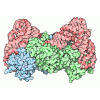
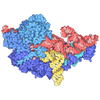
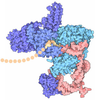
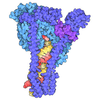
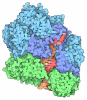
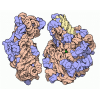
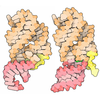
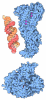
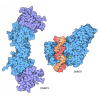
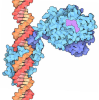
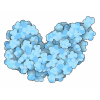
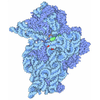
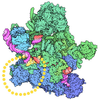
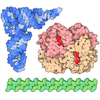
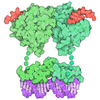
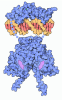
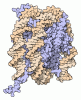
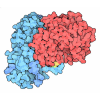
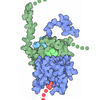
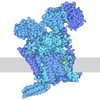
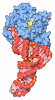
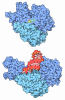
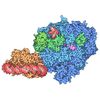
| Title | Activated XauSPARDA filament assembly with bound dsDNA substrate | |||||||||||||||||||||||||||
 Components Components |
| |||||||||||||||||||||||||||
 Keywords Keywords | RNA BINDING PROTEIN / short prokaryotic Argonaute / bacterial defence system / DREN domain / DREN-APAZ | |||||||||||||||||||||||||||
| Function / homology |  Function and homology information Function and homology information | |||||||||||||||||||||||||||
| Biological species |  Xanthobacter autotrophicus Py2 (bacteria) Xanthobacter autotrophicus Py2 (bacteria) Escherichia coli (E. coli) Escherichia coli (E. coli) | |||||||||||||||||||||||||||
| Method | ELECTRON MICROSCOPY / single particle reconstruction / cryo EM / Resolution: 3 Å | |||||||||||||||||||||||||||
 Authors Authors | Manakova, E.N. / Zaremba, M. / Jurgelaitis, E. | |||||||||||||||||||||||||||
| Funding support | 1items
| |||||||||||||||||||||||||||
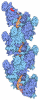
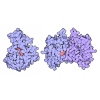
 Citation Citation | Journal: Cell Res / Year: 2025 Title: Activation of the SPARDA defense system by filament assembly using a beta-relay signaling mechanism widespread in prokaryotic Argonautes. Authors: Edvinas Jurgelaitis / Evelina Zagorskaitė / Aurimas Kopūstas / Simonas Asmontas / Elena Manakova / Indrė Dalgėdienė / Ugnė Tylenytė / Arunas Silanskas / Paulius Toliusis / Algirdas ...Authors: Edvinas Jurgelaitis / Evelina Zagorskaitė / Aurimas Kopūstas / Simonas Asmontas / Elena Manakova / Indrė Dalgėdienė / Ugnė Tylenytė / Arunas Silanskas / Paulius Toliusis / Algirdas Grybauskas / Marijonas Tutkus / Česlovas Venclovas / Mindaugas Zaremba Abstract: Present in all three domains of life, Argonaute proteins use short oligonucleotides as guides to recognize complementary nucleic acid targets. In eukaryotes, Argonautes are involved in RNA silencing, ...Present in all three domains of life, Argonaute proteins use short oligonucleotides as guides to recognize complementary nucleic acid targets. In eukaryotes, Argonautes are involved in RNA silencing, whereas in prokaryotes, they function in host defense against invading DNA. Here, we show that SPARDA (short prokaryotic Argonaute, DNase associated) systems from Xanthobacter autotrophicus (Xau) and Enhydrobacter aerosaccus (Eae) function in anti-plasmid defense. Upon activation, SPARDA nonspecifically degrades both invader and genomic DNA, causing host death, thereby preventing further spread of the invader in the population. X-ray structures of the apo Xau and EaeSPARDA complexes show that they are dimers, unlike other apo short pAgo systems, which are monomers. We show that dimerization in the apo state is essential for inhibition of XauSPARDA activity. We demonstrate by cryo-EM that activated XauSPARDA forms a filament. Upon activation, the recognition signal of the bound guide/target duplex is relayed to other functional XauSPARDA sites through a structural region that we termed the "beta-relay". Owing to dramatic conformational changes associated with guide/target binding, XauSPARDA undergoes a "dimer-monomer-filament" transition as the apo dimer dissociates into the guide/target-loaded monomers that subsequently assemble into the filament. Within the activated filament, the DREN nuclease domains form tetramers that are poised to cleave dsDNA. We show that other SPARDAs also form filaments during activation. Furthermore, we identify the presence of the beta-relay in pAgo from all clades, providing new insights into the structural mechanisms of pAgo proteins. Taken together, these findings reveal the detailed structural mechanism of SPARDA and highlight the importance of the beta-relay mechanism in signal transduction in Argonautes. | |||||||||||||||||||||||||||
| History |
|
- Structure visualization
| Structure viewer | Molecule: MolmilJmol/JSmol |
|---|
- Downloads & links
-Download
| PDBx/mmCIF format | 9qcc.cif.gz | 1.5 MB | Display | PDBx/mmCIF format |
|---|---|---|---|---|
| PDB format | pdb9qcc.ent.gz | 1.2 MB | Display | PDB format |
| PDBx/mmJSON format | 9qcc.json.gz | Tree view | PDBx/mmJSON format | |
| Others |  Other downloads Other downloads |
-Validation report
| Arichive directory | https://data.pdbj.org/pub/pdb/validation_reports/qc/9qccftp://data.pdbj.org/pub/pdb/validation_reports/qc/9qcc | HTTPS FTP |
|---|
-Related structure data
| Related structure data |  53008MC  9qblC  9qbpC  9qbqC C: citing same article ( M: map data used to model this data |
|---|---|
| Similar structure data |
-Links
 PDBj
PDBj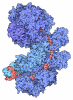

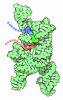
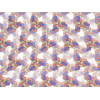
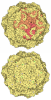
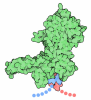

- Assembly
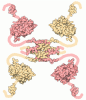
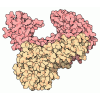
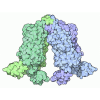
| Deposited unit | 
|
|---|---|
| 1 |
|
-Components
-Protein , 2 types, 16 molecules AEIMQUWYBFJNRVXZ
| #1: Protein | Mass: 52420.254 Da / Num. of mol.: 8 Source method: isolated from a genetically manipulated source Details: N-terminal purification His-tag Source: (gene. exp.) Xanthobacter autotrophicus Py2 (bacteria)Gene: Xaut_0433 / Plasmid: pBAD / Production host: Escherichia coli (E. coli) / References: UniProt: A7ICE8#2: Protein | Mass: 53589.664 Da / Num. of mol.: 8 Source method: isolated from a genetically manipulated source Source: (gene. exp.) Xanthobacter autotrophicus Py2 (bacteria)Gene: Xaut_0434 / Plasmid: pBAD / Production host: Escherichia coli BL21(DE3) (bacteria) / References: UniProt: A7ICE9 |
|---|
-DsDNA substrate, ... , 2 types, 2 molecules ST
| #5: DNA chain | Mass: 12994.325 Da / Num. of mol.: 1 / Source method: obtained synthetically / Details: first strand of dsDNA substrate / Source: (synth.) Escherichia coli (E. coli) |
|---|---|
| #6: DNA chain | Mass: 12862.349 Da / Num. of mol.: 1 / Source method: obtained synthetically / Details: complementary strand of dsDNA substrate / Source: (synth.) Escherichia coli (E. coli) |
-DNA chain / RNA chain / Non-polymers , 3 types, 28 molecules CGKO1357DHLP2468
| #3: DNA chain | Mass: 5202.384 Da / Num. of mol.: 8 / Source method: obtained synthetically / Details: DNA target strand / Source: (synth.) Escherichia coli (E. coli)#4: RNA chain | Mass: 5427.286 Da / Num. of mol.: 8 / Source method: obtained synthetically / Details: 5'-P RNA guide strand / Source: (synth.) Escherichia coli (E. coli)#7: Chemical | ChemComp-CA /  Mass: 40.078 Da / Num. of mol.: 12 / Source method: obtained synthetically / Formula: Ca / Feature type: SUBJECT OF INVESTIGATION Mass: 40.078 Da / Num. of mol.: 12 / Source method: obtained synthetically / Formula: Ca / Feature type: SUBJECT OF INVESTIGATION |
|---|
-Details
| Has ligand of interest | Y |
|---|---|
| Has protein modification | N |
-Experimental details
-Experiment
| Experiment | Method: ELECTRON MICROSCOPY |
|---|---|
| EM experiment | Aggregation state: PARTICLE / 3D reconstruction method: single particle reconstruction |
- Sample preparation
| Component |
| ||||||||||||||||||||||||||||
|---|---|---|---|---|---|---|---|---|---|---|---|---|---|---|---|---|---|---|---|---|---|---|---|---|---|---|---|---|---|
| Molecular weight |
| ||||||||||||||||||||||||||||
| Source (natural) |
| ||||||||||||||||||||||||||||
| Source (recombinant) |
| ||||||||||||||||||||||||||||
| Buffer solution | pH: 8 | ||||||||||||||||||||||||||||
| Buffer component |
| ||||||||||||||||||||||||||||
| Specimen | Conc.: 1.96 mg/ml / Embedding applied: NO / Shadowing applied: NO / Staining applied: NO / Vitrification applied: YES Details: Solution containing activated XauSPARDA monomers was mixed with solution containing dsDNA substrate and centrifugated before applying on the grid. | ||||||||||||||||||||||||||||
| Specimen support | Grid material: COPPER / Grid mesh size: 300 divisions/in. / Grid type: Quantifoil R1.2/1.3 | ||||||||||||||||||||||||||||
| Vitrification | Instrument: FEI VITROBOT MARK IV / Cryogen name: ETHANE / Humidity: 95 % / Chamber temperature: 277 K |
- Electron microscopy imaging
| Microscopy | Model: TFS GLACIOS |
|---|---|
| Electron gun | Electron source:  FIELD EMISSION GUN / Accelerating voltage: 200 kV / Illumination mode: SPOT SCAN FIELD EMISSION GUN / Accelerating voltage: 200 kV / Illumination mode: SPOT SCAN |
| Electron lens | Mode: BRIGHT FIELD / Nominal magnification: 92000 X / Nominal defocus max: 2000 nm / Nominal defocus min: 1000 nm / Cs: 2.7 mm / C2 aperture diameter: 100 µm / Alignment procedure: BASIC |
| Specimen holder | Cryogen: NITROGEN / Specimen holder model: OTHER |
| Image recording | Average exposure time: 46.33 sec. / Electron dose: 30 e/Å2 / Detector mode: COUNTING / Film or detector model: FEI FALCON III (4k x 4k) / Num. of grids imaged: 1 / Num. of real images: 1946 |
- Processing
| EM software |
| |||||||||||||||||||||||||||||||||||||||||||||
|---|---|---|---|---|---|---|---|---|---|---|---|---|---|---|---|---|---|---|---|---|---|---|---|---|---|---|---|---|---|---|---|---|---|---|---|---|---|---|---|---|---|---|---|---|---|---|
| CTF correction | Type: PHASE FLIPPING AND AMPLITUDE CORRECTION | |||||||||||||||||||||||||||||||||||||||||||||
| Particle selection | Num. of particles selected: 6077663 / Details: Template picking | |||||||||||||||||||||||||||||||||||||||||||||
| Symmetry | Point symmetry: C1 (asymmetric) | |||||||||||||||||||||||||||||||||||||||||||||
| 3D reconstruction | Resolution: 3 Å / Resolution method: FSC 0.143 CUT-OFF / Num. of particles: 204199 / Algorithm: FOURIER SPACE / Details: Local refinement within mask / Num. of class averages: 1 / Symmetry type: POINT | |||||||||||||||||||||||||||||||||||||||||||||
| Atomic model building | B value: 131 / Protocol: RIGID BODY FIT / Space: REAL | |||||||||||||||||||||||||||||||||||||||||||||
| Atomic model building | 3D fitting-ID: 1 / Accession code: 9QBQ / PDB-ID: 9QBQ / Source name: PDB / Type: experimental model
|
