 Movie
Movie Controller

[English] 日本語
 Yorodumi
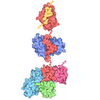
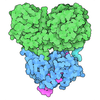
- PDB-9qbl: Crystal structure of Xanthobacter autotrophicus SPARDA mutant lac... -
+ Open data

- Basic information
| Entry | Database: PDB / ID: 9qbl | ||||||
|---|---|---|---|---|---|---|---|
| Title | Crystal structure of Xanthobacter autotrophicus SPARDA mutant lacking DREN nuclease domains | ||||||
 Components Components |
| ||||||
 Keywords Keywords | RNA BINDING PROTEIN / Protein-nucleic acid interactions / Argonaute / pAgo / guide and target specificity | ||||||
| Function / homology |  Function and homology information Function and homology information | ||||||
| Biological species |  Xanthobacter autotrophicus Py2 (bacteria) Xanthobacter autotrophicus Py2 (bacteria) | ||||||
| Method |  X-RAY DIFFRACTION / SYNCHROTRON / MAD / Resolution: 1.5 Å X-RAY DIFFRACTION / SYNCHROTRON / MAD / Resolution: 1.5 Å | ||||||
 Authors Authors | Manakova, E.N. / Grazulis, S. / Zaremba, M. | ||||||
| Funding support | European Union, 1items
| ||||||
 Citation Citation | Journal: Cell Res / Year: 2025 Title: Activation of the SPARDA defense system by filament assembly using a beta-relay signaling mechanism widespread in prokaryotic Argonautes. Authors: Edvinas Jurgelaitis / Evelina Zagorskaitė / Aurimas Kopūstas / Simonas Asmontas / Elena Manakova / Indrė Dalgėdienė / Ugnė Tylenytė / Arunas Silanskas / Paulius Toliusis / Algirdas ...Authors: Edvinas Jurgelaitis / Evelina Zagorskaitė / Aurimas Kopūstas / Simonas Asmontas / Elena Manakova / Indrė Dalgėdienė / Ugnė Tylenytė / Arunas Silanskas / Paulius Toliusis / Algirdas Grybauskas / Marijonas Tutkus / Česlovas Venclovas / Mindaugas Zaremba Abstract: Present in all three domains of life, Argonaute proteins use short oligonucleotides as guides to recognize complementary nucleic acid targets. In eukaryotes, Argonautes are involved in RNA silencing, ...Present in all three domains of life, Argonaute proteins use short oligonucleotides as guides to recognize complementary nucleic acid targets. In eukaryotes, Argonautes are involved in RNA silencing, whereas in prokaryotes, they function in host defense against invading DNA. Here, we show that SPARDA (short prokaryotic Argonaute, DNase associated) systems from Xanthobacter autotrophicus (Xau) and Enhydrobacter aerosaccus (Eae) function in anti-plasmid defense. Upon activation, SPARDA nonspecifically degrades both invader and genomic DNA, causing host death, thereby preventing further spread of the invader in the population. X-ray structures of the apo Xau and EaeSPARDA complexes show that they are dimers, unlike other apo short pAgo systems, which are monomers. We show that dimerization in the apo state is essential for inhibition of XauSPARDA activity. We demonstrate by cryo-EM that activated XauSPARDA forms a filament. Upon activation, the recognition signal of the bound guide/target duplex is relayed to other functional XauSPARDA sites through a structural region that we termed the "beta-relay". Owing to dramatic conformational changes associated with guide/target binding, XauSPARDA undergoes a "dimer-monomer-filament" transition as the apo dimer dissociates into the guide/target-loaded monomers that subsequently assemble into the filament. Within the activated filament, the DREN nuclease domains form tetramers that are poised to cleave dsDNA. We show that other SPARDAs also form filaments during activation. Furthermore, we identify the presence of the beta-relay in pAgo from all clades, providing new insights into the structural mechanisms of pAgo proteins. Taken together, these findings reveal the detailed structural mechanism of SPARDA and highlight the importance of the beta-relay mechanism in signal transduction in Argonautes. | ||||||
| History |
|
- Structure visualization
| Structure viewer | Molecule: MolmilJmol/JSmol |
|---|
- Downloads & links
-Download
| PDBx/mmCIF format | 9qbl.cif.gz | 346.2 KB | Display | PDBx/mmCIF format |
|---|---|---|---|---|
| PDB format | pdb9qbl.ent.gz | 277.4 KB | Display | PDB format |
| PDBx/mmJSON format | 9qbl.json.gz | Tree view | PDBx/mmJSON format | |
| Others |  Other downloads Other downloads |
-Validation report
| Arichive directory | https://data.pdbj.org/pub/pdb/validation_reports/qb/9qblftp://data.pdbj.org/pub/pdb/validation_reports/qb/9qbl | HTTPS FTP |
|---|
-Related structure data


-Links
 PDBj
PDBj
- Assembly
| Deposited unit | 
| ||||||||
|---|---|---|---|---|---|---|---|---|---|
| 1 |
| ||||||||
| Unit cell |
|
-Components
-Protein , 2 types, 4 molecules ACBD
| #1: Protein | Mass: 37138.730 Da / Num. of mol.: 2 Mutation: Deletion of N-terminal DUF4365 domain (1-153) and N-terminal His-tag Source method: isolated from a genetically manipulated source Details: Deletion of N-terminal DUF4365 domain (1-153) and N-terminal purification bHis-tag Source: (gene. exp.) Xanthobacter autotrophicus Py2 (bacteria)Gene: Xaut_0433 / Plasmid: pLATE / Production host:  Escherichia coli BL21(DE3) (bacteria) / References: UniProt: A7ICE8 Escherichia coli BL21(DE3) (bacteria) / References: UniProt: A7ICE8#2: Protein | Mass: 53900.258 Da / Num. of mol.: 2 Source method: isolated from a genetically manipulated source Source: (gene. exp.) Xanthobacter autotrophicus Py2 (bacteria)Gene: Xaut_0434 / Plasmid: plasmid / Details (production host): pLATE / Production host: Escherichia coli BL21(DE3) (bacteria) / References: UniProt: A7ICE9 |
|---|
-Non-polymers , 8 types, 1256 molecules 
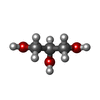
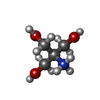
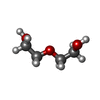

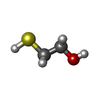
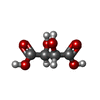
| #3: Chemical | ChemComp-ACY / 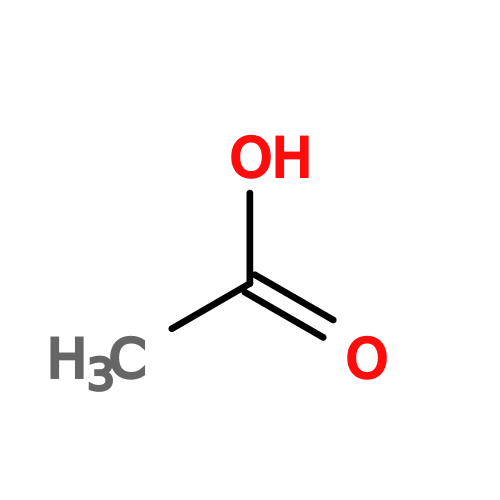 Mass: 60.052 Da / Num. of mol.: 5 / Source method: obtained synthetically / Formula: C2H4O2 Mass: 60.052 Da / Num. of mol.: 5 / Source method: obtained synthetically / Formula: C2H4O2#4: Chemical | ChemComp-GOL / 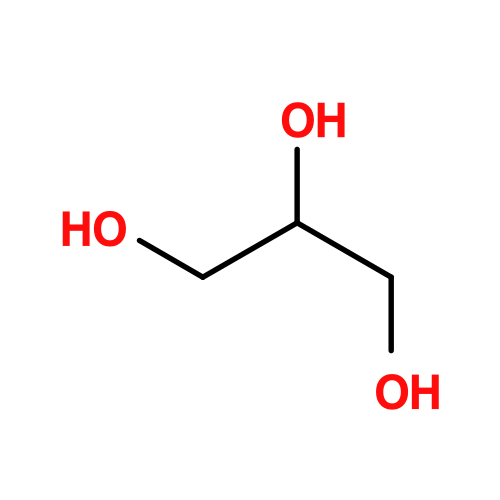 Mass: 92.094 Da / Num. of mol.: 7 / Source method: obtained synthetically / Formula: C3H8O3 Mass: 92.094 Da / Num. of mol.: 7 / Source method: obtained synthetically / Formula: C3H8O3#5: Chemical | ChemComp-TRS / | 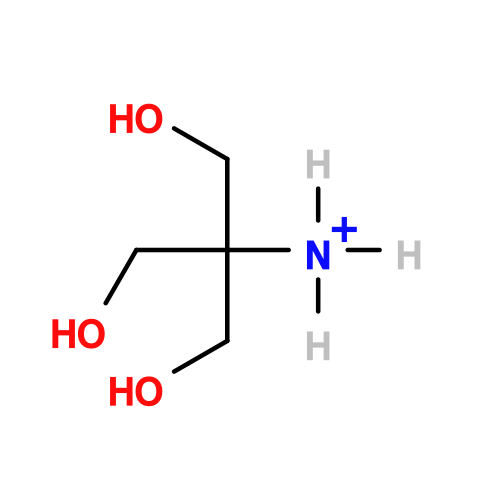 Mass: 122.143 Da / Num. of mol.: 1 / Source method: obtained synthetically / Formula: C4H12NO3 / Comment: pH buffer*YM Mass: 122.143 Da / Num. of mol.: 1 / Source method: obtained synthetically / Formula: C4H12NO3 / Comment: pH buffer*YM#6: Chemical | ChemComp-PEG / 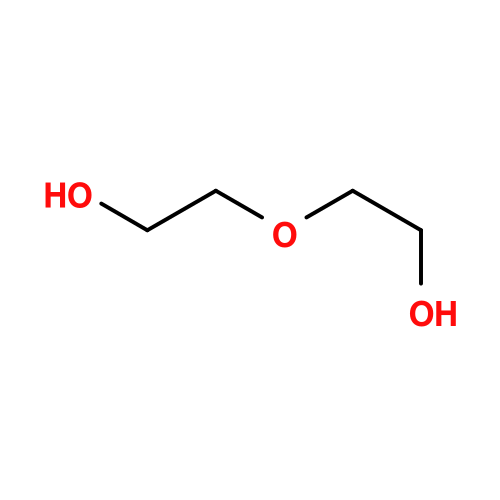 Mass: 106.120 Da / Num. of mol.: 5 / Source method: obtained synthetically / Formula: C4H10O3 Mass: 106.120 Da / Num. of mol.: 5 / Source method: obtained synthetically / Formula: C4H10O3#7: Chemical |  Mass: 35.453 Da / Num. of mol.: 3 / Source method: obtained synthetically / Formula: Cl Mass: 35.453 Da / Num. of mol.: 3 / Source method: obtained synthetically / Formula: Cl#8: Chemical | ChemComp-BME / 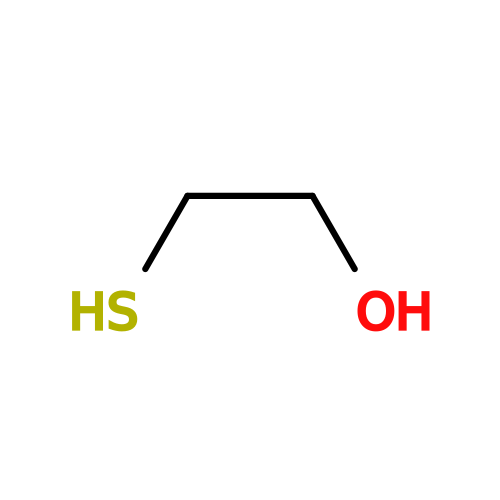 Mass: 78.133 Da / Num. of mol.: 5 / Source method: obtained synthetically / Formula: C2H6OS Mass: 78.133 Da / Num. of mol.: 5 / Source method: obtained synthetically / Formula: C2H6OS#9: Chemical | 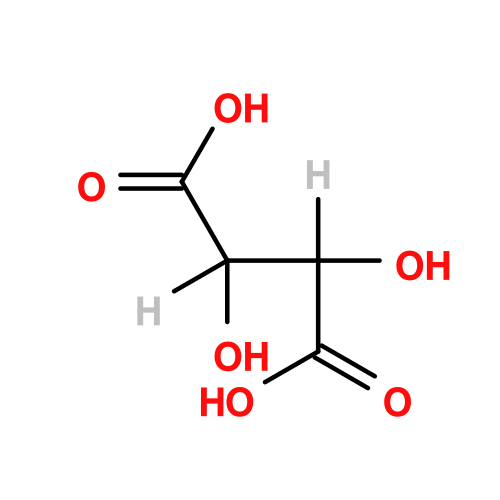 Mass: 150.087 Da / Num. of mol.: 2 / Source method: obtained synthetically / Formula: C4H6O6 Mass: 150.087 Da / Num. of mol.: 2 / Source method: obtained synthetically / Formula: C4H6O6#10: Water | ChemComp-HOH / | Mass: 18.015 Da / Num. of mol.: 1228 / Source method: isolated from a natural source / Formula: H2O |
|---|
-Details
| Has ligand of interest | N |
|---|---|
| Has protein modification | Y |
-Experimental details
-Experiment
| Experiment | Method: X-RAY DIFFRACTION / Number of used crystals: 1 |
|---|
- Sample preparation
| Crystal | Density Matthews: 2.52 Å3/Da / Density % sol: 51.25 % |
|---|---|
| Crystal grow | Temperature: 280 K / Method: vapor diffusion, sitting drop / pH: 8.5 Details: Protein concentration 6.4 mg/ml. Reservoir: Tris-Bicine pH 8.5 0.1 M; Ammonium Tartrate 0.25M; PEG5000 mme 9% (w/v); Glycerol 2% (v/v). Seeding with microcrystals Temp details: cold room |
-Data collection
| Diffraction | Mean temperature: 100 K / Serial crystal experiment: N | ||||||||||||
|---|---|---|---|---|---|---|---|---|---|---|---|---|---|
| Diffraction source | Source: SYNCHROTRON / Site: PETRA III, EMBL c/o DESY  / Beamline: P13 (MX1) / Wavelength: 0.97970,0.97980,0.98000 / Beamline: P13 (MX1) / Wavelength: 0.97970,0.97980,0.98000 | ||||||||||||
| Detector | Type: DECTRIS PILATUS 12M / Detector: PIXEL / Date: Jul 1, 2019 | ||||||||||||
| Radiation | Protocol: MAD / Monochromatic (M) / Laue (L): M / Scattering type: x-ray | ||||||||||||
| Radiation wavelength |
| ||||||||||||
| Reflection | Resolution: 1.5→161.34 Å / Num. obs: 284306 / % possible obs: 98.2 % / Redundancy: 16.5 % / Biso Wilson estimate: 28.703 Å2 / CC1/2: 0.998 / Rmerge(I) obs: 0.12 / Rpim(I) all: 0.043 / Rrim(I) all: 0.127 / Net I/av σ(I): 2.8 / Net I/σ(I): 10.3 | ||||||||||||
| Reflection shell | Resolution: 1.5→1.53 Å / Redundancy: 4 % / Rmerge(I) obs: 1.512 / Mean I/σ(I) obs: 0.6 / Num. unique obs: 8990 / CC1/2: 0.023 / Rpim(I) all: 0.956 / Rrim(I) all: 1.86 / % possible all: 63.3 |
- Processing
| Software |
| ||||||||||||||||||||||||||||||||||||||||||||||||||||||||||||||||||||||||||||||||||||||||||||||||||||||||||||||||||||||||||||||||||||||||||||||||||||||||||||||||||||||||||||||||||||||
|---|---|---|---|---|---|---|---|---|---|---|---|---|---|---|---|---|---|---|---|---|---|---|---|---|---|---|---|---|---|---|---|---|---|---|---|---|---|---|---|---|---|---|---|---|---|---|---|---|---|---|---|---|---|---|---|---|---|---|---|---|---|---|---|---|---|---|---|---|---|---|---|---|---|---|---|---|---|---|---|---|---|---|---|---|---|---|---|---|---|---|---|---|---|---|---|---|---|---|---|---|---|---|---|---|---|---|---|---|---|---|---|---|---|---|---|---|---|---|---|---|---|---|---|---|---|---|---|---|---|---|---|---|---|---|---|---|---|---|---|---|---|---|---|---|---|---|---|---|---|---|---|---|---|---|---|---|---|---|---|---|---|---|---|---|---|---|---|---|---|---|---|---|---|---|---|---|---|---|---|---|---|---|---|
| Refinement | Method to determine structure: MAD / Resolution: 1.5→80.67 Å / Cor.coef. Fo:Fc: 0.973 / Cor.coef. Fo:Fc free: 0.959 / SU B: 3.007 / SU ML: 0.095 / Cross valid method: THROUGHOUT / ESU R: 0.084 / ESU R Free: 0.09 / Stereochemistry target values: MAXIMUM LIKELIHOOD / Details: HYDROGENS HAVE BEEN USED IF PRESENT IN THE INPUT
| ||||||||||||||||||||||||||||||||||||||||||||||||||||||||||||||||||||||||||||||||||||||||||||||||||||||||||||||||||||||||||||||||||||||||||||||||||||||||||||||||||||||||||||||||||||||
| Solvent computation | Ion probe radii: 0.8 Å / Shrinkage radii: 0.8 Å / VDW probe radii: 1.4 Å / Solvent model: MASK | ||||||||||||||||||||||||||||||||||||||||||||||||||||||||||||||||||||||||||||||||||||||||||||||||||||||||||||||||||||||||||||||||||||||||||||||||||||||||||||||||||||||||||||||||||||||
| Displacement parameters | Biso mean: 41.48 Å2
| ||||||||||||||||||||||||||||||||||||||||||||||||||||||||||||||||||||||||||||||||||||||||||||||||||||||||||||||||||||||||||||||||||||||||||||||||||||||||||||||||||||||||||||||||||||||
| Refinement step | Cycle: LAST / Resolution: 1.5→80.67 Å
| ||||||||||||||||||||||||||||||||||||||||||||||||||||||||||||||||||||||||||||||||||||||||||||||||||||||||||||||||||||||||||||||||||||||||||||||||||||||||||||||||||||||||||||||||||||||
| Refine LS restraints |
|