 Movie
Movie Controller

[English] 日本語
 Yorodumi
- PDB-9y4w: Eukaryotic translation initiation factor 2-B (eIF2B) with a trunc... -
+ Open data

- Basic information
| Entry | Database: PDB / ID: 9y4w | |||||||||||||||||||||||||||
|---|---|---|---|---|---|---|---|---|---|---|---|---|---|---|---|---|---|---|---|---|---|---|---|---|---|---|---|---|
| Title | Eukaryotic translation initiation factor 2-B (eIF2B) with a truncation in the beta subunit (active-like-state) asymmetrically bound to the viral effector AcP10 | |||||||||||||||||||||||||||
 Components Components |
| |||||||||||||||||||||||||||
 Keywords Keywords | TRANSLATION / Guanine nucleotide exchange factor / GEF / initiation | |||||||||||||||||||||||||||
| Function / homology |  Function and homology information Function and homology informationuridine/cytidine kinase / uridine kinase activity / eukaryotic translation initiation factor 2B complex / Recycling of eIF2:GDP / astrocyte development / astrocyte differentiation / oligodendrocyte development / regulation of translational initiation / cytoplasmic translational initiation / response to glucose ...uridine/cytidine kinase / uridine kinase activity / eukaryotic translation initiation factor 2B complex / Recycling of eIF2:GDP / astrocyte development / astrocyte differentiation / oligodendrocyte development / regulation of translational initiation / cytoplasmic translational initiation / response to glucose / positive regulation of translational initiation / myelination / translation initiation factor activity / ovarian follicle development / guanyl-nucleotide exchange factor activity / response to endoplasmic reticulum stress / translation initiation factor binding / hippocampus development / central nervous system development / translational initiation / regulation of translation / response to peptide hormone / T cell receptor signaling pathway / response to heat / host cell perinuclear region of cytoplasm / positive regulation of apoptotic process / GTP binding / ATP binding / membrane / identical protein binding / nucleus / plasma membrane / cytosol / cytoplasm Similarity search - Function | |||||||||||||||||||||||||||
| Biological species |  Homo sapiens (human) Homo sapiens (human) Beluga whale coronavirus SW1 Beluga whale coronavirus SW1 | |||||||||||||||||||||||||||
| Method | ELECTRON MICROSCOPY / single particle reconstruction / cryo EM / Resolution: 2.4 Å | |||||||||||||||||||||||||||
 Authors Authors | Dalwadi, U. / Croll, T. / Subramanian, A. / Lee, D.J. / Arthur, C. / Walter, P. / Frost, A. | |||||||||||||||||||||||||||
| Funding support |  United States, 1items United States, 1items
| |||||||||||||||||||||||||||
 Citation Citation | Journal: Nat Chem Biol / Year: 2026 Title: Allosteric disordering of eIF2B regulates the integrated stress response. Authors: Udit Dalwadi / Advait Subramanian / Aniliese Deal / Julia E Conrad / Tamara Nadjsombati / Meera Venkatesh / Morgane Boone / Pascal F Egea / Lingjie He / Nimit Jain / D John Lee / Yuwei Liu / ...Authors: Udit Dalwadi / Advait Subramanian / Aniliese Deal / Julia E Conrad / Tamara Nadjsombati / Meera Venkatesh / Morgane Boone / Pascal F Egea / Lingjie He / Nimit Jain / D John Lee / Yuwei Liu / Lucas C Reineke / Kazuki Saito / Nathaniel Talledge / Hannah Toutkoushian / Maxence Le Vasseur / Francesca Zappa / Raoul J de Groot / Diego Acosta-Alvear / Christopher P Arthur / Jodi Nunnari / Susan Marqusee / Rosalie E Lawrence / Mauro Costa-Mattioli / James J Crawford / Frank J M van Kuppeveld / Tristan I Croll / Peter Walter / Adam Frost /  Abstract: The ternary complex, composed of eIF2, GTP and initiator methionyl-tRNA, delivers the first amino acid to the ribosome to initiate protein synthesis. Eukaryotic initiation factor 2B (eIF2B) catalyzes ...The ternary complex, composed of eIF2, GTP and initiator methionyl-tRNA, delivers the first amino acid to the ribosome to initiate protein synthesis. Eukaryotic initiation factor 2B (eIF2B) catalyzes GDP to GTP exchange on eIF2, thereby setting the ternary complex level. Stress-induced phosphorylation converts eIF2 from the substrate of eIF2B into an inhibitor (eIF2-P). This conversion reduces ternary complex levels and induces the integrated stress response (ISR). Here we chart an allosteric axis running through eIF2B, revealing the importance of an α-helix in its β-subunit, the 'latch-helix', that hooks onto the α-subunit to induce eIF2B activity. eIF2-P binding promotes latch-helix unhooking, opening eIF2B, which inhibits its activity. Convergently evolved viral proteins stabilize this latch-helix-binding active state of eIF2B. Using these insights, we generated ISR-activating compounds that stabilize eIF2B in its inhibited, unlatched state. Our study thus highlights how long-range eIF2B allostery can be pharmacologically manipulated to sustain or attenuate the ISR. | |||||||||||||||||||||||||||
| History |
|
- Structure visualization
| Structure viewer | Molecule: MolmilJmol/JSmol |
|---|
- Downloads & links
-Download
| PDBx/mmCIF format | 9y4w.cif.gz | 741.4 KB | Display | PDBx/mmCIF format |
|---|---|---|---|---|
| PDB format | pdb9y4w.ent.gz | 593.7 KB | Display | PDB format |
| PDBx/mmJSON format | 9y4w.json.gz | Tree view | PDBx/mmJSON format | |
| Others |  Other downloads Other downloads |
-Validation report
| Arichive directory | https://data.pdbj.org/pub/pdb/validation_reports/y4/9y4wftp://data.pdbj.org/pub/pdb/validation_reports/y4/9y4w | HTTPS FTP |
|---|
-Related structure data
| Related structure data |  72499MC  9y3pC  9y3qC  9y3tC  9y3uC  9y3vC  9y4bC  9y5rC  9y5sC  9y5tC  9y5uC C: citing same article ( M: map data used to model this data |
|---|---|
| Similar structure data |


-Links
 PDBj
PDBj

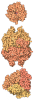
- Assembly
| Deposited unit | 
|
|---|---|
| 1 |
|
-Components
-Translation initiation factor eIF-2B subunit ... , 4 types, 8 molecules ABEFGHIJ
| #1: Protein | Mass: 80466.609 Da / Num. of mol.: 2 Source method: isolated from a genetically manipulated source Source: (gene. exp.) Homo sapiens (human) / Gene: EIF2B5, EIF2BE / Production host:   Escherichia coli (E. coli) / References: UniProt: Q13144 Escherichia coli (E. coli) / References: UniProt: Q13144#3: Protein | Mass: 57640.168 Da / Num. of mol.: 2 Source method: isolated from a genetically manipulated source Source: (gene. exp.) Homo sapiens (human) / Gene: EIF2B4, EIF2BD / Production host: Escherichia coli (E. coli) / References: UniProt: Q9UI10#4: Protein | Mass: 33754.148 Da / Num. of mol.: 2 Source method: isolated from a genetically manipulated source Source: (gene. exp.) Homo sapiens (human) / Gene: EIF2B1, EIF2BA / Production host: Escherichia coli (E. coli) / References: UniProt: Q14232#5: Protein | Mass: 50304.230 Da / Num. of mol.: 2 Source method: isolated from a genetically manipulated source Source: (gene. exp.) Homo sapiens (human) / Gene: EIF2B3 / Production host: Escherichia coli (E. coli) / References: UniProt: Q9NR50 |
|---|
-Protein , 2 types, 3 molecules CDK
| #2: Protein | Mass: 39438.922 Da / Num. of mol.: 2 Source method: isolated from a genetically manipulated source Details: latch-helix deletion / Source: (gene. exp.) Homo sapiens (human) / Gene: EIF2B2, EIF2BB / Production host: Escherichia coli (E. coli) / References: UniProt: P49770#6: Protein | | Mass: 23715.584 Da / Num. of mol.: 1 Source method: isolated from a genetically manipulated source Source: (gene. exp.) Beluga whale coronavirus SW1 / Gene: ORF10 / Production host: Escherichia coli (E. coli) / References: UniProt: B2BW43, uridine/cytidine kinase |
|---|
-Non-polymers , 4 types, 10 molecules 

| #7: Chemical |  Mass: 35.453 Da / Num. of mol.: 3 / Source method: obtained synthetically / Formula: Cl Mass: 35.453 Da / Num. of mol.: 3 / Source method: obtained synthetically / Formula: Cl#8: Chemical | 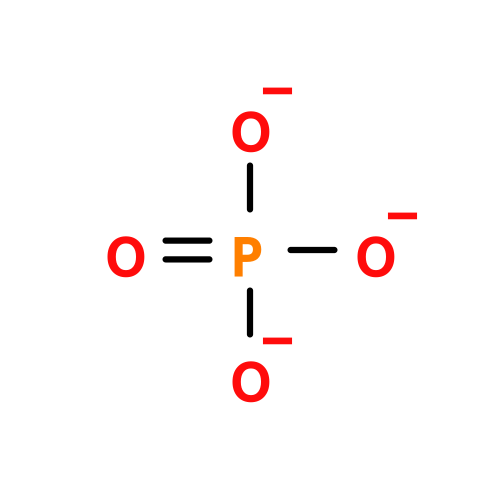 Mass: 94.971 Da / Num. of mol.: 3 / Source method: obtained synthetically / Formula: PO4 Mass: 94.971 Da / Num. of mol.: 3 / Source method: obtained synthetically / Formula: PO4#9: Chemical |  Mass: 65.409 Da / Num. of mol.: 2 / Source method: obtained synthetically / Formula: Zn Mass: 65.409 Da / Num. of mol.: 2 / Source method: obtained synthetically / Formula: Zn#10: Water | ChemComp-HOH / | Mass: 18.015 Da / Num. of mol.: 2 / Source method: isolated from a natural source / Formula: H2O |
|---|
-Details
| Has ligand of interest | N |
|---|---|
| Has protein modification | N |
-Experimental details
-Experiment
| Experiment | Method: ELECTRON MICROSCOPY |
|---|---|
| EM experiment | Aggregation state: PARTICLE / 3D reconstruction method: single particle reconstruction |
- Sample preparation
| Component |
| |||||||||||||||||||||||||
|---|---|---|---|---|---|---|---|---|---|---|---|---|---|---|---|---|---|---|---|---|---|---|---|---|---|---|
| Molecular weight |
| |||||||||||||||||||||||||
| Source (natural) |
| |||||||||||||||||||||||||
| Source (recombinant) |
| |||||||||||||||||||||||||
| Buffer solution | pH: 7.4 Details: 20 mM HEPES KOH pH 7.4, 200 mM KCl, 5 mM MgCl2, 1 mM TCEP | |||||||||||||||||||||||||
| Buffer component |
| |||||||||||||||||||||||||
| Specimen | Conc.: 6 mg/ml / Embedding applied: NO / Shadowing applied: NO / Staining applied: NO / Vitrification applied: YES | |||||||||||||||||||||||||
| Specimen support | Grid material: GOLD / Grid mesh size: 400 divisions/in. / Grid type: Quantifoil R1.2/1.3 | |||||||||||||||||||||||||
| Vitrification | Instrument: FEI VITROBOT MARK IV / Cryogen name: ETHANE / Humidity: 95 % / Chamber temperature: 277 K |
- Electron microscopy imaging
| Experimental equipment |  Model: Titan Krios / Image courtesy: FEI Company |
|---|---|
| Microscopy | Model: TFS KRIOS |
| Electron gun | Electron source:  FIELD EMISSION GUN / Accelerating voltage: 300 kV / Illumination mode: FLOOD BEAM FIELD EMISSION GUN / Accelerating voltage: 300 kV / Illumination mode: FLOOD BEAM |
| Electron lens | Mode: BRIGHT FIELD / Nominal magnification: 130000 X / Nominal defocus max: 1600 nm / Nominal defocus min: 600 nm / Cs: 2.7 mm / C2 aperture diameter: 50 µm |
| Specimen holder | Cryogen: NITROGEN / Specimen holder model: FEI TITAN KRIOS AUTOGRID HOLDER |
| Image recording | Electron dose: 50 e/Å2 / Film or detector model: TFS FALCON 4i (4k x 4k) / Num. of grids imaged: 1 / Num. of real images: 5000 |
| EM imaging optics | Energyfilter name: TFS Selectris / Energyfilter slit width: 10 eV |
| Image scans | Width: 4096 / Height: 4096 |
- Processing
| EM software |
| ||||||||||||||||||||||||||||||||||||||||
|---|---|---|---|---|---|---|---|---|---|---|---|---|---|---|---|---|---|---|---|---|---|---|---|---|---|---|---|---|---|---|---|---|---|---|---|---|---|---|---|---|---|
| CTF correction | Type: PHASE FLIPPING AND AMPLITUDE CORRECTION | ||||||||||||||||||||||||||||||||||||||||
| Particle selection | Num. of particles selected: 867729 | ||||||||||||||||||||||||||||||||||||||||
| Symmetry | Point symmetry: C1 (asymmetric) | ||||||||||||||||||||||||||||||||||||||||
| 3D reconstruction | Resolution: 2.4 Å / Resolution method: FSC 0.143 CUT-OFF / Num. of particles: 112494 / Num. of class averages: 1 / Symmetry type: POINT | ||||||||||||||||||||||||||||||||||||||||
| Atomic model building | Protocol: AB INITIO MODEL | ||||||||||||||||||||||||||||||||||||||||
| Atomic model building |
|

