 Movie
Movie Controller

[English] 日本語
 Yorodumi
- PDB-9y45: His-tagged beta galactosidase (LacZ) on a Ni-NTA lipid monolayer grid -
+ Open data

- Basic information
| Entry | Database: PDB / ID: 9y45 | ||||||
|---|---|---|---|---|---|---|---|
| Title | His-tagged beta galactosidase (LacZ) on a Ni-NTA lipid monolayer grid | ||||||
 Components Components | Beta-galactosidase | ||||||
 Keywords Keywords | HYDROLASE / beta galactosidase | ||||||
| Function / homology |  Function and homology information Function and homology informationalkali metal ion binding / lactose catabolic process / beta-galactosidase complex / beta-galactosidase / beta-galactosidase activity / carbohydrate binding / magnesium ion binding / identical protein binding Similarity search - Function | ||||||
| Biological species |   Escherichia coli (E. coli) Escherichia coli (E. coli) | ||||||
| Method | ELECTRON MICROSCOPY / single particle reconstruction / cryo EM / Resolution: 2.41 Å | ||||||
 Authors Authors | Baker, R.W. / Strauss, J.D. | ||||||
| Funding support |  United States, 1items United States, 1items
| ||||||
 Citation Citation | Journal: J Struct Biol / Year: 2025 Title: Nickel-NTA lipid-monolayer affinity grids allow for high-resolution structure determination by cryo-EM. Authors: Aleksandra Skrajna / Clara Lenger / Emily Robinson / Kevin Cannon / Reta Sarsam / Richard G Ouellette / Alberta M Abotsi / Patrick Brennwald / Robert K McGinty / Joshua D Strauss / Richard W Baker / Abstract: Grid preparation is a rate-limiting step in determining high-resolution structures by single particle cryo-EM. Particle interaction with the air-water interface often leads to denaturation, ...Grid preparation is a rate-limiting step in determining high-resolution structures by single particle cryo-EM. Particle interaction with the air-water interface often leads to denaturation, aggregation, or a preferred orientation within the ice. Some samples yield insufficient quantities of particles when using traditional grid making techniques and require the use of solid supports that concentrate samples onto the grid. Recent advances in grid-preparation show that affinity grids are promising tools to selectively concentrate proteins while simultaneously protecting samples from the air-water interface. One such technique utilizes lipid monolayers containing a lipid species with an affinity handle. Some of the first affinity grids used a holey carbon layer coated with nickel nitrilotriacetic acid (Ni-NTA) lipid, which allowed for the binding of proteins bearing the commonly used poly-histidine affinity tag. These studies however used complicated protocols and were conducted before the "resolution revolution" of cryo-EM. Here, we provide a straightforward preparation method and systematic analysis of Ni-NTA lipid monolayers as a tool for high-resolution single particle cryo-EM. We found the lipid affinity grids concentrate particles away from the AWI in thin ice (∼30 nm). We determined three structures ranging from 2.4 to 3.0 Å resolution, showing this method is amenable to high-resolution. Furthermore, we determined a 3.1 Å structure of a sub-100 kDa protein without symmetry, demonstrating the utility for a range of biological macromolecules. Lipid monolayers are therefore an easily extendable tool for most systems and help alleviate common problems such as low yield, disruption by the air-water interface, and thicker ice. | ||||||
| History |
|
- Structure visualization
| Structure viewer | Molecule: MolmilJmol/JSmol |
|---|
- Downloads & links
-Download
| PDBx/mmCIF format | 9y45.cif.gz | 786.2 KB | Display | PDBx/mmCIF format |
|---|---|---|---|---|
| PDB format | pdb9y45.ent.gz | 642.8 KB | Display | PDB format |
| PDBx/mmJSON format | 9y45.json.gz | Tree view | PDBx/mmJSON format | |
| Others |  Other downloads Other downloads |
-Validation report
| Arichive directory | https://data.pdbj.org/pub/pdb/validation_reports/y4/9y45ftp://data.pdbj.org/pub/pdb/validation_reports/y4/9y45 | HTTPS FTP |
|---|
-Related structure data
| Related structure data |  72471MC  9y46C  9y47C  9y48C  9y4aC M: map data used to model this data C: citing same article ( |
|---|---|
| Similar structure data |


-Links
 PDBj
PDBj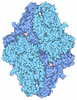
- Assembly
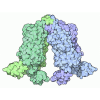
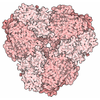
| Deposited unit | 
|
|---|---|
| 1 |
|
-Components
| #1: Protein | Mass: 117431.328 Da / Num. of mol.: 4 Source method: isolated from a genetically manipulated source Source: (gene. exp.) Escherichia coli (E. coli) / Gene: lacZ, b0344, JW0335 / Production host: Escherichia coli (E. coli) / References: UniProt: P00722, beta-galactosidase#2: Chemical | ChemComp-MG /  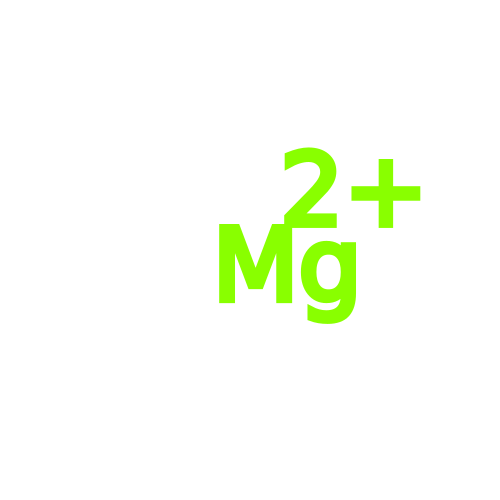 Mass: 24.305 Da / Num. of mol.: 8 / Source method: obtained synthetically / Formula: Mg Mass: 24.305 Da / Num. of mol.: 8 / Source method: obtained synthetically / Formula: Mg#3: Chemical | ChemComp-NA /   Mass: 22.990 Da / Num. of mol.: 4 / Source method: obtained synthetically / Formula: Na Mass: 22.990 Da / Num. of mol.: 4 / Source method: obtained synthetically / Formula: Na#4: Water | ChemComp-HOH / |  Mass: 18.015 Da / Num. of mol.: 12 / Source method: isolated from a natural source / Formula: H2O Mass: 18.015 Da / Num. of mol.: 12 / Source method: isolated from a natural source / Formula: H2OHas ligand of interest | N | Has protein modification | N | |
|---|
-Experimental details
-Experiment
| Experiment | Method: ELECTRON MICROSCOPY |
|---|---|
| EM experiment | Aggregation state: PARTICLE / 3D reconstruction method: single particle reconstruction |
- Sample preparation
| Component | Name: Beta Galactosidase (LacZ) / Type: COMPLEX / Entity ID: #1 / Source: RECOMBINANT |
|---|---|
| Source (natural) | Organism: Escherichia coli (E. coli) |
| Source (recombinant) | Organism: Escherichia coli (E. coli) |
| Buffer solution | pH: 8 |
| Specimen | Conc.: 0.19 mg/ml / Embedding applied: NO / Shadowing applied: NO / Staining applied: NO / Vitrification applied: YES |
| Specimen support | Grid type: Quantifoil |
| Vitrification | Cryogen name: ETHANE-PROPANE |
- Electron microscopy imaging
| Microscopy | Model: TFS TALOS |
|---|---|
| Electron gun | Electron source:  FIELD EMISSION GUN / Accelerating voltage: 200 kV / Illumination mode: FLOOD BEAM FIELD EMISSION GUN / Accelerating voltage: 200 kV / Illumination mode: FLOOD BEAM |
| Electron lens | Mode: BRIGHT FIELD / Nominal defocus max: 2000 nm / Nominal defocus min: 400 nm / Alignment procedure: COMA FREE |
| Specimen holder | Cryogen: NITROGEN |
| Image recording | Electron dose: 55 e/Å2 / Film or detector model: GATAN K3 (6k x 4k) |
- Processing
| EM software |
| ||||||||||||||||||||||||||||||||||||||||
|---|---|---|---|---|---|---|---|---|---|---|---|---|---|---|---|---|---|---|---|---|---|---|---|---|---|---|---|---|---|---|---|---|---|---|---|---|---|---|---|---|---|
| CTF correction | Type: PHASE FLIPPING AND AMPLITUDE CORRECTION | ||||||||||||||||||||||||||||||||||||||||
| Symmetry | Point symmetry: D2 (2x2 fold dihedral) | ||||||||||||||||||||||||||||||||||||||||
| 3D reconstruction | Resolution: 2.41 Å / Resolution method: FSC 0.143 CUT-OFF / Num. of particles: 515041 / Symmetry type: POINT | ||||||||||||||||||||||||||||||||||||||||
| Atomic model building | Protocol: RIGID BODY FIT / Space: REAL | ||||||||||||||||||||||||||||||||||||||||
| Atomic model building | PDB-ID: 1PX3 Accession code: 1PX3 / Source name: PDB / Type: experimental model |

