[English] 日本語
Yorodumi
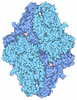
- EMDB-72471: His-tagged beta galactosidase (LacZ) on a Ni-NTA lipid monolayer grid -

+
Open data


ID or keywords:

Loading...

-
Basic information

Entry
Database: EMDB / ID: EMD-72471
TitleHis-tagged beta galactosidase (LacZ) on a Ni-NTA lipid monolayer grid
Map dataB-factor sharpened map
Sample
  • Complex: Beta Galactosidase (LacZ)
    • Protein or peptide: Beta-galactosidase
  • Ligand: MAGNESIUM ION
  • Ligand: SODIUM ION
  • Ligand: water
Keywordsbeta galactosidase / HYDROLASE
Function / homology
Function and homology information


alkali metal ion binding / lactose catabolic process / beta-galactosidase complex / beta-galactosidase / beta-galactosidase activity / carbohydrate binding / magnesium ion binding / identical protein binding
Similarity search - Function
Glycoside hydrolase, family 2, beta-galactosidase / Beta galactosidase small chain/ domain 5 / Beta-galactosidase, domain 4 / Beta galactosidase small chain / Beta-galactosidase, domain 4 / Beta galactosidase small chain / : / Glycoside hydrolase, family 2, active site / Glycosyl hydrolases family 2 acid/base catalyst. / Glycoside hydrolase, family 2, conserved site ...Glycoside hydrolase, family 2, beta-galactosidase / Beta galactosidase small chain/ domain 5 / Beta-galactosidase, domain 4 / Beta galactosidase small chain / Beta-galactosidase, domain 4 / Beta galactosidase small chain / : / Glycoside hydrolase, family 2, active site / Glycosyl hydrolases family 2 acid/base catalyst. / Glycoside hydrolase, family 2, conserved site / Glycosyl hydrolases family 2 signature 1. / Glycoside hydrolase, family 2 / Glycosyl hydrolases family 2, sugar binding domain / Glycoside hydrolase family 2, catalytic domain / Glycosyl hydrolases family 2, sugar binding domain / Glycosyl hydrolases family 2, TIM barrel domain / Glycoside hydrolase, family 2, immunoglobulin-like beta-sandwich / Glycosyl hydrolases family 2 / Beta-Galactosidase/glucuronidase domain superfamily / Glycoside hydrolase-type carbohydrate-binding / Galactose mutarotase-like domain superfamily / Galactose-binding-like domain superfamily / Glycoside hydrolase superfamily / Immunoglobulin-like fold
Similarity search - Domain/homology
Biological speciesEscherichia coli (E. coli)
Methodsingle particle reconstruction / cryo EM / Resolution: 2.41 Å
AuthorsBaker RW / Strauss JD
Funding support United States, 1 items
OrganizationGrant numberCountry
National Institutes of Health/National Institute of General Medical Sciences (NIH/NIGMS)R35 GM150960 United States
CitationJournal: J Struct Biol / Year: 2025
Title: Nickel-NTA lipid-monolayer affinity grids allow for high-resolution structure determination by cryo-EM.
Authors: Aleksandra Skrajna / Clara Lenger / Emily Robinson / Kevin Cannon / Reta Sarsam / Richard G Ouellette / Alberta M Abotsi / Patrick Brennwald / Robert K McGinty / Joshua D Strauss / Richard W Baker /
Abstract: Grid preparation is a rate-limiting step in determining high-resolution structures by single particle cryo-EM. Particle interaction with the air-water interface often leads to denaturation, ...Grid preparation is a rate-limiting step in determining high-resolution structures by single particle cryo-EM. Particle interaction with the air-water interface often leads to denaturation, aggregation, or a preferred orientation within the ice. Some samples yield insufficient quantities of particles when using traditional grid making techniques and require the use of solid supports that concentrate samples onto the grid. Recent advances in grid-preparation show that affinity grids are promising tools to selectively concentrate proteins while simultaneously protecting samples from the air-water interface. One such technique utilizes lipid monolayers containing a lipid species with an affinity handle. Some of the first affinity grids used a holey carbon layer coated with nickel nitrilotriacetic acid (Ni-NTA) lipid, which allowed for the binding of proteins bearing the commonly used poly-histidine affinity tag. These studies however used complicated protocols and were conducted before the "resolution revolution" of cryo-EM. Here, we provide a straightforward preparation method and systematic analysis of Ni-NTA lipid monolayers as a tool for high-resolution single particle cryo-EM. We found the lipid affinity grids concentrate particles away from the AWI in thin ice (∼30 nm). We determined three structures ranging from 2.4 to 3.0 Å resolution, showing this method is amenable to high-resolution. Furthermore, we determined a 3.1 Å structure of a sub-100 kDa protein without symmetry, demonstrating the utility for a range of biological macromolecules. Lipid monolayers are therefore an easily extendable tool for most systems and help alleviate common problems such as low yield, disruption by the air-water interface, and thicker ice.
History
DepositionSep 2, 2025-
Header (metadata) releaseNov 26, 2025-
Map releaseNov 26, 2025-
UpdateNov 26, 2025-
Current statusNov 26, 2025Processing site: RCSB / Status: Released

-
Structure visualization

Supplemental images

Downloads & links

-
Map

FileDownload / File: emd_72471.map.gz / Format: CCP4 / Size: 325 MB / Type: IMAGE STORED AS FLOATING POINT NUMBER (4 BYTES)
AnnotationB-factor sharpened map
Projections & slices

Image control

Size
Brightness
Contrast
Others
AxesZ (Sec.)Y (Row.)X (Col.)
0.87 Å/pix.
x 440 pix.
= 384.428 Å
0.87 Å/pix.
x 440 pix.
= 384.428 Å
0.87 Å/pix.
x 440 pix.
= 384.428 Å

Surface

Projections

Slices (1/3)

Slices (1/2)

Slices (2/3)

Images are generated by Spider.

Voxel sizeX=Y=Z: 0.8737 Å
Density
Contour LevelBy AUTHOR: 0.1
Minimum - Maximum-1.8572786 - 2.7201579
Average (Standard dev.)0.000013209566 (±0.06638489)
SymmetrySpace group: 1
Details

EMDB XML:

Map geometry
Axis orderXYZ
Origin000
Dimensions440440440
Spacing440440440
CellA=B=C: 384.428 Å
α=β=γ: 90.0 °

-
Supplemental data

-
Mask #1

Fileemd_72471_msk_1.map
Projections & Slices
AxesZYX

Projections

Slices (1/2)
Density Histograms

-
Mask #2

Fileemd_72471_msk_2.map
Projections & Slices
AxesZYX

Projections

Slices (1/2)
Density Histograms

-
Additional map: deepEMhancer sharpened map

Fileemd_72471_additional_1.map
AnnotationdeepEMhancer sharpened map
Projections & Slices
AxesZYX

Projections

Slices (1/2)
Density Histograms

-
Additional map: Full map

Fileemd_72471_additional_2.map
AnnotationFull map
Projections & Slices
AxesZYX

Projections

Slices (1/2)
Density Histograms

-
Additional map: Locres file for coloring by local resolution

Fileemd_72471_additional_3.map
AnnotationLocres file for coloring by local resolution
Projections & Slices
AxesZYX

Projections

Slices (1/2)
Density Histograms

-
Additional map: Map filtered by local resolution

Fileemd_72471_additional_4.map
AnnotationMap filtered by local resolution
Projections & Slices
AxesZYX

Projections

Slices (1/2)
Density Histograms

-
Half map: Half-map 1

Fileemd_72471_half_map_1.map
AnnotationHalf-map 1
Projections & Slices
AxesZYX

Projections

Slices (1/2)
Density Histograms

-
Half map: Half map 2

Fileemd_72471_half_map_2.map
AnnotationHalf map 2
Projections & Slices
AxesZYX

Projections

Slices (1/2)
Density Histograms

-
Sample components

-
Entire : Beta Galactosidase (LacZ)

EntireName: Beta Galactosidase (LacZ)
Components
  • Complex: Beta Galactosidase (LacZ)
    • Protein or peptide: Beta-galactosidase
  • Ligand: MAGNESIUM ION
  • Ligand: SODIUM ION
  • Ligand: water

-
Supramolecule #1: Beta Galactosidase (LacZ)

SupramoleculeName: Beta Galactosidase (LacZ) / type: complex / ID: 1 / Parent: 0 / Macromolecule list: #1
Source (natural)Organism: Escherichia coli (E. coli)

-
Macromolecule #1: Beta-galactosidase

MacromoleculeName: Beta-galactosidase / type: protein_or_peptide / ID: 1 / Number of copies: 4 / Enantiomer: LEVO / EC number: beta-galactosidase
Source (natural)Organism: Escherichia coli (E. coli)
Molecular weightTheoretical: 117.431328 KDa
Recombinant expressionOrganism: Escherichia coli (E. coli)
SequenceString: MTMITDSLAV VLQRRDWENP GVTQLNRLAA HPPFASWRNS EEARTDRPSQ QLRSLNGEWR FAWFPAPEAV PESWLECDLP EADTVVVPS NWQMHGYDAP IYTNVTYPIT VNPPFVPTEN PTGCYSLTFN VDESWLQEGQ TRIIFDGVNS AFHLWCNGRW V GYGQDSRL ...String:
MTMITDSLAV VLQRRDWENP GVTQLNRLAA HPPFASWRNS EEARTDRPSQ QLRSLNGEWR FAWFPAPEAV PESWLECDLP EADTVVVPS NWQMHGYDAP IYTNVTYPIT VNPPFVPTEN PTGCYSLTFN VDESWLQEGQ TRIIFDGVNS AFHLWCNGRW V GYGQDSRL PSEFDLSAFL RAGENRLAVM VLRWSDGSYL EDQDMWRMSG IFRDVSLLHK PTTQISDFHV ATRFNDDFSR AV LEAEVQM CGELRDYLRV TVSLWQGETQ VASGTAPFGG EIIDERGGYA DRVTLRLNVE NPKLWSAEIP NLYRAVVELH TAD GTLIEA EACDVGFREV RIENGLLLLN GKPLLIRGVN RHEHHPLHGQ VMDEQTMVQD ILLMKQNNFN AVRCSHYPNH PLWY TLCDR YGLYVVDEAN IETHGMVPMN RLTDDPRWLP AMSERVTRMV QRDRNHPSVI IWSLGNESGH GANHDALYRW IKSVD PSRP VQYEGGGADT TATDIICPMY ARVDEDQPFP AVPKWSIKKW LSLPGETRPL ILCEYAHAMG NSLGGFAKYW QAFRQY PRL QGGFVWDWVD QSLIKYDENG NPWSAYGGDF GDTPNDRQFC MNGLVFADRT PHPALTEAKH QQQFFQFRLS GQTIEVT SE YLFRHSDNEL LHWMVALDGK PLASGEVPLD VAPQGKQLIE LPELPQPESA GQLWLTVRVV QPNATAWSEA GHISAWQQ W RLAENLSVTL PAASHAIPHL TTSEMDFCIE LGNKRWQFNR QSGFLSQMWI GDKKQLLTPL RDQFTRAPLD NDIGVSEAT RIDPNAWVER WKAAGHYQAE AALLQCTADT LADAVLITTA HAWQHQGKTL FISRKTYRID GSGQMAITVD VEVASDTPHP ARIGLNCQL AQVAERVNWL GLGPQENYPD RLTAACFDRW DLPLSDMYTP YVFPSENGLR CGTRELNYGP HQWRGDFQFN I SRYSQQQL METSHRHLLH AEEGTWLNID GFHMGIGGDD SWSPSVSAEF QLSAGRYHYQ LVWCQKHHHH HH

UniProtKB: Beta-galactosidase

-
Macromolecule #2: MAGNESIUM ION

MacromoleculeName: MAGNESIUM ION / type: ligand / ID: 2 / Number of copies: 8 / Formula: MG
Molecular weightTheoretical: 24.305 Da

-
Macromolecule #3: SODIUM ION

MacromoleculeName: SODIUM ION / type: ligand / ID: 3 / Number of copies: 4
Molecular weightTheoretical: 22.99 Da

-
Macromolecule #4: water

MacromoleculeName: water / type: ligand / ID: 4 / Number of copies: 12 / Formula: HOH
Molecular weightTheoretical: 18.015 Da
Chemical component information

ChemComp-HOH:
WATER

-
Experimental details

-
Structure determination

Methodcryo EM
Processingsingle particle reconstruction
Aggregation stateparticle

-
Sample preparation

Concentration0.19 mg/mL
BufferpH: 8
GridModel: Quantifoil / Support film - Material: CARBON
VitrificationCryogen name: ETHANE-PROPANE

-
Electron microscopy

MicroscopeTFS TALOS
Image recordingFilm or detector model: GATAN K3 (6k x 4k) / Average electron dose: 55.0 e/Å2
Electron beamAcceleration voltage: 200 kV / Electron source: FIELD EMISSION GUN
Electron opticsIllumination mode: FLOOD BEAM / Imaging mode: BRIGHT FIELD / Nominal defocus max: 2.0 µm / Nominal defocus min: 0.4 µm
Sample stageCooling holder cryogen: NITROGEN

+
Image processing

CTF correctionSoftware - Name: cryoSPARC / Type: PHASE FLIPPING AND AMPLITUDE CORRECTION
Startup modelType of model: PDB ENTRY
PDB model - PDB ID:
Final reconstructionApplied symmetry - Point group: D2 (2x2 fold dihedral) / Resolution.type: BY AUTHOR / Resolution: 2.41 Å / Resolution method: FSC 0.143 CUT-OFF / Software - Name: cryoSPARC / Number images used: 515041
Initial angle assignmentType: OTHER / Software - Name: cryoSPARC
Final angle assignmentType: OTHER / Software - Name: cryoSPARC
FSC plot (resolution estimation)

-
Atomic model buiding 1

Initial modelPDB ID:

Chain - Source name: PDB / Chain - Initial model type: experimental model
RefinementSpace: REAL / Protocol: RIGID BODY FIT
Output model

PDB-9y45:
His-tagged beta galactosidase (LacZ) on a Ni-NTA lipid monolayer grid

+
About Yorodumi

-
News

-
Feb 9, 2022. New format data for meta-information of EMDB entries

New format data for meta-information of EMDB entries

  • Version 3 of the EMDB header file is now the official format.
  • The previous official version 1.9 will be removed from the archive.

Related info.:EMDB header

External links:wwPDB to switch to version 3 of the EMDB data model

-
Aug 12, 2020. Covid-19 info

Covid-19 info

URL: https://pdbj.org/emnavi/covid19.php

New page: Covid-19 featured information page in EM Navigator.

Related info.:Covid-19 info / Mar 5, 2020. Novel coronavirus structure data

+
Mar 5, 2020. Novel coronavirus structure data

Novel coronavirus structure data

Related info.:Yorodumi Speices / Aug 12, 2020. Covid-19 info

External links:COVID-19 featured content - PDBj / Molecule of the Month (242):Coronavirus Proteases

+
Jan 31, 2019. EMDB accession codes are about to change! (news from PDBe EMDB page)

EMDB accession codes are about to change! (news from PDBe EMDB page)

  • The allocation of 4 digits for EMDB accession codes will soon come to an end. Whilst these codes will remain in use, new EMDB accession codes will include an additional digit and will expand incrementally as the available range of codes is exhausted. The current 4-digit format prefixed with “EMD-” (i.e. EMD-XXXX) will advance to a 5-digit format (i.e. EMD-XXXXX), and so on. It is currently estimated that the 4-digit codes will be depleted around Spring 2019, at which point the 5-digit format will come into force.
  • The EM Navigator/Yorodumi systems omit the EMD- prefix.

Related info.:Q: What is EMD? / ID/Accession-code notation in Yorodumi/EM Navigator

External links:EMDB Accession Codes are Changing Soon! / Contact to PDBj

+
Jul 12, 2017. Major update of PDB

Major update of PDB

  • wwPDB released updated PDB data conforming to the new PDBx/mmCIF dictionary.
  • This is a major update changing the version number from 4 to 5, and with Remediation, in which all the entries are updated.
  • In this update, many items about electron microscopy experimental information are reorganized (e.g. em_software).
  • Now, EM Navigator and Yorodumi are based on the updated data.

External links:wwPDB Remediation / Enriched Model Files Conforming to OneDep Data Standards Now Available in the PDB FTP Archive

-
Yorodumi

Thousand views of thousand structures

  • Yorodumi is a browser for structure data from EMDB, PDB, SASBDB, etc.
  • This page is also the successor to EM Navigator detail page, and also detail information page/front-end page for Omokage search.
  • The word "yorodu" (or yorozu) is an old Japanese word meaning "ten thousand". "mi" (miru) is to see.

Related info.:EMDB / PDB / SASBDB / Comparison of 3 databanks / Yorodumi Search / Aug 31, 2016. New EM Navigator & Yorodumi / Yorodumi Papers / Jmol/JSmol / Function and homology information / Changes in new EM Navigator and Yorodumi

Read more