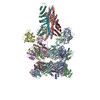
Movie
Movie Controller

[English] 日本語
 Yorodumi
- PDB-9ojj: sx20S complex (NSF-alphaSNAP-syntaxin-1a), 4:4 alphaSNAP-syntaxin... -
+ Open data

- Basic information
| Entry | Database: PDB / ID: 9ojj | ||||||||||||
|---|---|---|---|---|---|---|---|---|---|---|---|---|---|
| Title | sx20S complex (NSF-alphaSNAP-syntaxin-1a), 4:4 alphaSNAP-syntaxin-1a subcomplex local refinement, non-hydrolyzing, class 1 | ||||||||||||
 Components Components |
| ||||||||||||
 Keywords Keywords | HYDROLASE / ATPase / SNARE / hydrolysis / disassembly / translocation / exocytosis / neurotransmitter release / synapse / synaptic transmission / membrane fusion | ||||||||||||
| Function / homology |  Function and homology information Function and homology informationIntra-Golgi traffic / Retrograde transport at the Trans-Golgi-Network / COPI-dependent Golgi-to-ER retrograde traffic / COPI-mediated anterograde transport / soluble NSF attachment protein activity / lamellar body / myosin head/neck binding / Other interleukin signaling / synaptobrevin 2-SNAP-25-syntaxin-1a-complexin II complex / synaptobrevin 2-SNAP-25-syntaxin-1a-complexin I complex ...Intra-Golgi traffic / Retrograde transport at the Trans-Golgi-Network / COPI-dependent Golgi-to-ER retrograde traffic / COPI-mediated anterograde transport / soluble NSF attachment protein activity / lamellar body / myosin head/neck binding / Other interleukin signaling / synaptobrevin 2-SNAP-25-syntaxin-1a-complexin II complex / synaptobrevin 2-SNAP-25-syntaxin-1a-complexin I complex / synaptobrevin 2-SNAP-25-syntaxin-1a complex / Glutamate Neurotransmitter Release Cycle / Norepinephrine Neurotransmitter Release Cycle / Acetylcholine Neurotransmitter Release Cycle / Serotonin Neurotransmitter Release Cycle / GABA synthesis, release, reuptake and degradation / protein-containing complex disassembly / positive regulation of catecholamine secretion / positive regulation of norepinephrine secretion / Dopamine Neurotransmitter Release Cycle / COPII-mediated vesicle transport / hormone secretion / regulation of synaptic vesicle priming / Golgi Associated Vesicle Biogenesis / : / regulated exocytosis / secretion by cell / Insertion of tail-anchored proteins into the endoplasmic reticulum membrane / calcium-ion regulated exocytosis / SNARE complex disassembly / positive regulation of calcium ion-dependent exocytosis / positive regulation of neurotransmitter secretion / : / chloride channel inhibitor activity / regulation of exocytosis / protein carrier activity / SNARE complex / SNAP receptor activity / vesicle fusion / actomyosin / LGI-ADAM interactions / positive regulation of ATP-dependent activity / ATP-dependent protein binding / cytoplasmic side of membrane / insulin secretion / apical protein localization / syntaxin binding / protein localization to membrane / exocytosis / myosin binding / SNARE complex assembly / synaptic vesicle priming / response to gravity / synaptic vesicle exocytosis / neurotransmitter transport / positive regulation of exocytosis / response to hyperoxia / regulation of dopamine secretion / modulation of excitatory postsynaptic potential / protein sumoylation / synaptic vesicle endocytosis / calcium channel inhibitor activity / presynaptic active zone membrane / secretory granule / acrosomal vesicle / positive regulation of excitatory postsynaptic potential / brain development / SNARE binding / synaptic membrane / neuromuscular junction / synaptic transmission, glutamatergic / intracellular protein transport / postsynaptic density membrane / Schaffer collateral - CA1 synapse / kinase binding / calcium-dependent protein binding / terminal bouton / synaptic vesicle membrane / neuron differentiation / presynapse / synaptic vesicle / nuclear membrane / cytoplasmic vesicle / presynaptic membrane / membrane fusion / perikaryon / transmembrane transporter binding / postsynapse / protein-macromolecule adaptor activity / postsynaptic membrane / neuron projection / axon / dendrite / protein-containing complex binding / glutamatergic synapse / protein-containing complex / mitochondrion / membrane / identical protein binding / plasma membrane Similarity search - Function | ||||||||||||
| Biological species |   Rattus norvegicus (Norway rat) Rattus norvegicus (Norway rat) | ||||||||||||
| Method | ELECTRON MICROSCOPY / single particle reconstruction / cryo EM / Resolution: 4.07 Å | ||||||||||||
 Authors Authors | White, K.I. / Brunger, A.T. | ||||||||||||
| Funding support |  United States, 3items United States, 3items
| ||||||||||||
 Citation Citation | Journal: Nat Commun / Year: 2025 Title: Structural remodeling of target-SNARE protein complexes by NSF enables synaptic transmission. Authors: K Ian White / Yousuf A Khan / Kangqiang Qiu / Ashwin Balaji / Sergio Couoh-Cardel / Luis Esquivies / Richard A Pfuetzner / Jiajie Diao / Axel T Brunger / Abstract: Synaptic vesicles containing neurotransmitters fuse with the plasma membrane upon the arrival of an action potential at the active zone. Multiple proteins organize trans-SNARE complex assembly and ...Synaptic vesicles containing neurotransmitters fuse with the plasma membrane upon the arrival of an action potential at the active zone. Multiple proteins organize trans-SNARE complex assembly and priming, leading to fusion. One target membrane SNARE, syntaxin, forms nanodomains at the active zone, and another, SNAP-25, enters non-fusogenic complexes with it. Here, we reveal mechanistic details of AAA+ protein NSF (N-ethylmaleimide sensitive factor) and SNAP (soluble NSF attachment protein) action before fusion. We show that syntaxin clusters are conserved, that NSF colocalizes with them, and characterize SNARE populations that may exist within or near them using cryo-EM. Supercomplexes of NSF, α-SNAP, and either a syntaxin tetramer or one of two binary complexes of syntaxin-SNAP-25 reveal atomic details of SNARE processing and show how sequential ATP hydrolysis drives disassembly. These results suggest a functional role for syntaxin clusters as reservoirs and a corresponding role for NSF in syntaxin liberation and SNARE protein quality control preceding fusion. | ||||||||||||
| History |
|
- Structure visualization
| Structure viewer | Molecule: MolmilJmol/JSmol |
|---|
- Downloads & links
-Download
| PDBx/mmCIF format | 9ojj.cif.gz | 456.8 KB | Display | PDBx/mmCIF format |
|---|---|---|---|---|
| PDB format | pdb9ojj.ent.gz | 374 KB | Display | PDB format |
| PDBx/mmJSON format | 9ojj.json.gz | Tree view | PDBx/mmJSON format | |
| Others |  Other downloads Other downloads |
-Validation report
| Arichive directory | https://data.pdbj.org/pub/pdb/validation_reports/oj/9ojjftp://data.pdbj.org/pub/pdb/validation_reports/oj/9ojj | HTTPS FTP |
|---|
-Related structure data
| Related structure data |  70536MC  9oj2C  9ojrC  9ojuC  9ojzC  9ok3C  9ok5C  9okcC  9oljC  9oloC  9om6C  9omqC  9pafC  9pagC  9pb9C  9pbaC  9pbfC  9pbvC  9pc3C  9pcxC  9pczC  9pd1C  9pd8C  9pdbC  9pddC  9pf2C  9pfcC  9pffC  9pfgC C: citing same article ( M: map data used to model this data |
|---|---|
| Similar structure data |


-Links
 PDBj
PDBj
- Assembly
| Deposited unit | 
|
|---|---|
| 1 |
|
-Components
| #1: Protein | Mass: 29350.803 Da / Num. of mol.: 4 / Fragment: residues 1-253 Source method: isolated from a genetically manipulated source Source: (gene. exp.) Rattus norvegicus (Norway rat) / Gene: Stx1a, Sap / Production host:   Escherichia coli (E. coli) / References: UniProt: P32851 Escherichia coli (E. coli) / References: UniProt: P32851#2: Protein | Mass: 33290.715 Da / Num. of mol.: 4 Source method: isolated from a genetically manipulated source Source: (gene. exp.) Rattus norvegicus (Norway rat) / Gene: Napa, Snap, Snapa / Production host: Escherichia coli (E. coli) / References: UniProt: P54921#3: Water | ChemComp-HOH / |  Mass: 18.015 Da / Num. of mol.: 9 / Source method: isolated from a natural source / Formula: H2O Mass: 18.015 Da / Num. of mol.: 9 / Source method: isolated from a natural source / Formula: H2OHas protein modification | N | |
|---|
-Experimental details
-Experiment
| Experiment | Method: ELECTRON MICROSCOPY |
|---|---|
| EM experiment | Aggregation state: PARTICLE / 3D reconstruction method: single particle reconstruction |
- Sample preparation
| Component |
| ||||||||||||||||||||||||||||||||||||
|---|---|---|---|---|---|---|---|---|---|---|---|---|---|---|---|---|---|---|---|---|---|---|---|---|---|---|---|---|---|---|---|---|---|---|---|---|---|
| Molecular weight |
| ||||||||||||||||||||||||||||||||||||
| Source (natural) |
| ||||||||||||||||||||||||||||||||||||
| Source (recombinant) |
| ||||||||||||||||||||||||||||||||||||
| Buffer solution | pH: 8 | ||||||||||||||||||||||||||||||||||||
| Buffer component |
| ||||||||||||||||||||||||||||||||||||
| Specimen | Conc.: 15 mg/ml / Embedding applied: NO / Shadowing applied: NO / Staining applied: NO / Vitrification applied: YES | ||||||||||||||||||||||||||||||||||||
| Specimen support | Details: 15 mA with PELCO easiGlow Glow Discharge Cleaning System Grid material: GOLD / Grid mesh size: 200 divisions/in. / Grid type: Quantifoil R1.2/1.3 | ||||||||||||||||||||||||||||||||||||
| Vitrification | Instrument: FEI VITROBOT MARK IV / Cryogen name: ETHANE / Humidity: 100 % / Chamber temperature: 298 K |
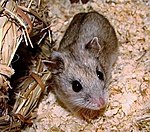 Cricetulus griseus (Chinese hamster)
- Electron microscopy imaging
| Experimental equipment |  Model: Titan Krios / Image courtesy: FEI Company |
|---|---|
| Microscopy | Model: TFS KRIOS |
| Electron gun | Electron source:  FIELD EMISSION GUN / Accelerating voltage: 300 kV / Illumination mode: FLOOD BEAM FIELD EMISSION GUN / Accelerating voltage: 300 kV / Illumination mode: FLOOD BEAM |
| Electron lens | Mode: BRIGHT FIELD / Nominal magnification: 22500 X / Nominal defocus max: 3000 nm / Nominal defocus min: 1000 nm / Cs: 2.7 mm / Alignment procedure: COMA FREE |
| Specimen holder | Cryogen: NITROGEN / Specimen holder model: FEI TITAN KRIOS AUTOGRID HOLDER |
| Image recording | Electron dose: 27.608 e/Å2 / Film or detector model: GATAN K3 (6k x 4k) |
- Processing
| EM software |
| ||||||||||||||||||||||||||||||||||||||||||||||||||||||||||||
|---|---|---|---|---|---|---|---|---|---|---|---|---|---|---|---|---|---|---|---|---|---|---|---|---|---|---|---|---|---|---|---|---|---|---|---|---|---|---|---|---|---|---|---|---|---|---|---|---|---|---|---|---|---|---|---|---|---|---|---|---|---|
| CTF correction | Type: PHASE FLIPPING AND AMPLITUDE CORRECTION | ||||||||||||||||||||||||||||||||||||||||||||||||||||||||||||
| Particle selection | Num. of particles selected: 975203 | ||||||||||||||||||||||||||||||||||||||||||||||||||||||||||||
| 3D reconstruction | Resolution: 4.07 Å / Resolution method: FSC 0.143 CUT-OFF / Num. of particles: 53244 / Algorithm: BACK PROJECTION Details: Reconstruction performed using cryoSPARC local refinement following signal subtraction of all NSF domains. Symmetry type: POINT | ||||||||||||||||||||||||||||||||||||||||||||||||||||||||||||
| Atomic model building | Protocol: FLEXIBLE FIT | ||||||||||||||||||||||||||||||||||||||||||||||||||||||||||||
| Atomic model building |
|