 Movie
Movie Controller


+ Open data

- Basic information
| Entry | Database: PDB / ID: 9hwg | ||||||
|---|---|---|---|---|---|---|---|
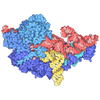
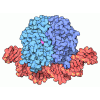
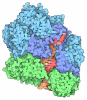
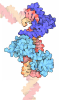
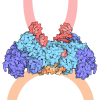
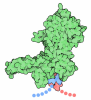
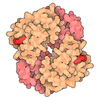
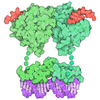
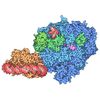
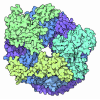
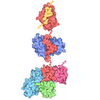
| Title | Structure of the transcribing Pol II-TCR-RECQL5 complex | ||||||
 Components Components |
| ||||||
 Keywords Keywords | TRANSCRIPTION / transcription elongation / DNA helicase / transcription-coupled repair / RNA polymerase II | ||||||
| Function / homology |  Function and homology information Function and homology informationmitotic DNA-templated DNA replication / RNA polymerase inhibitor activity / negative regulation of double-strand break repair via nonhomologous end joining / chromosome separation / regulation of transcription-coupled nucleotide-excision repair / nucleotide-excision repair complex / response to auditory stimulus / regulation of transcription elongation by RNA polymerase II / four-way junction helicase activity / DNA protection ...mitotic DNA-templated DNA replication / RNA polymerase inhibitor activity / negative regulation of double-strand break repair via nonhomologous end joining / chromosome separation / regulation of transcription-coupled nucleotide-excision repair / nucleotide-excision repair complex / response to auditory stimulus / regulation of transcription elongation by RNA polymerase II / four-way junction helicase activity / DNA protection / B-WICH complex positively regulates rRNA expression / RNA Polymerase I Transcription Initiation / RNA Polymerase I Promoter Escape / RNA Polymerase I Transcription Termination / RNA Polymerase III Transcription Initiation From Type 1 Promoter / RNA Polymerase III Transcription Initiation From Type 2 Promoter / RNA Polymerase III Transcription Initiation From Type 3 Promoter / mRNA Polyadenylation / Formation of RNA Pol II elongation complex / Formation of the Early Elongation Complex / Transcriptional regulation by small RNAs / RNA Polymerase II Pre-transcription Events / TP53 Regulates Transcription of DNA Repair Genes / FGFR2 alternative splicing / RNA polymerase II transcribes snRNA genes / mRNA Capping / mRNA Splicing - Minor Pathway / Processing of Capped Intron-Containing Pre-mRNA / RNA Polymerase II Promoter Escape / RNA Polymerase II Transcription Pre-Initiation And Promoter Opening / RNA Polymerase II Transcription Initiation / RNA Polymerase II Transcription Elongation / RNA Polymerase II Transcription Initiation And Promoter Clearance / RNA Pol II CTD phosphorylation and interaction with CE / Estrogen-dependent gene expression / Formation of TC-NER Pre-Incision Complex / Dual incision in TC-NER / Gap-filling DNA repair synthesis and ligation in TC-NER / mRNA Splicing - Major Pathway / double-strand break repair via classical nonhomologous end joining / single strand break repair / RNA polymerase binding / positive regulation by virus of viral protein levels in host cell / positive regulation of DNA-templated transcription, elongation / spindle assembly involved in female meiosis / epigenetic programming in the zygotic pronuclei / ATP-dependent chromatin remodeler activity / chromatin-protein adaptor activity / transcription preinitiation complex / UV-damage excision repair / biological process involved in interaction with symbiont / DNA metabolic process / ATP-dependent DNA damage sensor activity / regulation of mitotic cell cycle phase transition / WD40-repeat domain binding / Cul4A-RING E3 ubiquitin ligase complex / Cul4-RING E3 ubiquitin ligase complex / negative regulation of transcription elongation by RNA polymerase II / negative regulation of reproductive process / negative regulation of developmental process / positive regulation of transcription by RNA polymerase I / positive regulation of transcription by RNA polymerase III / Cul4B-RING E3 ubiquitin ligase complex / ectopic germ cell programmed cell death / ubiquitin ligase complex scaffold activity / RNA polymerase II complex binding / RNA Polymerase I Transcription Initiation / protein tyrosine kinase activator activity / DNA 3'-5' helicase / viral release from host cell / maintenance of transcriptional fidelity during transcription elongation by RNA polymerase II / response to X-ray / response to UV / 3'-5' DNA helicase activity / cullin family protein binding / transcription elongation factor complex / translation elongation factor activity / ATP-dependent activity, acting on DNA / positive regulation of viral genome replication / positive regulation of double-strand break repair via homologous recombination / protein autoubiquitination / neurogenesis / termination of RNA polymerase III transcription / transcription initiation at RNA polymerase III promoter / ubiquitin-like ligase-substrate adaptor activity / RNA polymerase I complex / RNA polymerase III complex / RNA polymerase II, core complex / tRNA transcription by RNA polymerase III / transcription by RNA polymerase I / transcription elongation by RNA polymerase I / protein localization to chromatin / positive regulation of gluconeogenesis / DNA damage checkpoint signaling / transcription-coupled nucleotide-excision repair / DNA helicase activity / positive regulation of DNA repair / helicase activity / regulation of DNA-templated transcription elongation / site of DNA damage Similarity search - Function | ||||||
| Biological species |  Homo sapiens (human) Homo sapiens (human)  Sus scrofa domesticus (domestic pig) Sus scrofa domesticus (domestic pig)synthetic construct (others) | ||||||
| Method | ELECTRON MICROSCOPY / single particle reconstruction / cryo EM / Resolution: 3.5 Å | ||||||
 Authors Authors | Zhang, L. / Zhang, S. | ||||||
| Funding support |  United Kingdom, 1items United Kingdom, 1items
| ||||||
 Citation Citation | Journal: Nat Struct Mol Biol / Year: 2025 Title: Structural basis of RECQL5-induced RNA polymerase II transcription braking and subsequent reactivation. Authors: Luojia Zhang / Yuliya Gordiyenko / Tomos Morgan / Catarina Franco / Ana Tufegdžić Vidaković / Suyang Zhang / Abstract: Abnormally fast transcription elongation can lead to detrimental consequences such as transcription-replication collisions, altered alternative splicing patterns and genome instability. Therefore, ...Abnormally fast transcription elongation can lead to detrimental consequences such as transcription-replication collisions, altered alternative splicing patterns and genome instability. Therefore, elongating RNA polymerase II (Pol II) requires mechanisms to slow its progression, yet the molecular basis of transcription braking remains unclear. RECQL5 is a DNA helicase that functions as a general elongation factor by slowing down Pol II. Here we report cryo-electron microscopy structures of human RECQL5 bound to multiple transcription elongation complexes. Combined with biochemical analysis, we identify an α-helix of RECQL5 responsible for binding Pol II and slowdown of transcription elongation. We further reveal that the transcription-coupled DNA repair (TCR) complex allows Pol II to overcome RECQL5-induced transcription braking through concerted actions of its translocase activity and competition with RECQL5 for engaging Pol II. Additionally, RECQL5 inhibits TCR-mediated Pol II ubiquitination to prevent activation of the DNA repair pathway. Our results suggest a model in which RECQL5 and the TCR complex coordinately regulate transcription elongation rates to ensure transcription efficiency while maintaining genome stability. | ||||||
| History |
|
- Structure visualization
| Structure viewer | Molecule: MolmilJmol/JSmol |
|---|
- Downloads & links
-Download
| PDBx/mmCIF format | 9hwg.cif.gz | 1.2 MB | Display | PDBx/mmCIF format |
|---|---|---|---|---|
| PDB format | pdb9hwg.ent.gz | 936.2 KB | Display | PDB format |
| PDBx/mmJSON format | 9hwg.json.gz | Tree view | PDBx/mmJSON format | |
| Others |  Other downloads Other downloads |
-Validation report
| Arichive directory | https://data.pdbj.org/pub/pdb/validation_reports/hw/9hwgftp://data.pdbj.org/pub/pdb/validation_reports/hw/9hwg | HTTPS FTP |
|---|
-Related structure data
| Related structure data |  52449MC  9hvoC  9hvqC M: map data used to model this data C: citing same article ( |
|---|---|
| Similar structure data |


-Links
 PDBj
PDBj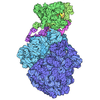
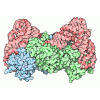


- Assembly
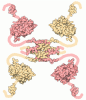
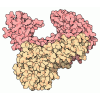
| Deposited unit | 
|
|---|---|
| 1 |
|
-Components
-DNA-directed RNA polymerase ... , 7 types, 7 molecules ABCEGIK
| #1: Protein | Mass: 217450.078 Da / Num. of mol.: 1 / Source method: isolated from a natural source / Source: (natural) Sus scrofa domesticus (domestic pig)References: UniProt: A0A8D1DPV6, DNA-directed RNA polymerase |
|---|---|
| #2: Protein | Mass: 134041.422 Da / Num. of mol.: 1 / Source method: isolated from a natural source / Source: (natural) Sus scrofa domesticus (domestic pig)References: UniProt: A0A0B8RVL1, DNA-directed RNA polymerase |
| #3: Protein | Mass: 31439.074 Da / Num. of mol.: 1 / Source method: isolated from a natural source / Source: (natural) Sus scrofa domesticus (domestic pig) / References: UniProt: I3LCH3 |
| #5: Protein | Mass: 24644.318 Da / Num. of mol.: 1 / Source method: isolated from a natural source / Source: (natural) Sus scrofa domesticus (domestic pig) / References: UniProt: I3LSI7 |
| #7: Protein | Mass: 19314.283 Da / Num. of mol.: 1 / Source method: isolated from a natural source / Source: (natural) Sus scrofa domesticus (domestic pig) / References: UniProt: A0A4X1VKG7 |
| #9: Protein | Mass: 14541.221 Da / Num. of mol.: 1 / Source method: isolated from a natural source / Source: (natural) Sus scrofa domesticus (domestic pig) / References: UniProt: P60899 |
| #11: Protein | Mass: 13310.284 Da / Num. of mol.: 1 / Source method: isolated from a natural source / Source: (natural) Sus scrofa domesticus (domestic pig) / References: UniProt: F1RKE4 |
-RNA polymerase ... , 2 types, 2 molecules DL
| #4: Protein | Mass: 16331.255 Da / Num. of mol.: 1 / Source method: isolated from a natural source / Source: (natural) Sus scrofa domesticus (domestic pig) / References: UniProt: A0A4X1VM56 |
|---|---|
| #12: Protein | Mass: 7018.244 Da / Num. of mol.: 1 / Source method: isolated from a natural source / Source: (natural) Sus scrofa domesticus (domestic pig) / References: UniProt: A0A4X1TRS6 |
-DNA-directed RNA polymerases I, II, and III subunit ... , 3 types, 3 molecules FHJ
| #6: Protein | Mass: 14477.001 Da / Num. of mol.: 1 / Source method: isolated from a natural source / Source: (natural) Sus scrofa domesticus (domestic pig) / References: UniProt: A0A4X1VEK9 |
|---|---|
| #8: Protein | Mass: 17162.273 Da / Num. of mol.: 1 / Source method: isolated from a natural source / Source: (natural) Sus scrofa domesticus (domestic pig) / References: UniProt: I3LCB2 |
| #10: Protein | Mass: 7655.123 Da / Num. of mol.: 1 / Source method: isolated from a natural source / Source: (natural) Sus scrofa domesticus (domestic pig) / References: UniProt: A0A4X1VYD0 |
-DNA chain , 2 types, 2 molecules NT
| #13: DNA chain | Mass: 14494.314 Da / Num. of mol.: 1 / Source method: obtained synthetically / Source: (synth.) synthetic construct (others) |
|---|---|
| #16: DNA chain | Mass: 14269.129 Da / Num. of mol.: 1 / Source method: obtained synthetically / Source: (synth.) synthetic construct (others) |
-Protein , 4 types, 4 molecules Ocde
| #14: Protein | Mass: 109024.859 Da / Num. of mol.: 1 Source method: isolated from a genetically manipulated source Source: (gene. exp.) Homo sapiens (human) / Gene: RECQL5, RECQ5 / Production host:  Trichoplusia ni (cabbage looper) / References: UniProt: O94762, DNA 3'-5' helicase Trichoplusia ni (cabbage looper) / References: UniProt: O94762, DNA 3'-5' helicase |
|---|---|
| #19: Protein | Mass: 80721.680 Da / Num. of mol.: 1 Source method: isolated from a genetically manipulated source Source: (gene. exp.) Homo sapiens (human) / Gene: UVSSA, KIAA1530 / Production host: Trichoplusia ni (cabbage looper) / References: UniProt: Q2YD98 |
| #20: Protein | Mass: 127097.469 Da / Num. of mol.: 1 Source method: isolated from a genetically manipulated source Source: (gene. exp.) Homo sapiens (human) / Gene: DDB1, XAP1 / Production host: Trichoplusia ni (cabbage looper) / References: UniProt: Q16531 |
| #21: Protein | Mass: 9475.881 Da / Num. of mol.: 1 Source method: isolated from a genetically manipulated source Source: (gene. exp.) Homo sapiens (human) / Gene: ELOF1, hCG_29982 / Production host: Trichoplusia ni (cabbage looper) / References: UniProt: A0A024R7E8 |
-RNA chain , 1 types, 1 molecules P
| #15: RNA chain | Mass: 14490.756 Da / Num. of mol.: 1 / Source method: obtained synthetically / Source: (synth.) synthetic construct (others) |
|---|
-DNA excision repair protein ERCC- ... , 2 types, 2 molecules ab
| #17: Protein | Mass: 44107.160 Da / Num. of mol.: 1 Source method: isolated from a genetically manipulated source Source: (gene. exp.) Homo sapiens (human) / Gene: ERCC8, CKN1, CSA / Production host: Trichoplusia ni (cabbage looper) / References: UniProt: Q13216 |
|---|---|
| #18: Protein | Mass: 168673.547 Da / Num. of mol.: 1 Source method: isolated from a genetically manipulated source Source: (gene. exp.) Homo sapiens (human) / Gene: ERCC6, CSB / Production host: Trichoplusia ni (cabbage looper)References: UniProt: Q03468, Hydrolases; Acting on acid anhydrides; Acting on acid anhydrides to facilitate cellular and subcellular movement |
-Non-polymers , 2 types, 12 molecules 

| #22: Chemical | ChemComp-ZN /  Mass: 65.409 Da / Num. of mol.: 10 / Source method: obtained synthetically / Formula: Zn Mass: 65.409 Da / Num. of mol.: 10 / Source method: obtained synthetically / Formula: Zn#23: Chemical |  Mass: 24.305 Da / Num. of mol.: 2 / Source method: obtained synthetically / Formula: Mg Mass: 24.305 Da / Num. of mol.: 2 / Source method: obtained synthetically / Formula: Mg |
|---|
-Details
| Has ligand of interest | N |
|---|---|
| Has protein modification | Y |
-Experimental details
-Experiment
| Experiment | Method: ELECTRON MICROSCOPY |
|---|---|
| EM experiment | Aggregation state: PARTICLE / 3D reconstruction method: single particle reconstruction |
- Sample preparation
| Component | Name: PolII-TCR-RECQL5 complex / Type: COMPLEX / Entity ID: #1-#21 / Source: RECOMBINANT |
|---|---|
| Source (natural) | Organism: Homo sapiens (human) |
| Source (recombinant) | Organism: Trichoplusia ni (cabbage looper) |
| Buffer solution | pH: 7.5 Details: 20 mM HEPES pH 7.5, 50 mM KCl, 4 mM MgCl2, 1 mM DTT |
| Specimen | Embedding applied: NO / Shadowing applied: NO / Staining applied: NO / Vitrification applied: YES |
| Specimen support | Grid material: COPPER / Grid mesh size: 200 divisions/in. / Grid type: Quantifoil R3.5/1 |
| Vitrification | Instrument: FEI VITROBOT MARK IV / Cryogen name: ETHANE / Humidity: 100 % |
- Electron microscopy imaging
| Experimental equipment |  Model: Titan Krios / Image courtesy: FEI Company |
|---|---|
| Microscopy | Model: TFS KRIOS |
| Electron gun | Electron source:  FIELD EMISSION GUN / Accelerating voltage: 300 kV / Illumination mode: FLOOD BEAM FIELD EMISSION GUN / Accelerating voltage: 300 kV / Illumination mode: FLOOD BEAM |
| Electron lens | Mode: BRIGHT FIELD / Nominal magnification: 96000 X / Nominal defocus max: 2500 nm / Nominal defocus min: 500 nm / Cs: 2.7 mm / C2 aperture diameter: 50 µm |
| Specimen holder | Cryogen: NITROGEN / Specimen holder model: FEI TITAN KRIOS AUTOGRID HOLDER |
| Image recording | Electron dose: 36.6 e/Å2 / Film or detector model: FEI FALCON IV (4k x 4k) / Num. of grids imaged: 1 |
- Processing
| EM software | Name: PHENIX / Version: 1.21.2_5419: / Category: model refinement |
|---|---|
| CTF correction | Type: PHASE FLIPPING AND AMPLITUDE CORRECTION |
| 3D reconstruction | Resolution: 3.5 Å / Resolution method: FSC 0.143 CUT-OFF / Num. of particles: 19458 / Num. of class averages: 1 / Symmetry type: POINT |
