 ムービー
ムービー コントローラー


+ データを開く

- 基本情報
基本情報
| 登録情報 | データベース: PDB / ID: 8pr0 | ||||||||||||
|---|---|---|---|---|---|---|---|---|---|---|---|---|---|
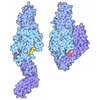
| タイトル | Cytoplasmic dynein-A heavy chain bound to dynactin-p150glued and IC-LC tower | ||||||||||||
 要素 要素 |
| ||||||||||||
 キーワード キーワード | MOTOR PROTEIN / Dynein / AAA-Atpase / dynactin / p150 / LC8 / TCTEX1 | ||||||||||||
| 機能・相同性 |  機能・相同性情報 機能・相同性情報intracellular transport of viral protein in host cell / nitric-oxide synthase inhibitor activity / deoxyribonuclease inhibitor activity / negative regulation of DNA strand resection involved in replication fork processing / secretory vesicle / centriolar subdistal appendage / negative regulation of phosphorylation / positive regulation of neuromuscular junction development / centriole-centriole cohesion / intraciliary retrograde transport ...intracellular transport of viral protein in host cell / nitric-oxide synthase inhibitor activity / deoxyribonuclease inhibitor activity / negative regulation of DNA strand resection involved in replication fork processing / secretory vesicle / centriolar subdistal appendage / negative regulation of phosphorylation / positive regulation of neuromuscular junction development / centriole-centriole cohesion / intraciliary retrograde transport / Regulation of PLK1 Activity at G2/M Transition / Loss of Nlp from mitotic centrosomes / Loss of proteins required for interphase microtubule organization from the centrosome / Anchoring of the basal body to the plasma membrane / AURKA Activation by TPX2 / transport along microtubule / Recruitment of mitotic centrosome proteins and complexes / microtubule anchoring at centrosome / dynein light chain binding / ventral spinal cord development / dynein heavy chain binding / Activation of BIM and translocation to mitochondria / motile cilium assembly / retromer complex / microtubule plus-end / nuclear membrane disassembly / Intraflagellar transport / positive regulation of intracellular transport / positive regulation of microtubule nucleation / negative regulation of nitric oxide biosynthetic process / regulation of metaphase plate congression / positive regulation of spindle assembly / melanosome transport / establishment of spindle localization / regulation of G protein-coupled receptor signaling pathway / microtubule-dependent intracellular transport of viral material towards nucleus / non-motile cilium assembly / dynein complex / retrograde transport, endosome to Golgi / COPI-independent Golgi-to-ER retrograde traffic / retrograde axonal transport / P-body assembly / HSP90 chaperone cycle for steroid hormone receptors (SHR) in the presence of ligand / MHC class II antigen presentation / microtubule motor activity / Recruitment of NuMA to mitotic centrosomes / microtubule associated complex / minus-end-directed microtubule motor activity / centrosome localization / dynein light intermediate chain binding / cytoplasmic dynein complex / COPI-mediated anterograde transport / microtubule-based movement / neuromuscular process / nuclear migration / Macroautophagy / ciliary tip / neuromuscular junction development / motor behavior / cell leading edge / dynein intermediate chain binding / establishment of mitotic spindle orientation / tertiary granule membrane / ficolin-1-rich granule membrane / spermatid development / positive regulation of insulin secretion involved in cellular response to glucose stimulus / intercellular bridge / COPI-mediated anterograde transport / cytoplasmic microtubule / cytoplasmic microtubule organization / axon cytoplasm / neuron projection maintenance / Amplification of signal from unattached kinetochores via a MAD2 inhibitory signal / Loss of Nlp from mitotic centrosomes / Loss of proteins required for interphase microtubule organization from the centrosome / Recruitment of mitotic centrosome proteins and complexes / MHC class II antigen presentation / centriole / Mitotic Prometaphase / substantia nigra development / Recruitment of NuMA to mitotic centrosomes / enzyme inhibitor activity / Anchoring of the basal body to the plasma membrane / EML4 and NUDC in mitotic spindle formation / stress granule assembly / HSP90 chaperone cycle for steroid hormone receptors (SHR) in the presence of ligand / AURKA Activation by TPX2 / regulation of mitotic spindle organization / Resolution of Sister Chromatid Cohesion / mitotic spindle organization / filopodium / RHO GTPases Activate Formins / cellular response to nerve growth factor stimulus / neuron cellular homeostasis / negative regulation of neurogenesis / kinetochore / microtubule cytoskeleton organization / spindle / HCMV Early Events / spindle pole 類似検索 - 分子機能 | ||||||||||||
| 生物種 |  Homo sapiens (ヒト) Homo sapiens (ヒト)  Sus scrofa (ブタ) Sus scrofa (ブタ) | ||||||||||||
| 手法 | 電子顕微鏡法 / 単粒子再構成法 / クライオ電子顕微鏡法 / 解像度: 9.4 Å | ||||||||||||
 データ登録者 データ登録者 | Singh, K. / Lau, C.K. / Manigrasso, G. / Gassmann, R. / Carter, A.P. | ||||||||||||
| 資金援助 |  英国, European Union, 3件 英国, European Union, 3件
| ||||||||||||
 引用 引用 | ジャーナル: Science / 年: 2024 タイトル: Molecular mechanism of dynein-dynactin complex assembly by LIS1. 著者: Kashish Singh / Clinton K Lau / Giulia Manigrasso / José B Gama / Reto Gassmann / Andrew P Carter /  要旨: Cytoplasmic dynein is a microtubule motor vital for cellular organization and division. It functions as a ~4-megadalton complex containing its cofactor dynactin and a cargo-specific coiled-coil ...Cytoplasmic dynein is a microtubule motor vital for cellular organization and division. It functions as a ~4-megadalton complex containing its cofactor dynactin and a cargo-specific coiled-coil adaptor. However, how dynein and dynactin recognize diverse adaptors, how they interact with each other during complex formation, and the role of critical regulators such as lissencephaly-1 (LIS1) protein (LIS1) remain unclear. In this study, we determined the cryo-electron microscopy structure of dynein-dynactin on microtubules with LIS1 and the lysosomal adaptor JIP3. This structure reveals the molecular basis of interactions occurring during dynein activation. We show how JIP3 activates dynein despite its atypical architecture. Unexpectedly, LIS1 binds dynactin's p150 subunit, tethering it along the length of dynein. Our data suggest that LIS1 and p150 constrain dynein-dynactin to ensure efficient complex formation. | ||||||||||||
| 履歴 |
|
- 構造の表示
構造の表示
| 構造ビューア | 分子: MolmilJmol/JSmol |
|---|
- ダウンロードとリンク
-ダウンロード
| PDBx/mmCIF形式 | 8pr0.cif.gz | 571.3 KB | 表示 | PDBx/mmCIF形式 |
|---|---|---|---|---|
| PDB形式 | pdb8pr0.ent.gz | 表示 | PDB形式 | |
| PDBx/mmJSON形式 | 8pr0.json.gz | ツリー表示 | PDBx/mmJSON形式 | |
| その他 |  その他のダウンロード その他のダウンロード |
-検証レポート
| アーカイブディレクトリ | https://data.pdbj.org/pub/pdb/validation_reports/pr/8pr0ftp://data.pdbj.org/pub/pdb/validation_reports/pr/8pr0 | HTTPS FTP |
|---|
-関連構造データ
| 関連構造データ |  17830MC  8pqvC 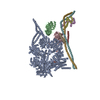 8pqwC  8pqyC 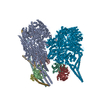 8pqzC  8pr1C  8pr2C  8pr3C  8pr4C  8pr5C  8ptkC M: このデータのモデリングに利用したマップデータ C: 同じ文献を引用 ( |
|---|---|
| 類似構造データ |


-リンク
 PDBj
PDBj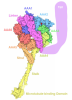
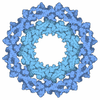
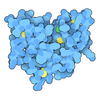
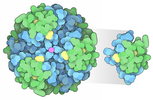
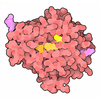

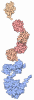
- 集合体
集合体
| 登録構造単位 | 
|
|---|---|
| 1 |
|
-要素
-Cytoplasmic dynein 1 ... , 3種, 5分子 DCBAK
| #1: タンパク質 | 分子量: 68442.141 Da / 分子数: 2 / 由来タイプ: 組換発現 / 由来: (組換発現) Homo sapiens (ヒト) / 遺伝子: DYNC1I2, DNCI2, DNCIC2発現宿主:   Spodoptera frugiperda (ツマジロクサヨトウ) Spodoptera frugiperda (ツマジロクサヨトウ)参照: UniProt: Q13409 #5: タンパク質 | 分子量: 533055.125 Da / 分子数: 2 / Mutation: R1567E, K1610E / 由来タイプ: 組換発現 / 由来: (組換発現) Homo sapiens (ヒト)遺伝子: DYNC1H1, DHC1, DNCH1, DNCL, DNECL, DYHC, KIAA0325 発現宿主: Spodoptera frugiperda (ツマジロクサヨトウ)参照: UniProt: Q14204 #6: タンパク質 | | 分子量: 54173.156 Da / 分子数: 1 / 由来タイプ: 組換発現 / 由来: (組換発現) Homo sapiens (ヒト) / 遺伝子: DYNC1LI2, DNCLI2, LIC2発現宿主: Spodoptera frugiperda (ツマジロクサヨトウ)参照: UniProt: O43237 |
|---|
-Dynein light chain ... , 2種, 4分子 FEGH
| #2: タンパク質 | 分子量: 10381.899 Da / 分子数: 2 / 由来タイプ: 組換発現 / 由来: (組換発現) Homo sapiens (ヒト) / 遺伝子: DYNLL1, DLC1, DNCL1, DNCLC1, HDLC1発現宿主: Spodoptera frugiperda (ツマジロクサヨトウ)参照: UniProt: P63167 #3: タンパク質 | 分子量: 12461.996 Da / 分子数: 2 / 由来タイプ: 組換発現 / 由来: (組換発現) Homo sapiens (ヒト) / 遺伝子: DYNLT1, TCTEL1, TCTEX-1, TCTEX1発現宿主: Spodoptera frugiperda (ツマジロクサヨトウ)参照: UniProt: P63172 |
|---|
-タンパク質 , 1種, 2分子 IJ
| #4: タンパク質 | 分子量: 142015.484 Da / 分子数: 2 / 由来タイプ: 天然 / 由来: (天然) Sus scrofa (ブタ) / 参照: UniProt: A0A287B8J2 |
|---|
-実験情報
-実験
| 実験 | 手法: 電子顕微鏡法 |
|---|---|
| EM実験 | 試料の集合状態: PARTICLE / 3次元再構成法: 単粒子再構成法 |
- 試料調製
試料調製
| 構成要素 | 名称: Cytoplasmic dynein-A heavy chain bound to dynactin p150 and IC-LC tower タイプ: COMPLEX / Entity ID: all / 由来: RECOMBINANT |
|---|---|
| 由来(天然) | 生物種: Homo sapiens (ヒト) |
| 由来(組換発現) | 生物種: Spodoptera frugiperda (ツマジロクサヨトウ) |
| 緩衝液 | pH: 7.2 |
| 試料 | 包埋: NO / シャドウイング: NO / 染色: NO / 凍結: YES |
| 急速凍結 | 凍結剤: ETHANE |
- 電子顕微鏡撮影
| 実験機器 |  モデル: Titan Krios / 画像提供: FEI Company |
|---|---|
| 顕微鏡 | モデル: FEI TITAN KRIOS |
| 電子銃 | 電子線源:  FIELD EMISSION GUN / 加速電圧: 300 kV / 照射モード: FLOOD BEAM FIELD EMISSION GUN / 加速電圧: 300 kV / 照射モード: FLOOD BEAM |
| 電子レンズ | モード: BRIGHT FIELD / 最大 デフォーカス(公称値): 4000 nm / 最小 デフォーカス(公称値): 500 nm |
| 撮影 | 電子線照射量: 53 e/Å2 フィルム・検出器のモデル: GATAN K3 BIOQUANTUM (6k x 4k) |
- 解析
解析
| EMソフトウェア |
| ||||||||||||
|---|---|---|---|---|---|---|---|---|---|---|---|---|---|
| CTF補正 | タイプ: PHASE FLIPPING AND AMPLITUDE CORRECTION | ||||||||||||
| 3次元再構成 | 解像度: 9.4 Å / 解像度の算出法: FSC 0.143 CUT-OFF / 粒子像の数: 42909 / 対称性のタイプ: POINT | ||||||||||||
| 原子モデル構築 | PDB-ID: 7Z8G Accession code: 7Z8G / Source name: PDB / タイプ: experimental model |

