regulation of Schwann cell differentiation / regulation of attachment of mitotic spindle microtubules to kinetochore / pronuclear fusion / response to DDT / regulation of chromosome condensation / cyclin B1-CDK1 complex / positive regulation of mitochondrial ATP synthesis coupled electron transport / Mitotic Prophase / positive regulation of mitotic sister chromatid segregation / ventricular cardiac muscle cell development ...regulation of Schwann cell differentiation / regulation of attachment of mitotic spindle microtubules to kinetochore / pronuclear fusion / response to DDT / regulation of chromosome condensation / cyclin B1-CDK1 complex / positive regulation of mitochondrial ATP synthesis coupled electron transport / Mitotic Prophase / positive regulation of mitotic sister chromatid segregation / ventricular cardiac muscle cell development / histone kinase activity / Golgi disassembly / E2F-enabled inhibition of pre-replication complex formation / microtubule cytoskeleton organization involved in mitosis / Depolymerization of the Nuclear Lamina / positive regulation of mRNA 3'-end processing / regulation of mitotic cell cycle spindle assembly checkpoint / positive regulation of attachment of spindle microtubules to kinetochore / MASTL Facilitates Mitotic Progression / Activation of NIMA Kinases NEK9, NEK6, NEK7 / tissue regeneration / patched binding / Phosphorylation of Emi1 / RNA polymerase II CTD heptapeptide repeat S5 kinase activity / oocyte maturation / Transcriptional regulation by RUNX2 / mitotic nuclear membrane disassembly / Nuclear Pore Complex (NPC) Disassembly / snRNA transcription by RNA polymerase II / Phosphorylation of the APC/C / G2/M DNA replication checkpoint / transcription factor TFIIK complex / CAK-ERCC2 complex / outer kinetochore / protein localization to kinetochore / Transcription of E2F targets under negative control by p107 (RBL1) and p130 (RBL2) in complex with HDAC1 / digestive tract development / Initiation of Nuclear Envelope (NE) Reformation / Polo-like kinase mediated events / Golgi Cisternae Pericentriolar Stack Reorganization / cellular response to fatty acid / transcription factor TFIIH core complex / transcription factor TFIIH holo complex / cyclin-dependent protein serine/threonine kinase activator activity / [RNA-polymerase]-subunit kinase / cellular response to iron(III) ion / chromosome condensation / Condensation of Prometaphase Chromosomes / response to amine / centrosome cycle / positive regulation of ubiquitin-dependent protein catabolic process / RNA Polymerase I Transcription Termination / cyclin-dependent protein serine/threonine kinase regulator activity / response to copper ion / cyclin-dependent protein kinase activity / regulation of heterochromatin organization / peptidyl-threonine phosphorylation / MAPK3 (ERK1) activation / RNA Pol II CTD phosphorylation and interaction with CE during HIV infection / RNA Pol II CTD phosphorylation and interaction with CE / G1/S-Specific Transcription / Formation of the Early Elongation Complex / Formation of the HIV-1 Early Elongation Complex / mRNA Capping / mitotic G2 DNA damage checkpoint signaling / HIV Transcription Initiation / RNA Polymerase II HIV Promoter Escape / Transcription of the HIV genome / RNA Polymerase II Promoter Escape / RNA Polymerase II Transcription Pre-Initiation And Promoter Opening / RNA Polymerase II Transcription Initiation / RNA Polymerase II Transcription Initiation And Promoter Clearance / Regulation of APC/C activators between G1/S and early anaphase / microtubule organizing center / RNA Polymerase I Transcription Initiation / response to axon injury / RNA polymerase II transcribes snRNA genes / male germ cell nucleus / ubiquitin-like protein ligase binding / regulation of embryonic development / response to cadmium ion / positive regulation of G2/M transition of mitotic cell cycle / ERK1 and ERK2 cascade / response to mechanical stimulus / cyclin-dependent kinase / mitotic metaphase chromosome alignment / cyclin-dependent protein serine/threonine kinase activity / positive regulation of cardiac muscle cell proliferation / protein deubiquitination / ATP-dependent activity, acting on DNA / Tat-mediated elongation of the HIV-1 transcript / Regulation of MITF-M-dependent genes involved in cell cycle and proliferation / Cyclin E associated events during G1/S transition / Formation of HIV-1 elongation complex containing HIV-1 Tat / cyclin-dependent protein kinase holoenzyme complex / Cyclin A:Cdk2-associated events at S phase entry / Formation of HIV elongation complex in the absence of HIV Tat / Chk1/Chk2(Cds1) mediated inactivation of Cyclin B:Cdk1 complex / Cyclin A/B1/B2 associated events during G2/M transition / RNA Polymerase II Transcription Elongation Similarity search - Function
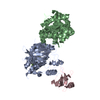
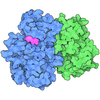
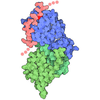
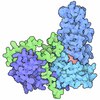
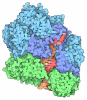
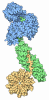
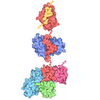
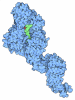
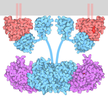
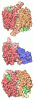
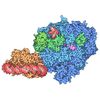
Journal: Science / Year: 2025 Title: Structural basis of T-loop-independent recognition and activation of CDKs by the CDK-activating kinase. Authors: Victoria I Cushing / Amy J S McGeoch / Sophie L Williams / Theodoros I Roumeliotis / Junjie Feng / Lucy M Dan / Jyoti S Choudhary / Norman E Davey / Basil J Greber / Abstract: Cyclin-dependent kinases (CDKs) are prototypical regulators of the cell cycle. The CDK-activating kinase (CAK) acts as a master regulator of CDK activity by catalyzing the activating phosphorylation ...Cyclin-dependent kinases (CDKs) are prototypical regulators of the cell cycle. The CDK-activating kinase (CAK) acts as a master regulator of CDK activity by catalyzing the activating phosphorylation of CDKs on a conserved threonine residue within the regulatory T-loop. However, structural data illuminating the mechanism by which the CAK recognizes and activates CDKs have remained elusive. In this study, we determined high-resolution structures of the CAK in complex with CDK2 and CDK2-cyclin A2 by cryogenic electron microscopy. Our structures reveal a T-loop-independent kinase-kinase interface with contributions from both kinase lobes. Computational analysis and structures of the CAK in complex with CDK1-cyclin B1 and CDK11 indicate that these structures represent the general architecture of CAK-CDK complexes. These results advance our mechanistic understanding of cell cycle regulation and kinase signaling cascades.
In the structure databanks used in Yorodumi, some data are registered as the other names, "COVID-19 virus" and "2019-nCoV". Here are the details of the virus and the list of structure data.
Jan 31, 2019. EMDB accession codes are about to change! (news from PDBe EMDB page)
EMDB accession codes are about to change! (news from PDBe EMDB page)
The allocation of 4 digits for EMDB accession codes will soon come to an end. Whilst these codes will remain in use, new EMDB accession codes will include an additional digit and will expand incrementally as the available range of codes is exhausted. The current 4-digit format prefixed with “EMD-” (i.e. EMD-XXXX) will advance to a 5-digit format (i.e. EMD-XXXXX), and so on. It is currently estimated that the 4-digit codes will be depleted around Spring 2019, at which point the 5-digit format will come into force.
The EM Navigator/Yorodumi systems omit the EMD- prefix.
Related info.:Q: What is EMD? / ID/Accession-code notation in Yorodumi/EM Navigator
Yorodumi is a browser for structure data from EMDB, PDB, SASBDB, etc.
This page is also the successor to EM Navigator detail page, and also detail information page/front-end page for Omokage search.
The word "yorodu" (or yorozu) is an old Japanese word meaning "ten thousand". "mi" (miru) is to see.
Related info.:EMDB / PDB / SASBDB / Comparison of 3 databanks / Yorodumi Search / Aug 31, 2016. New EM Navigator & Yorodumi / Yorodumi Papers / Jmol/JSmol / Function and homology information / Changes in new EM Navigator and Yorodumi
 Movie
Movie Controller


 Open data
 Basic information
 Map data
 Sample
 Keywords
 Function and homology information
 Homo sapiens (human)
 Authors
 United Kingdom, 3 items
  Citation
 Structure visualization
 Downloads & links
 emd_54971.png
 http://ftp.pdbj.org/pub/emdb/structures/EMD-54971



 Z (Sec.)
 Y (Row.)
 X (Col.)


 Sample components
 Trichoplusia ni (cabbage looper)
 Processing
 Electron microscopy
 FIELD EMISSION GUN