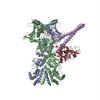
Movie
Movie Controller


+ Open data

- Basic information
| Entry | Database: EMDB / ID: EMD-23213 | |||||||||
|---|---|---|---|---|---|---|---|---|---|---|
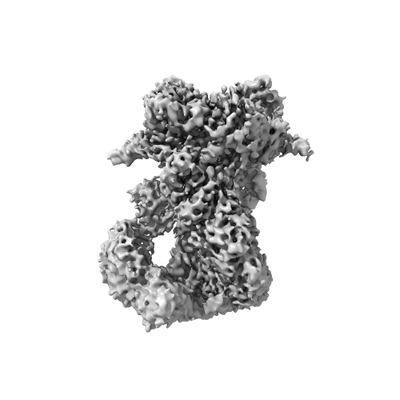
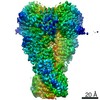
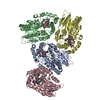
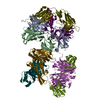
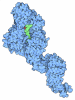
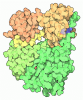
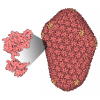
| Title | Cryo-EM structure of Hsp90:FKBP51:p23 closed-state complex | |||||||||
 Map data Map data | Cryo-EM structure of Hsp90:FKBP51:p23 closed-state complex | |||||||||
 Sample Sample |
| |||||||||
 Keywords Keywords | ISOMERASE-CHAPERONE complex | |||||||||
| Function / homology |  Function and homology information Function and homology informationprostaglandin-E synthase / prostaglandin-E synthase activity / Aryl hydrocarbon receptor signalling / telomerase activity / prostanoid biosynthetic process / Synthesis of Prostaglandins (PG) and Thromboxanes (TX) / cyclooxygenase pathway / prostaglandin biosynthetic process / Modulation of host responses by IFN-stimulated genes / telomerase holoenzyme complex ...prostaglandin-E synthase / prostaglandin-E synthase activity / Aryl hydrocarbon receptor signalling / telomerase activity / prostanoid biosynthetic process / Synthesis of Prostaglandins (PG) and Thromboxanes (TX) / cyclooxygenase pathway / prostaglandin biosynthetic process / Modulation of host responses by IFN-stimulated genes / telomerase holoenzyme complex / sperm plasma membrane / sperm mitochondrial sheath / sulfonylurea receptor binding / CTP binding / Scavenging by Class F Receptors / positive regulation of protein polymerization / vRNP Assembly / UTP binding / mitochondrial transport / dATP binding / telomerase holoenzyme complex assembly / chaperone-mediated autophagy / Respiratory syncytial virus genome replication / Rho GDP-dissociation inhibitor binding / FK506 binding / Drug-mediated inhibition of ERBB2 signaling / Resistance of ERBB2 KD mutants to trastuzumab / Resistance of ERBB2 KD mutants to sapitinib / Resistance of ERBB2 KD mutants to tesevatinib / Resistance of ERBB2 KD mutants to neratinib / Resistance of ERBB2 KD mutants to osimertinib / Resistance of ERBB2 KD mutants to afatinib / Resistance of ERBB2 KD mutants to AEE788 / Resistance of ERBB2 KD mutants to lapatinib / Drug resistance in ERBB2 TMD/JMD mutants / Uptake and function of diphtheria toxin / positive regulation of cell size / dendritic growth cone / protein import into mitochondrial matrix / TPR domain binding / PIWI-interacting RNA (piRNA) biogenesis / Assembly and release of respiratory syncytial virus (RSV) virions / non-chaperonin molecular chaperone ATPase / response to salt stress / Sema3A PAK dependent Axon repulsion / regulation of protein ubiquitination / response to unfolded protein / HSF1-dependent transactivation / cardiac muscle cell apoptotic process / regulation of protein-containing complex assembly / protein folding chaperone complex / Attenuation phase / HSF1 activation / enzyme-substrate adaptor activity / chaperone-mediated protein complex assembly / axonal growth cone / neurofibrillary tangle assembly / regulation of postsynaptic membrane neurotransmitter receptor levels / telomere maintenance via telomerase / positive regulation of lamellipodium assembly / RHOBTB2 GTPase cycle / Dengue virus activates/modulates innate and adaptive immune responses / nitric oxide metabolic process / protein unfolding / MECP2 regulates neuronal receptors and channels / positive regulation of defense response to virus by host / skeletal muscle contraction / Signaling by ERBB2 / eNOS activation / response to cold / heat shock protein binding / positive regulation of telomere maintenance via telomerase / Tetrahydrobiopterin (BH4) synthesis, recycling, salvage and regulation / endocytic vesicle lumen / DNA polymerase binding / positive regulation of cardiac muscle contraction / Loss of Nlp from mitotic centrosomes / Loss of proteins required for interphase microtubule organization from the centrosome / Recruitment of mitotic centrosome proteins and complexes / lysosomal lumen / Recruitment of NuMA to mitotic centrosomes / ESR-mediated signaling / Anchoring of the basal body to the plasma membrane / activation of innate immune response / positive regulation of interferon-beta production / HSP90 chaperone cycle for steroid hormone receptors (SHR) in the presence of ligand / telomere maintenance / AURKA Activation by TPX2 / protein tyrosine kinase binding / Constitutive Signaling by Overexpressed ERBB2 / nitric-oxide synthase regulator activity / negative regulation of phosphatidylinositol 3-kinase/protein kinase B signal transduction / ATP-dependent protein folding chaperone / response to cocaine / VEGFR2 mediated vascular permeability / peptidylprolyl isomerase / brush border membrane / peptidyl-prolyl cis-trans isomerase activity / : / cellular response to virus Similarity search - Function | |||||||||
| Biological species |  Homo sapiens (human) Homo sapiens (human) | |||||||||
| Method | single particle reconstruction / cryo EM / Resolution: 3.3 Å | |||||||||
 Authors Authors | Lee K / Thwin AC | |||||||||
| Funding support |  United States, 2 items United States, 2 items
| |||||||||
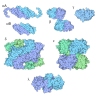
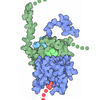
 Citation Citation | Journal: Mol Cell / Year: 2021 Title: The structure of an Hsp90-immunophilin complex reveals cochaperone recognition of the client maturation state. Authors: Kanghyun Lee / Aye C Thwin / Cory M Nadel / Eric Tse / Stephanie N Gates / Jason E Gestwicki / Daniel R Southworth / Abstract: The Hsp90 chaperone promotes folding and activation of hundreds of client proteins in the cell through an ATP-dependent conformational cycle guided by distinct cochaperone regulators. The FKBP51 ...The Hsp90 chaperone promotes folding and activation of hundreds of client proteins in the cell through an ATP-dependent conformational cycle guided by distinct cochaperone regulators. The FKBP51 immunophilin binds Hsp90 with its tetratricopeptide repeat (TPR) domain and catalyzes peptidyl-prolyl isomerase (PPIase) activity during folding of kinases, nuclear receptors, and tau. Here we determined the cryoelectron microscopy (cryo-EM) structure of the human Hsp90:FKBP51:p23 complex to 3.3 Å, which, together with mutagenesis and crosslinking analyses, reveals the basis for cochaperone binding to Hsp90 during client maturation. A helix extension in the TPR functions as a key recognition element, interacting across the Hsp90 C-terminal dimer interface presented in the closed, ATP conformation. The PPIase domain is positioned along the middle domain, adjacent to Hsp90 client binding sites, whereas a single p23 makes stabilizing interactions with the N-terminal dimer. With this architecture, FKBP51 is positioned to act on specific client residues presented during Hsp90-catalyzed remodeling. | |||||||||
| History |
|
- Structure visualization
| Movie |
Movie viewer |
|---|---|
| Structure viewer | EM map: SurfViewMolmilJmol/JSmol |
| Supplemental images |
- Downloads & links
-EMDB archive
| Map data | emd_23213.map.gz | 179.5 MB | EMDB map data format | |
|---|---|---|---|---|
| Header (meta data) | emd-23213-v30.xmlemd-23213.xml | 14.3 KB 14.3 KB | Display Display | EMDB header |
| Images |  emd_23213.png emd_23213.png | 36.5 KB | ||
| Filedesc metadata | emd-23213.cif.gz | 6.1 KB | ||
| Archive directory |  https://data.pdbj.org/pub/emdb/structures/EMD-23213ftp://data.pdbj.org/pub/emdb/structures/EMD-23213 https://data.pdbj.org/pub/emdb/structures/EMD-23213ftp://data.pdbj.org/pub/emdb/structures/EMD-23213 | HTTPS FTP |
-Related structure data
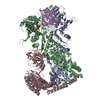
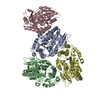
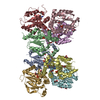
| Related structure data |  7l7iMC  7l7jC C: citing same article ( M: atomic model generated by this map |
|---|---|
| Similar structure data |



-Links
| EMDB pages | EMDB (EBI/PDBe) / EMDataResource |
|---|---|
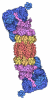
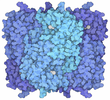
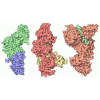
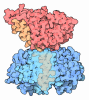
| Related items in Molecule of the Month |


-Map
| File | Download / File: emd_23213.map.gz / Format: CCP4 / Size: 190.1 MB / Type: IMAGE STORED AS FLOATING POINT NUMBER (4 BYTES) | ||||||||||||||||||||||||||||||||||||||||||||||||||||||||||||
|---|---|---|---|---|---|---|---|---|---|---|---|---|---|---|---|---|---|---|---|---|---|---|---|---|---|---|---|---|---|---|---|---|---|---|---|---|---|---|---|---|---|---|---|---|---|---|---|---|---|---|---|---|---|---|---|---|---|---|---|---|---|
| Annotation | Cryo-EM structure of Hsp90:FKBP51:p23 closed-state complex | ||||||||||||||||||||||||||||||||||||||||||||||||||||||||||||
| Projections & slices | Image control
Images are generated by Spider. | ||||||||||||||||||||||||||||||||||||||||||||||||||||||||||||
| Voxel size | X=Y=Z: 0.814 Å | ||||||||||||||||||||||||||||||||||||||||||||||||||||||||||||
| Density |
| ||||||||||||||||||||||||||||||||||||||||||||||||||||||||||||
| Symmetry | Space group: 1 | ||||||||||||||||||||||||||||||||||||||||||||||||||||||||||||
| Details | EMDB XML:
CCP4 map header:
| ||||||||||||||||||||||||||||||||||||||||||||||||||||||||||||
 Z (Sec.)
 Y (Row.)
 X (Col.)


-Supplemental data
- Sample components
-Entire : Hsp90:FKBP51:p23 closed-state complex
| Entire | Name: Hsp90:FKBP51:p23 closed-state complex |
|---|---|
| Components |
|
-Supramolecule #1: Hsp90:FKBP51:p23 closed-state complex
| Supramolecule | Name: Hsp90:FKBP51:p23 closed-state complex / type: complex / ID: 1 / Parent: 0 / Macromolecule list: #1-#3 |
|---|---|
| Source (natural) | Organism: Homo sapiens (human) |
-Macromolecule #1: Peptidyl-prolyl cis-trans isomerase FKBP5
| Macromolecule | Name: Peptidyl-prolyl cis-trans isomerase FKBP5 / type: protein_or_peptide / ID: 1 / Number of copies: 1 / Enantiomer: LEVO / EC number: peptidylprolyl isomerase |
|---|---|
| Source (natural) | Organism: Homo sapiens (human) |
| Molecular weight | Theoretical: 51.290191 KDa |
| Recombinant expression | Organism:   Escherichia coli (E. coli) Escherichia coli (E. coli) |
| Sequence | String: MTTDEGAKNN EESPTATVAE QGEDITSKKD RGVLKIVKRV GNGEETPMIG DKVYVHYKGK LSNGKKFDSS HDRNEPFVFS LGKGQVIKA WDIGVATMKK GEICHLLCKP EYAYGSAGSL PKIPSNATLF FEIELLDFKG EDLFEDGGII RRTKRKGEGY S NPNEGATV ...String: MTTDEGAKNN EESPTATVAE QGEDITSKKD RGVLKIVKRV GNGEETPMIG DKVYVHYKGK LSNGKKFDSS HDRNEPFVFS LGKGQVIKA WDIGVATMKK GEICHLLCKP EYAYGSAGSL PKIPSNATLF FEIELLDFKG EDLFEDGGII RRTKRKGEGY S NPNEGATV EIHLEGRCGG RMFDCRDVAF TVGEGEDHDI PIGIDKALEK MQREEQCILY LGPRYGFGEA GKPKFGIEPN AE LIYEVTL KSFEKAKESW EMDTKEKLEQ AAIVKEKGTV YFKGGKYMQA VIQYGKIVSW LEMEYGLSEK ESKASESFLL AAF LNLAMC YLKLREYTKA VECCDKALGL DSANEKGLYR RGEAQLLMNE FESAKGDFEK VLEVNPQNKA ARLQISMCQK KAKE HNERD RRIYANMFKK FAEQDAKEEA NKAMGKKTSE GVTNEKGTDS QAMEEEKPEG HV UniProtKB: Peptidyl-prolyl cis-trans isomerase FKBP5 |
-Macromolecule #2: Heat shock protein HSP 90-alpha
| Macromolecule | Name: Heat shock protein HSP 90-alpha / type: protein_or_peptide / ID: 2 / Number of copies: 2 / Enantiomer: LEVO |
|---|---|
| Source (natural) | Organism: Homo sapiens (human) |
| Molecular weight | Theoretical: 84.781727 KDa |
| Recombinant expression | Organism: Escherichia coli (E. coli) |
| Sequence | String: MPEETQTQDQ PMEEEEVETF AFQAEIAQLM SLIINTFYSN KEIFLRELIS NSSDALDKIR YESLTDPSKL DSGKELHINL IPNKQDRTL TIVDTGIGMT KADLINNLGT IAKSGTKAFM EALQAGADIS MIGQFGVGFY SAYLVAEKVT VITKHNDDEQ Y AWESSAGG ...String: MPEETQTQDQ PMEEEEVETF AFQAEIAQLM SLIINTFYSN KEIFLRELIS NSSDALDKIR YESLTDPSKL DSGKELHINL IPNKQDRTL TIVDTGIGMT KADLINNLGT IAKSGTKAFM EALQAGADIS MIGQFGVGFY SAYLVAEKVT VITKHNDDEQ Y AWESSAGG SFTVRTDTGE PMGRGTKVIL HLKEDQTEYL EERRIKEIVK KHSQFIGYPI TLFVEKERDK EVSDDEAEEK ED KEEEKEK EEKESEDKPE IEDVGSDEEE EKKDGDKKKK KKIKEKYIDQ EELNKTKPIW TRNPDDITNE EYGEFYKSLT NDW EDHLAV KHFSVEGQLE FRALLFVPRR APFDLFENRK KKNNIKLYVR RVFIMDNCEE LIPEYLNFIR GVVDSEDLPL NISR EMLQQ SKILKVIRKN LVKKCLELFT ELAEDKENYK KFYEQFSKNI KLGIHEDSQN RKKLSELLRY YTSASGDEMV SLKDY CTRM KENQKHIYYI TGETKDQVAN SAFVERLRKH GLEVIYMIEP IDEYCVQQLK EFEGKTLVSV TKEGLELPED EEEKKK QEE KKTKFENLCK IMKDILEKKV EKVVVSNRLV TSPCCIVTST YGWTANMERI MKAQALRDNS TMGYMAAKKH LEINPDH SI IETLRQKAEA DKNDKSVKDL VILLYETALL SSGFSLEDPQ THANRIYRMI KLGLGIDEDD PTADDTSAAV TEEMPPLE G DDDTSRMEEV D UniProtKB: Heat shock protein HSP 90-alpha |
-Macromolecule #3: Prostaglandin E synthase 3
| Macromolecule | Name: Prostaglandin E synthase 3 / type: protein_or_peptide / ID: 3 / Number of copies: 1 / Enantiomer: LEVO / EC number: prostaglandin-E synthase |
|---|---|
| Source (natural) | Organism: Homo sapiens (human) |
| Molecular weight | Theoretical: 18.720395 KDa |
| Recombinant expression | Organism: Escherichia coli (E. coli) |
| Sequence | String: MQPASAKWYD RRDYVFIEFC VEDSKDVNVN FEKSKLTFSC LGGSDNFKHL NEIDLFHCID PNDSKHKRTD RSILCCLRKG ESGQSWPRL TKERAKLNWL SVDFNNWKDW EDDSDEDMSN FDRFSEMMNN MGGDEDVDLP EVDGADDDSQ DSDDEKMPDL E UniProtKB: Prostaglandin E synthase 3 |
-Macromolecule #4: PHOSPHOAMINOPHOSPHONIC ACID-ADENYLATE ESTER
| Macromolecule | Name: PHOSPHOAMINOPHOSPHONIC ACID-ADENYLATE ESTER / type: ligand / ID: 4 / Number of copies: 2 / Formula: ANP |
|---|---|
| Molecular weight | Theoretical: 506.196 Da |
| Chemical component information | 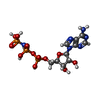 ChemComp-ANP: |
-Experimental details
-Structure determination
| Method | cryo EM |
|---|---|
 Processing Processing | single particle reconstruction |
| Aggregation state | particle |
-Sample preparation
| Buffer | pH: 7.5 |
|---|---|
| Vitrification | Cryogen name: ETHANE |
- Electron microscopy
| Microscope | FEI TITAN KRIOS |
|---|---|
| Image recording | #0 - Image recording ID: 1 / #0 - Film or detector model: GATAN K2 SUMMIT (4k x 4k) / #0 - Average electron dose: 70.0 e/Å2 / #1 - Image recording ID: 2 / #1 - Film or detector model: GATAN K3 BIOQUANTUM (6k x 4k) / #1 - Average electron dose: 66.0 e/Å2 |
| Electron beam | Acceleration voltage: 300 kV / Electron source:  FIELD EMISSION GUN FIELD EMISSION GUN |
| Electron optics | Illumination mode: FLOOD BEAM / Imaging mode: BRIGHT FIELD |
| Experimental equipment |  Model: Titan Krios / Image courtesy: FEI Company |