 Movie
Movie Controller

[English] 日本語
 Yorodumi
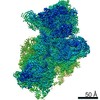
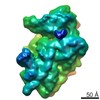
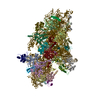
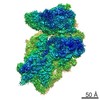
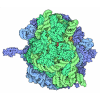
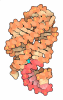
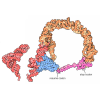
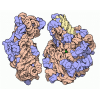
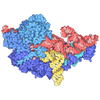
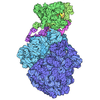
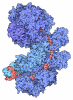
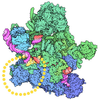
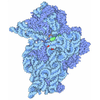
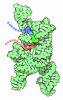
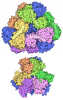
- PDB-6zxe: Cryo-EM structure of a late human pre-40S ribosomal subunit - State F2 -
+ Open data

- Basic information
| Entry | Database: PDB / ID: 6zxe | ||||||
|---|---|---|---|---|---|---|---|
| Title | Cryo-EM structure of a late human pre-40S ribosomal subunit - State F2 | ||||||
 Components Components |
| ||||||
 Keywords Keywords | RIBOSOME / Ribosome Biogenesis / Pre-40S | ||||||
| Function / homology |  Function and homology information Function and homology informationphenylalanyl-tRNA aminoacylation / phenylalanine-tRNA ligase activity / methyltransferase complex / methylosome / positive regulation of rRNA processing / negative regulation of endoplasmic reticulum unfolded protein response / oxidized pyrimidine DNA binding / response to TNF agonist / positive regulation of base-excision repair / positive regulation of intrinsic apoptotic signaling pathway in response to DNA damage ...phenylalanyl-tRNA aminoacylation / phenylalanine-tRNA ligase activity / methyltransferase complex / methylosome / positive regulation of rRNA processing / negative regulation of endoplasmic reticulum unfolded protein response / oxidized pyrimidine DNA binding / response to TNF agonist / positive regulation of base-excision repair / positive regulation of intrinsic apoptotic signaling pathway in response to DNA damage / positive regulation of respiratory burst involved in inflammatory response / positive regulation of gastrulation / regulation of adenylate cyclase-activating G protein-coupled receptor signaling pathway / protein tyrosine kinase inhibitor activity / IRE1-RACK1-PP2A complex / TNFR1-mediated ceramide production / positive regulation of Golgi to plasma membrane protein transport / nucleolus organization / positive regulation of ubiquitin-protein transferase activity / positive regulation of DNA-templated transcription initiation / negative regulation of RNA splicing / negative regulation of DNA repair / preribosome, small subunit precursor / erythrocyte homeostasis / supercoiled DNA binding / regulation of establishment of cell polarity / rRNA modification in the nucleus and cytosol / oxidized purine DNA binding / NF-kappaB complex / negative regulation of intrinsic apoptotic signaling pathway in response to hydrogen peroxide / negative regulation of phagocytosis / ubiquitin-like protein conjugating enzyme binding / cytoplasmic translational initiation / cytoplasmic side of rough endoplasmic reticulum membrane / Formation of the ternary complex, and subsequently, the 43S complex / laminin receptor activity / ion channel inhibitor activity / Ribosomal scanning and start codon recognition / protein kinase A binding / Translation initiation complex formation / negative regulation of Wnt signaling pathway / fibroblast growth factor binding / BH3 domain binding / Protein hydroxylation / TOR signaling / mTORC1-mediated signalling / negative regulation of translational frameshifting / monocyte chemotaxis / PELO:HBS1L and ABCE1 dissociate a ribosome on a non-stop mRNA / SARS-CoV-1 modulates host translation machinery / regulation of cell division / positive regulation of GTPase activity / Peptide chain elongation / Selenocysteine synthesis / negative regulation of protein binding / Formation of a pool of free 40S subunits / negative regulation of respiratory burst involved in inflammatory response / positive regulation of intrinsic apoptotic signaling pathway by p53 class mediator / protein serine/threonine kinase inhibitor activity / Eukaryotic Translation Termination / Dengue Virus Attachment and Entry / SRP-dependent cotranslational protein targeting to membrane / Response of EIF2AK4 (GCN2) to amino acid deficiency / ubiquitin ligase inhibitor activity / Viral mRNA Translation / endonucleolytic cleavage to generate mature 3'-end of SSU-rRNA from (SSU-rRNA, 5.8S rRNA, LSU-rRNA) / Nonsense Mediated Decay (NMD) independent of the Exon Junction Complex (EJC) / positive regulation of signal transduction by p53 class mediator / GTP hydrolysis and joining of the 60S ribosomal subunit / L13a-mediated translational silencing of Ceruloplasmin expression / Hydrolases; Acting on acid anhydrides; In phosphorus-containing anhydrides / regulation of translational fidelity / Major pathway of rRNA processing in the nucleolus and cytosol / spindle assembly / positive regulation of microtubule polymerization / phagocytic cup / Nonsense Mediated Decay (NMD) enhanced by the Exon Junction Complex (EJC) / negative regulation of ubiquitin-dependent protein catabolic process / Protein methylation / positive regulation of cell cycle / endonucleolytic cleavage in ITS1 to separate SSU-rRNA from 5.8S rRNA and LSU-rRNA from tricistronic rRNA transcript (SSU-rRNA, 5.8S rRNA, LSU-rRNA) / RNA endonuclease activity / translation regulator activity / Nuclear events stimulated by ALK signaling in cancer / DNA-(apurinic or apyrimidinic site) endonuclease activity / ribosomal small subunit export from nucleus / negative regulation of protein ubiquitination / Amplification of signal from unattached kinetochores via a MAD2 inhibitory signal / rough endoplasmic reticulum / laminin binding / SH2 domain binding / positive regulation of apoptotic signaling pathway / signaling adaptor activity / Maturation of protein E / MDM2/MDM4 family protein binding / Maturation of protein E / Mitotic Prometaphase / ER Quality Control Compartment (ERQC) / translation initiation factor binding / EML4 and NUDC in mitotic spindle formation Similarity search - Function | ||||||
| Biological species |  Homo sapiens (human) Homo sapiens (human) | ||||||
| Method | ELECTRON MICROSCOPY / single particle reconstruction / cryo EM / Resolution: 3 Å | ||||||
 Authors Authors | Ameismeier, M. / Zemp, I. / van den Heuvel, J. / Thoms, M. / Berninghausen, O. / Kutay, U. / Beckmann, R. | ||||||
| Funding support |  Germany, 1items Germany, 1items
| ||||||
 Citation Citation | Journal: Nature / Year: 2020 Title: Structural basis for the final steps of human 40S ribosome maturation. Authors: Michael Ameismeier / Ivo Zemp / Jasmin van den Heuvel / Matthias Thoms / Otto Berninghausen / Ulrike Kutay / Roland Beckmann /  Abstract: Eukaryotic ribosomes consist of a small 40S and a large 60S subunit that are assembled in a highly coordinated manner. More than 200 factors ensure correct modification, processing and folding of ...Eukaryotic ribosomes consist of a small 40S and a large 60S subunit that are assembled in a highly coordinated manner. More than 200 factors ensure correct modification, processing and folding of ribosomal RNA and the timely incorporation of ribosomal proteins. Small subunit maturation ends in the cytosol, when the final rRNA precursor, 18S-E, is cleaved at site 3 by the endonuclease NOB1. Previous structures of human 40S precursors have shown that NOB1 is kept in an inactive state by its partner PNO1. The final maturation events, including the activation of NOB1 for the decisive rRNA-cleavage step and the mechanisms driving the dissociation of the last biogenesis factors have, however, remained unresolved. Here we report five cryo-electron microscopy structures of human 40S subunit precursors, which describe the compositional and conformational progression during the final steps of 40S assembly. Our structures explain the central role of RIOK1 in the displacement and dissociation of PNO1, which in turn allows conformational changes and activation of the endonuclease NOB1. In addition, we observe two factors, eukaryotic translation initiation factor 1A domain-containing protein (EIF1AD) and leucine-rich repeat-containing protein 47 (LRRC47), which bind to late pre-40S particles near RIOK1 and the central rRNA helix 44. Finally, functional data shows that EIF1AD is required for efficient assembly factor recycling and 18S-E processing. Our results thus enable a detailed understanding of the last steps in 40S formation in human cells and, in addition, provide evidence for principal differences in small ribosomal subunit formation between humans and the model organism Saccharomyces cerevisiae. | ||||||
| History |
|
- Structure visualization
| Movie |
Movie viewer |
|---|---|
| Structure viewer | Molecule: MolmilJmol/JSmol |
- Downloads & links
-Download
| PDBx/mmCIF format | 6zxe.cif.gz | 1.8 MB | Display | PDBx/mmCIF format |
|---|---|---|---|---|
| PDB format | pdb6zxe.ent.gz | 1.4 MB | Display | PDB format |
| PDBx/mmJSON format | 6zxe.json.gz | Tree view | PDBx/mmJSON format | |
| Others |  Other downloads Other downloads |
-Validation report
| Arichive directory | https://data.pdbj.org/pub/pdb/validation_reports/zx/6zxeftp://data.pdbj.org/pub/pdb/validation_reports/zx/6zxe | HTTPS FTP |
|---|
-Related structure data
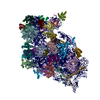
| Related structure data | 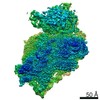 11518MC  6zxdC  6zxfC  6zxgC 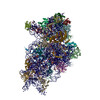 6zxhC M: map data used to model this data C: citing same article ( |
|---|---|
| Similar structure data |
-Links
 PDBj
PDBj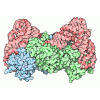
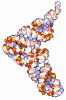
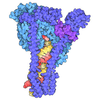




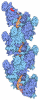
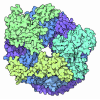
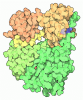
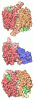
- Assembly
| Deposited unit | 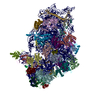
|
|---|---|
| 1 |
|
-Components
+40S ribosomal protein ... , 30 types, 30 molecules RABCEGHIJLNOVWXYbedDFKMPQSTUZc
-RNA-binding protein ... , 2 types, 2 molecules xy
| #20: Protein | Mass: 27970.355 Da / Num. of mol.: 1 / Source method: isolated from a natural source / Source: (natural) Homo sapiens (human) / References: UniProt: Q9NRX1 |
|---|---|
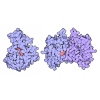
| #21: Protein | Mass: 46743.914 Da / Num. of mol.: 1 / Source method: isolated from a natural source / Source: (natural) Homo sapiens (human)References: UniProt: Q9ULX3, Hydrolases; Acting on ester bonds |
-Protein , 4 types, 4 molecules fgkz
| #34: Protein | Mass: 18004.041 Da / Num. of mol.: 1 / Source method: isolated from a natural source / Source: (natural) Homo sapiens (human) / References: UniProt: P62979 |
|---|---|
| #35: Protein | Mass: 35115.652 Da / Num. of mol.: 1 / Source method: isolated from a natural source / Source: (natural) Homo sapiens (human) / References: UniProt: P63244 |
| #36: Protein | Mass: 63563.941 Da / Num. of mol.: 1 / Source method: isolated from a natural source / Source: (natural) Homo sapiens (human) / References: UniProt: Q8N1G4 |
| #37: Protein | Mass: 65692.094 Da / Num. of mol.: 1 / Source method: isolated from a natural source / Source: (natural) Homo sapiens (human)References: UniProt: Q9BRS2, non-specific serine/threonine protein kinase, Hydrolases; Acting on acid anhydrides; Acting on acid anhydrides to catalyse transmembrane movement of substances |
-RNA chain / Non-polymers , 2 types, 3 molecules 2
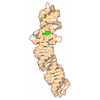
| #1: RNA chain | Mass: 604102.750 Da / Num. of mol.: 1 / Source method: isolated from a natural source / Source: (natural) Homo sapiens (human) / References: GenBank: 151415227 |
|---|---|
| #38: Chemical |  Mass: 65.409 Da / Num. of mol.: 2 / Source method: obtained synthetically / Formula: Zn Mass: 65.409 Da / Num. of mol.: 2 / Source method: obtained synthetically / Formula: Zn |
-Details
| Has ligand of interest | N |
|---|
-Experimental details
-Experiment
| Experiment | Method: ELECTRON MICROSCOPY |
|---|---|
| EM experiment | Aggregation state: PARTICLE / 3D reconstruction method: single particle reconstruction |
- Sample preparation
| Component | Name: Cryo-EM structure of a late human pre-40S ribosomal subunit - State F2 Type: RIBOSOME / Details: Map filtered at local resolution / Entity ID: #1-#37 / Source: NATURAL |
|---|---|
| Source (natural) | Organism: Homo sapiens (human) / Strain: HEK293T |
| Buffer solution | pH: 7.6 |
| Specimen | Embedding applied: NO / Shadowing applied: NO / Staining applied: NO / Vitrification applied: YES |
| Vitrification | Cryogen name: ETHANE |
- Electron microscopy imaging
| Experimental equipment |  Model: Titan Krios / Image courtesy: FEI Company |
|---|---|
| Microscopy | Model: FEI TITAN KRIOS |
| Electron gun | Electron source:  FIELD EMISSION GUN / Accelerating voltage: 300 kV / Illumination mode: FLOOD BEAM FIELD EMISSION GUN / Accelerating voltage: 300 kV / Illumination mode: FLOOD BEAM |
| Electron lens | Mode: BRIGHT FIELD |
| Image recording | Electron dose: 48 e/Å2 / Film or detector model: GATAN K2 SUMMIT (4k x 4k) |
- Processing
| CTF correction | Type: PHASE FLIPPING AND AMPLITUDE CORRECTION |
|---|---|
| 3D reconstruction | Resolution: 3 Å / Resolution method: FSC 0.143 CUT-OFF / Num. of particles: 32535 / Symmetry type: POINT |
