 Movie
Movie Controller


+ Open data

- Basic information
| Entry | Database: PDB / ID: 6v4p | |||||||||||||||||||||||||||||||||||||||||||||||||||
|---|---|---|---|---|---|---|---|---|---|---|---|---|---|---|---|---|---|---|---|---|---|---|---|---|---|---|---|---|---|---|---|---|---|---|---|---|---|---|---|---|---|---|---|---|---|---|---|---|---|---|---|---|
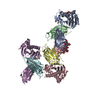
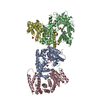
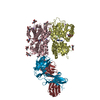
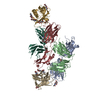
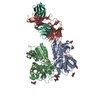
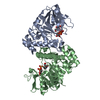
| Title | Structure of the integrin AlphaIIbBeta3-Abciximab complex | |||||||||||||||||||||||||||||||||||||||||||||||||||
 Components Components |
| |||||||||||||||||||||||||||||||||||||||||||||||||||
 Keywords Keywords | Cell Adhesion/Immune System / Integrin / Abciximab / BLOOD CLOTTING / Cell Adhesion-Immune System complex | |||||||||||||||||||||||||||||||||||||||||||||||||||
| Function / homology |  Function and homology information Function and homology informationregulation of serotonin uptake / positive regulation of adenylate cyclase-inhibiting opioid receptor signaling pathway / tube development / alpha9-beta1 integrin-ADAM8 complex / response to platelet-derived growth factor / integrin alphaIIb-beta3 complex / regulation of postsynaptic neurotransmitter receptor diffusion trapping / maintenance of postsynaptic specialization structure / alphav-beta3 integrin-vitronectin complex / platelet alpha granule membrane ...regulation of serotonin uptake / positive regulation of adenylate cyclase-inhibiting opioid receptor signaling pathway / tube development / alpha9-beta1 integrin-ADAM8 complex / response to platelet-derived growth factor / integrin alphaIIb-beta3 complex / regulation of postsynaptic neurotransmitter receptor diffusion trapping / maintenance of postsynaptic specialization structure / alphav-beta3 integrin-vitronectin complex / platelet alpha granule membrane / positive regulation of glomerular mesangial cell proliferation / integrin alphav-beta3 complex / negative regulation of lipoprotein metabolic process / smooth muscle cell migration / alphav-beta3 integrin-PKCalpha complex / fibrinogen binding / positive regulation of leukocyte migration / alphav-beta3 integrin-HMGB1 complex / negative regulation of lipid transport / vascular endothelial growth factor receptor 2 binding / angiogenesis involved in wound healing / positive regulation of vascular endothelial growth factor signaling pathway / regulation of release of sequestered calcium ion into cytosol / Elastic fibre formation / mesodermal cell differentiation / positive regulation of bone resorption / alphav-beta3 integrin-IGF-1-IGF1R complex / platelet-derived growth factor receptor binding / cell-cell adhesion mediated by integrin / filopodium membrane / glycinergic synapse / extracellular matrix binding / positive regulation of fibroblast migration / positive regulation of cell adhesion mediated by integrin / positive regulation of vascular endothelial growth factor receptor signaling pathway / apolipoprotein A-I-mediated signaling pathway / regulation of bone resorption / negative regulation of low-density lipoprotein particle clearance / apoptotic cell clearance / wound healing, spreading of epidermal cells / positive regulation of smooth muscle cell migration / integrin complex / Molecules associated with elastic fibres / heterotypic cell-cell adhesion / cell adhesion mediated by integrin / negative chemotaxis / positive regulation of osteoblast proliferation / Mechanical load activates signaling by PIEZO1 and integrins in osteocytes / cellular response to insulin-like growth factor stimulus / Syndecan interactions / p130Cas linkage to MAPK signaling for integrins / regulation of postsynaptic neurotransmitter receptor internalization / cell-substrate adhesion / protein disulfide isomerase activity / microvillus membrane / PECAM1 interactions / GRB2:SOS provides linkage to MAPK signaling for Integrins / negative regulation of endothelial cell apoptotic process / TGF-beta receptor signaling activates SMADs / fibronectin binding / lamellipodium membrane / negative regulation of macrophage derived foam cell differentiation / negative regulation of lipid storage / Integrin cell surface interactions / ECM proteoglycans / substrate adhesion-dependent cell spreading / positive regulation of T cell migration / cell-matrix adhesion / embryo implantation / coreceptor activity / Integrin signaling / positive regulation of endothelial cell proliferation / positive regulation of smooth muscle cell proliferation / positive regulation of endothelial cell migration / cell adhesion molecule binding / integrin-mediated signaling pathway / Turbulent (oscillatory, disturbed) flow shear stress activates signaling by PIEZO1 and integrins in endothelial cells / response to activity / protein kinase C binding / wound healing / Signal transduction by L1 / cellular response to xenobiotic stimulus / regulation of actin cytoskeleton organization / cell-cell adhesion / cellular response to mechanical stimulus / platelet activation / Signaling by high-kinase activity BRAF mutants / MAP2K and MAPK activation / RUNX1 regulates genes involved in megakaryocyte differentiation and platelet function / platelet aggregation / VEGFA-VEGFR2 Pathway / integrin binding / ruffle membrane / blood coagulation / positive regulation of angiogenesis / Signaling by RAF1 mutants / cell-cell junction / Signaling by moderate kinase activity BRAF mutants / Paradoxical activation of RAF signaling by kinase inactive BRAF / Signaling downstream of RAS mutants Similarity search - Function | |||||||||||||||||||||||||||||||||||||||||||||||||||
| Biological species |  Homo sapiens (human) Homo sapiens (human)synthetic construct (others) | |||||||||||||||||||||||||||||||||||||||||||||||||||
| Method | ELECTRON MICROSCOPY / single particle reconstruction / cryo EM / Resolution: 2.8 Å | |||||||||||||||||||||||||||||||||||||||||||||||||||
 Authors Authors | Nesic, D. / Zhang, Y. / Spasic, A. / Li, J. / Provasi, D. / Filizola, M. / Walz, T. / Coller, B.S. | |||||||||||||||||||||||||||||||||||||||||||||||||||
| Funding support |  United States, 3items United States, 3items
| |||||||||||||||||||||||||||||||||||||||||||||||||||
 Citation Citation | Journal: Arterioscler Thromb Vasc Biol / Year: 2020 Title: Cryo-Electron Microscopy Structure of the αIIbβ3-Abciximab Complex. Authors: Dragana Nešić / Yixiao Zhang / Aleksandar Spasic / Jihong Li / Davide Provasi / Marta Filizola / Thomas Walz / Barry S Coller Abstract: OBJECTIVE: The αIIbβ3 antagonist antiplatelet drug abciximab is the chimeric antigen-binding fragment comprising the variable regions of murine monoclonal antibody 7E3 and the constant domains of ...OBJECTIVE: The αIIbβ3 antagonist antiplatelet drug abciximab is the chimeric antigen-binding fragment comprising the variable regions of murine monoclonal antibody 7E3 and the constant domains of human IgG1 and light chain κ. Previous mutagenesis studies suggested that abciximab binds to the β3 C177-C184 specificity-determining loop (SDL) and Trp129 on the adjacent β1-α1 helix. These studies could not, however, assess whether 7E3 or abciximab prevents fibrinogen binding by steric interference, disruption of either the αIIbβ3-binding pocket for fibrinogen or the β3 SDL (which is not part of the binding pocket but affects fibrinogen binding), or some combination of these effects. To address this gap, we used cryo-electron microscopy to determine the structure of the αIIbβ3-abciximab complex at 2.8 Å resolution. Approach and Results: The interacting surface of abciximab is comprised of residues from all 3 complementarity-determining regions of both the light and heavy chains, with high representation of aromatic residues. Binding is primarily to the β3 SDL and neighboring residues, the β1-α1 helix, and β3 residues Ser211, Val212 and Met335. Unexpectedly, the structure also indicated several interactions with αIIb. As judged by the cryo-electron microscopy model, molecular-dynamics simulations, and mutagenesis, the binding of abciximab does not appear to rely on the interaction with the αIIb residues and does not result in disruption of the fibrinogen-binding pocket; it does, however, compress and reduce the flexibility of the SDL. CONCLUSIONS: We deduce that abciximab prevents ligand binding by steric interference, with a potential contribution via displacement of the SDL and limitation of the flexibility of the SDL residues. | |||||||||||||||||||||||||||||||||||||||||||||||||||
| History |
|
- Structure visualization
| Movie |
Movie viewer |
|---|---|
| Structure viewer | Molecule: MolmilJmol/JSmol |
- Downloads & links
-Download
| PDBx/mmCIF format | 6v4p.cif.gz | 249.7 KB | Display | PDBx/mmCIF format |
|---|---|---|---|---|
| PDB format | pdb6v4p.ent.gz | 183.9 KB | Display | PDB format |
| PDBx/mmJSON format | 6v4p.json.gz | Tree view | PDBx/mmJSON format | |
| Others |  Other downloads Other downloads |
-Validation report
| Arichive directory | https://data.pdbj.org/pub/pdb/validation_reports/v4/6v4pftp://data.pdbj.org/pub/pdb/validation_reports/v4/6v4p | HTTPS FTP |
|---|
-Related structure data
| Related structure data |  21044MC M: map data used to model this data C: citing same article ( |
|---|---|
| Similar structure data |


-Links
 PDBj
PDBj
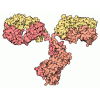
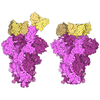

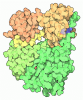
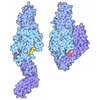

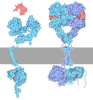
- Assembly
| Deposited unit | 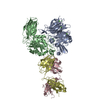
|
|---|---|
| 1 |
|
-Components
-Protein , 2 types, 2 molecules AB
| #1: Protein | Mass: 104894.438 Da / Num. of mol.: 1 Source method: isolated from a genetically manipulated source Source: (gene. exp.) Homo sapiens (human) / Gene: ITGA2B, GP2B, ITGAB / Production host: Homo sapiens (human) / References: UniProt: P08514 |
|---|---|
| #2: Protein | Mass: 75974.828 Da / Num. of mol.: 1 Source method: isolated from a genetically manipulated source Source: (gene. exp.) Homo sapiens (human) / Gene: ITGB3, GP3A / Production host: Homo sapiens (human) / References: UniProt: P05106 |
-Antibody , 2 types, 2 molecules CD
| #3: Antibody | Mass: 24161.119 Da / Num. of mol.: 1 Source method: isolated from a genetically manipulated source Source: (gene. exp.) synthetic construct (others) / Production host: Homo sapiens (human) |
|---|---|
| #4: Antibody | Mass: 23501.986 Da / Num. of mol.: 1 Source method: isolated from a genetically manipulated source Source: (gene. exp.) synthetic construct (others) / Production host: Homo sapiens (human) |
-Non-polymers , 2 types, 7 molecules 

| #5: Chemical | ChemComp-CA /  Mass: 40.078 Da / Num. of mol.: 6 / Source method: obtained synthetically / Formula: Ca / Feature type: SUBJECT OF INVESTIGATION Mass: 40.078 Da / Num. of mol.: 6 / Source method: obtained synthetically / Formula: Ca / Feature type: SUBJECT OF INVESTIGATION#6: Chemical | ChemComp-MG / |  Mass: 24.305 Da / Num. of mol.: 1 / Source method: obtained synthetically / Formula: Mg / Feature type: SUBJECT OF INVESTIGATION Mass: 24.305 Da / Num. of mol.: 1 / Source method: obtained synthetically / Formula: Mg / Feature type: SUBJECT OF INVESTIGATION |
|---|
-Details
| Has ligand of interest | Y |
|---|---|
| Has protein modification | Y |
-Experimental details
-Experiment
| Experiment | Method: ELECTRON MICROSCOPY |
|---|---|
| EM experiment | Aggregation state: PARTICLE / 3D reconstruction method: single particle reconstruction |
- Sample preparation
| Component | Name: Integrin AlphaIIbBeta3-Abciximab Complex / Type: COMPLEX / Entity ID: #1-#4 / Source: RECOMBINANT |
|---|---|
| Source (natural) | Organism: Homo sapiens (human) |
| Source (recombinant) | Organism: Homo sapiens (human) |
| Buffer solution | pH: 7.4 |
| Specimen | Conc.: 0.1 mg/ml / Embedding applied: NO / Shadowing applied: NO / Staining applied: NO / Vitrification applied: YES |
| Vitrification | Cryogen name: NITROGEN |
- Electron microscopy imaging
| Experimental equipment |  Model: Titan Krios / Image courtesy: FEI Company |
|---|---|
| Microscopy | Model: FEI TITAN KRIOS |
| Electron gun | Electron source:  FIELD EMISSION GUN / Accelerating voltage: 300 kV / Illumination mode: FLOOD BEAM FIELD EMISSION GUN / Accelerating voltage: 300 kV / Illumination mode: FLOOD BEAM |
| Electron lens | Mode: BRIGHT FIELD |
| Image recording | Electron dose: 60 e/Å2 / Film or detector model: GATAN K2 SUMMIT (4k x 4k) |
- Processing
| Software | Name: PHENIX / Version: 1.17.1_3660: / Classification: refinement | ||||||||||||||||||||||||
|---|---|---|---|---|---|---|---|---|---|---|---|---|---|---|---|---|---|---|---|---|---|---|---|---|---|
| EM software | Name: PHENIX / Category: model refinement | ||||||||||||||||||||||||
| CTF correction | Type: PHASE FLIPPING AND AMPLITUDE CORRECTION | ||||||||||||||||||||||||
| 3D reconstruction | Resolution: 2.8 Å / Resolution method: FSC 0.143 CUT-OFF / Num. of particles: 1161396 / Symmetry type: POINT | ||||||||||||||||||||||||
| Refine LS restraints |
|
