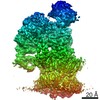
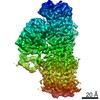
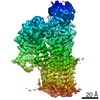
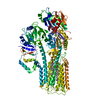
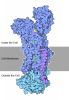
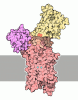
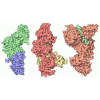
- EMDB-24214: Cryo-EM structure of ATP13A2 in the BeF-bound E2P-like state -
+
データを開く
IDまたはキーワード:
読み込み中...
-
基本情報
登録情報
データベース: EMDB / ID: EMD-24214
タイトル
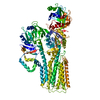
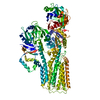
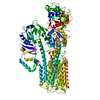
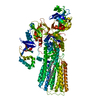
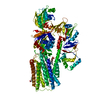
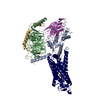
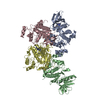
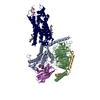
Cryo-EM structure of ATP13A2 in the BeF-bound E2P-like state
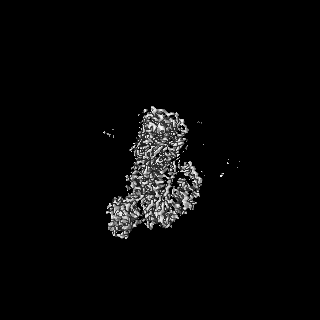
マップデータ
Summed, unsharpened map
試料
複合体: Human ATP13A2 complexed with BeF3
タンパク質・ペプチド: Isoform 3 of Polyamine-transporting ATPase 13A2
リガンド: BERYLLIUM TRIFLUORIDE ION
リガンド: MAGNESIUM ION
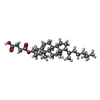
リガンド: CHOLESTEROL HEMISUCCINATE
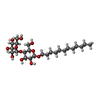
リガンド: DODECYL-BETA-D-MALTOSIDE
キーワード
P-type ATPase / P5B-ATPase / polyamine transporter / TRANSPORT PROTEIN
機能・相同性
機能・相同性情報
polyamine transmembrane transport / spermine transmembrane transport / polyamine transmembrane transporter activity / ABC-type polyamine transporter activity / regulation of autophagosome size / extracellular exosome biogenesis / negative regulation of lysosomal protein catabolic process / regulation of chaperone-mediated autophagy / P-type ion transporter activity / regulation of autophagy of mitochondrion ...polyamine transmembrane transport / spermine transmembrane transport / polyamine transmembrane transporter activity / ABC-type polyamine transporter activity / regulation of autophagosome size / extracellular exosome biogenesis / negative regulation of lysosomal protein catabolic process / regulation of chaperone-mediated autophagy / P-type ion transporter activity / regulation of autophagy of mitochondrion / regulation of lysosomal protein catabolic process / intracellular monoatomic cation homeostasis / autophagosome-lysosome fusion / autophagosome organization / protein localization to lysosome / positive regulation of exosomal secretion / ATPase-coupled monoatomic cation transmembrane transporter activity / multivesicular body membrane / phosphatidic acid binding / intracellular zinc ion homeostasis / cupric ion binding / regulation of mitochondrion organization / regulation of protein localization to nucleus / phosphatidylinositol-3,5-bisphosphate binding / トランスロカーゼ; 他の化合物の輸送を触媒; ヌクレオシド三リン酸の加水分解に伴う / lysosomal transport / regulation of intracellular protein transport / lipid homeostasis / cellular response to zinc ion / autophagosome membrane / Ion transport by P-type ATPases / regulation of macroautophagy / transport vesicle / cellular response to manganese ion / multivesicular body / lysosomal lumen / autophagosome / regulation of neuron apoptotic process / positive regulation of protein secretion / autophagy / intracellular calcium ion homeostasis / late endosome / late endosome membrane / manganese ion binding / cellular response to oxidative stress / monoatomic ion transmembrane transport / vesicle / intracellular iron ion homeostasis / lysosome / neuron projection / lysosomal membrane / neuronal cell body / positive regulation of gene expression / ATP hydrolysis activity / zinc ion binding / ATP binding / membrane 類似検索 - 分子機能
ジャーナル: Mol Cell / 年: 2021 タイトル: Structural basis of polyamine transport by human ATP13A2 (PARK9). 著者: Sue Im Sim / Sören von Bülow / Gerhard Hummer / Eunyong Park / 要旨: Polyamines are small, organic polycations that are ubiquitous and essential to all forms of life. Currently, how polyamines are transported across membranes is not understood. Recent studies have ...Polyamines are small, organic polycations that are ubiquitous and essential to all forms of life. Currently, how polyamines are transported across membranes is not understood. Recent studies have suggested that ATP13A2 and its close homologs, collectively known as P5B-ATPases, are polyamine transporters at endo-/lysosomes. Loss-of-function mutations of ATP13A2 in humans cause hereditary early-onset Parkinson's disease. To understand the polyamine transport mechanism of ATP13A2, we determined high-resolution cryoelectron microscopy (cryo-EM) structures of human ATP13A2 in five distinct conformational intermediates, which together, represent a near-complete transport cycle of ATP13A2. The structural basis of the polyamine specificity was revealed by an endogenous polyamine molecule bound to a narrow, elongated cavity within the transmembrane domain. The structures show an atypical transport path for a water-soluble substrate, in which polyamines may exit within the cytosolic leaflet of the membrane. Our study provides important mechanistic insights into polyamine transport and a framework to understand the functions and mechanisms of P5B-ATPases.
 ムービー
ムービー コントローラー


 データを開く
 基本情報
基本情報 マップデータ
 試料
試料 キーワード
キーワード 機能・相同性情報
 Homo sapiens (ヒト)
 データ登録者
 米国, 1件
  引用
引用
 構造の表示
構造の表示
 ダウンロードとリンク
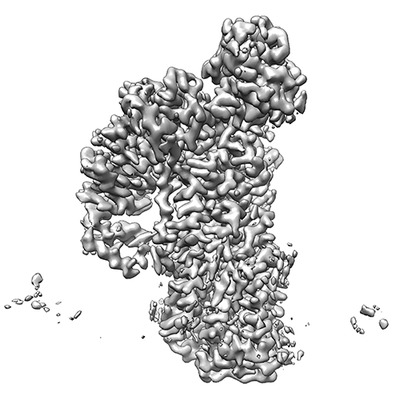 emd_24214.png
 http://ftp.pdbj.org/pub/emdb/structures/EMD-24214










 Z (Sec.)
 Y (Row.)
 X (Col.)






 試料の構成要素
 Spodoptera frugiperda (ツマジロクサヨトウ)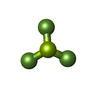
 解析
解析 電子顕微鏡法
 FIELD EMISSION GUN

