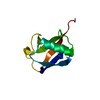
negative regulation of mRNA 3'-end processing / histone H2AK127 ubiquitin ligase activity / histone H2AK129 ubiquitin ligase activity / Defective DNA double strand break response due to BRCA1 loss of function / Defective DNA double strand break response due to BARD1 loss of function / BRCA1-BARD1 complex / BRCA1-B complex / BRCA1-A complex / BRCA1-C complex / ubiquitin-modified histone reader activity ...negative regulation of mRNA 3'-end processing / histone H2AK127 ubiquitin ligase activity / histone H2AK129 ubiquitin ligase activity / Defective DNA double strand break response due to BRCA1 loss of function / Defective DNA double strand break response due to BARD1 loss of function / BRCA1-BARD1 complex / BRCA1-B complex / BRCA1-A complex / BRCA1-C complex / ubiquitin-modified histone reader activity / regulation of phosphorylation / DNA strand resection involved in replication fork processing / nuclear ubiquitin ligase complex / homologous recombination / tissue homeostasis / mitotic G2/M transition checkpoint / negative regulation of protein export from nucleus / regulation of DNA damage checkpoint / Impaired BRCA2 binding to PALB2 / hypothalamus gonadotrophin-releasing hormone neuron development / protein K6-linked ubiquitination / female meiosis I / positive regulation of protein monoubiquitination / fat pad development / mitochondrion transport along microtubule / Homologous DNA Pairing and Strand Exchange / Defective homologous recombination repair (HRR) due to BRCA1 loss of function / Defective HDR through Homologous Recombination Repair (HRR) due to PALB2 loss of BRCA1 binding function / Defective HDR through Homologous Recombination Repair (HRR) due to PALB2 loss of BRCA2/RAD51/RAD51C binding function / Resolution of D-loop Structures through Synthesis-Dependent Strand Annealing (SDSA) / HDR through Single Strand Annealing (SSA) / Resolution of D-loop Structures through Holliday Junction Intermediates / seminiferous tubule development / female gonad development / Impaired BRCA2 binding to RAD51 / negative regulation of cell cycle / male meiosis I / Presynaptic phase of homologous DNA pairing and strand exchange / positive regulation of intrinsic apoptotic signaling pathway by p53 class mediator / ubiquitin ligase complex / negative regulation of tumor necrosis factor-mediated signaling pathway / regulation of DNA repair / negative regulation of megakaryocyte differentiation / neuron projection morphogenesis / protein localization to CENP-A containing chromatin / Chromatin modifying enzymes / energy homeostasis / Replacement of protamines by nucleosomes in the male pronucleus / CENP-A containing nucleosome / regulation of proteasomal protein catabolic process / Packaging Of Telomere Ends / Maturation of protein E / Maturation of protein E / ER Quality Control Compartment (ERQC) / Myoclonic epilepsy of Lafora / FLT3 signaling by CBL mutants / IRAK2 mediated activation of TAK1 complex / Prevention of phagosomal-lysosomal fusion / Alpha-protein kinase 1 signaling pathway / Recognition and association of DNA glycosylase with site containing an affected purine / Cleavage of the damaged purine / Glycogen synthesis / IRAK1 recruits IKK complex / IRAK1 recruits IKK complex upon TLR7/8 or 9 stimulation / Endosomal Sorting Complex Required For Transport (ESCRT) / Membrane binding and targetting of GAG proteins / Negative regulation of FLT3 / Regulation of TBK1, IKKε (IKBKE)-mediated activation of IRF3, IRF7 / PTK6 Regulates RTKs and Their Effectors AKT1 and DOK1 / Regulation of TBK1, IKKε-mediated activation of IRF3, IRF7 upon TLR3 ligation / IRAK2 mediated activation of TAK1 complex upon TLR7/8 or 9 stimulation / Deposition of new CENPA-containing nucleosomes at the centromere / Constitutive Signaling by NOTCH1 HD Domain Mutants / NOTCH2 Activation and Transmission of Signal to the Nucleus / TICAM1,TRAF6-dependent induction of TAK1 complex / epigenetic regulation of gene expression / TICAM1-dependent activation of IRF3/IRF7 / APC/C:Cdc20 mediated degradation of Cyclin B / Regulation of FZD by ubiquitination / Downregulation of ERBB4 signaling / telomere organization / APC-Cdc20 mediated degradation of Nek2A / p75NTR recruits signalling complexes / Interleukin-7 signaling / Recognition and association of DNA glycosylase with site containing an affected pyrimidine / Cleavage of the damaged pyrimidine / InlA-mediated entry of Listeria monocytogenes into host cells / TRAF6 mediated IRF7 activation in TLR7/8 or 9 signaling / regulation of neuron apoptotic process / NF-kB is activated and signals survival / TRAF6-mediated induction of TAK1 complex within TLR4 complex / Regulation of pyruvate metabolism / RNA Polymerase I Promoter Opening / Pexophagy / Regulation of innate immune responses to cytosolic DNA / NRIF signals cell death from the nucleus / Downregulation of ERBB2:ERBB3 signaling / Regulation of PTEN localization / Inhibition of DNA recombination at telomere / Assembly of the ORC complex at the origin of replication 類似検索 - 分子機能
National Institutes of Health/National Cancer Institute (NIH/NCI)
R01 CA132878
米国
National Institutes of Health/National Institute of General Medical Sciences (NIH/NIGMS)
R35 GM136262
米国
National Institutes of Health/National Institute of General Medical Sciences (NIH/NIGMS)
R01 GM116829
米国
引用
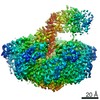
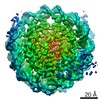
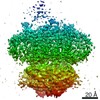
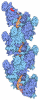
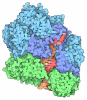
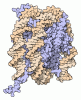
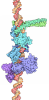
ジャーナル: Nature / 年: 2021 タイトル: Mechanisms of BRCA1-BARD1 nucleosome recognition and ubiquitylation. 著者: Qi Hu / Maria Victoria Botuyan / Debiao Zhao / Gaofeng Cui / Elie Mer / Georges Mer / 要旨: The BRCA1-BARD1 tumour suppressor is an E3 ubiquitin ligase necessary for the repair of DNA double-strand breaks by homologous recombination. The BRCA1-BARD1 complex localizes to damaged chromatin ...The BRCA1-BARD1 tumour suppressor is an E3 ubiquitin ligase necessary for the repair of DNA double-strand breaks by homologous recombination. The BRCA1-BARD1 complex localizes to damaged chromatin after DNA replication and catalyses the ubiquitylation of histone H2A and other cellular targets. The molecular bases for the recruitment to double-strand breaks and target recognition of BRCA1-BARD1 remain unknown. Here we use cryo-electron microscopy to show that the ankyrin repeat and tandem BRCT domains in BARD1 adopt a compact fold and bind to nucleosomal histones, DNA and monoubiquitin attached to H2A amino-terminal K13 or K15, two signals known to be specific for double-strand breaks. We further show that RING domains in BRCA1-BARD1 orient an E2 ubiquitin-conjugating enzyme atop the nucleosome in a dynamic conformation, primed for ubiquitin transfer to the flexible carboxy-terminal tails of H2A and variant H2AX. Our work reveals a regulatory crosstalk in which recognition of monoubiquitin by BRCA1-BARD1 at the N terminus of H2A blocks the formation of polyubiquitin chains and cooperatively promotes ubiquitylation at the C terminus of H2A. These findings elucidate the mechanisms of BRCA1-BARD1 chromatin recruitment and ubiquitylation specificity, highlight key functions of BARD1 in both processes and explain how BRCA1-BARD1 promotes homologous recombination by opposing the DNA repair protein 53BP1 in post-replicative chromatin. These data provide a structural framework to evaluate BARD1 variants and help to identify mutations that drive the development of cancer.
source_name: PDB, initial_model_type: experimental model
精密化
空間: REAL / プロトコル: RIGID BODY FIT
得られたモデル
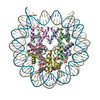
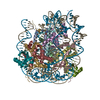
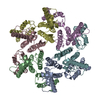
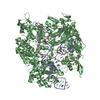
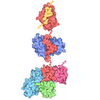
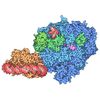
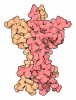
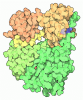
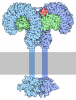
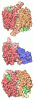
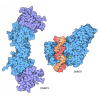
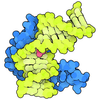
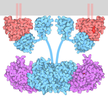
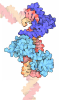
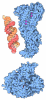
PDB-7lyc: Cryo-EM structure of the human nucleosome core particle ubiquitylated at histone H2A Lys13 and Lys15 in complex with BARD1 (residues 415-777)
 ムービー
ムービー コントローラー


 データを開く
 基本情報
基本情報 マップデータ
 試料
試料 キーワード
キーワード 機能・相同性情報
 Homo sapiens (ヒト)
 データ登録者
 米国, 3件
  引用
引用 構造の表示
構造の表示
 ダウンロードとリンク
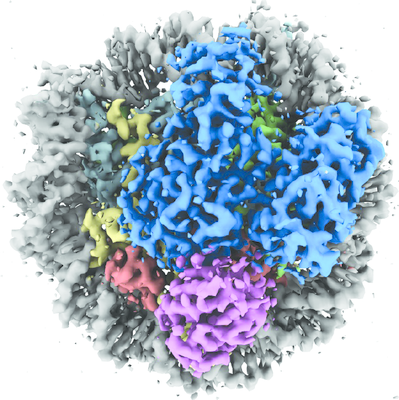 emd_23592.png
 http://ftp.pdbj.org/pub/emdb/structures/EMD-23592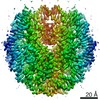





 Z (Sec.)
 Y (Row.)
 X (Col.)






 試料の構成要素
 Escherichia coli (大腸菌)
 解析
解析 電子顕微鏡法
 FIELD EMISSION GUN