[English] 日本語
Yorodumi Papers
- Database of articles cited by EMDB/PDB/SASBDB data -

+
Search query

Keywords
Structure methods
Author
Journal
IF

-
Structure paper

TitleProton perception and activation of a proton-sensing GPCR.
Journal, issue, pagesMol Cell, Vol. 85, Issue 8, Page 1640-11657.e8, Year 2025
Publish dateApr 17, 2025
AuthorsLi-Nan Chen / Hui Zhou / Kun Xi / Shizhuo Cheng / Yongfeng Liu / Yifan Fu / Xiangyu Ma / Ping Xu / Su-Yu Ji / Wei-Wei Wang / Dan-Dan Shen / Huibing Zhang / Qingya Shen / Renjie Chai / Min Zhang / Lin Yang / Feng Han / Chunyou Mao / Xiujun Cai / Yan Zhang /
PubMed AbstractMaintaining pH at cellular, tissular, and systemic levels is essential for human health. Proton-sensing GPCRs regulate physiological and pathological processes by sensing the extracellular acidity. ...Maintaining pH at cellular, tissular, and systemic levels is essential for human health. Proton-sensing GPCRs regulate physiological and pathological processes by sensing the extracellular acidity. However, the molecular mechanism of proton sensing and activation of these receptors remains elusive. Here, we present cryoelectron microscopy (cryo-EM) structures of human GPR4, a prototypical proton-sensing GPCR, in its inactive and active states. Our studies reveal that three extracellular histidine residues are crucial for proton sensing of human GPR4. The binding of protons induces substantial conformational changes in GPR4's ECLs, particularly in ECL2, which transforms from a helix-loop to a β-turn-β configuration. This transformation leads to the rearrangements of H-bond network and hydrophobic packing, relayed by non-canonical motifs to accommodate G proteins. Furthermore, the antagonist NE52-QQ57 hinders human GPR4 activation by preventing hydrophobic stacking rearrangement. Our findings provide a molecular framework for understanding the activation mechanism of a human proton-sensing GPCR, aiding future drug discovery.
External linksMol Cell / PubMed:40215960
MethodsEM (single particle)
Resolution2.4 - 3.2 Å
Structure data

EMDB-39865, PDB-8z9o:
Cryo-EM structure of human GPR4-Gs complex
Method: EM (single particle) / Resolution: 2.4 Å

EMDB-39866, PDB-8z9p:
Cryo-EM structure of human GPR4-Gi complex
Method: EM (single particle) / Resolution: 2.5 Å

EMDB-63219, PDB-9lmo:
Cryo-EM structure of human apo inactive GPR4
Method: EM (single particle) / Resolution: 3.2 Å

EMDB-63220, PDB-9lmp:
Cryo-EM structure of antagonist-bounded inactive human GPR4
Method: EM (single particle) / Resolution: 2.65 Å

Chemicals

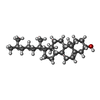
ChemComp-CLR:
CHOLESTEROL

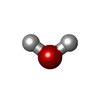
ChemComp-HOH:
WATER

PDB-1l1e:
Crystal Structure of Mycolic Acid Cyclopropane Synthase PcaA Complexed with S-adenosyl-L-homocysteine

Source
  • homo sapiens (human)
  • rattus norvegicus (Norway rat)
  • bos taurus (domestic cattle)
  • synthetic construct (others)
  • escherichia coli (E. coli)
KeywordsMEMBRANE PROTEIN/IMMUNE SYSTEM / GPCR / class A / GPR4-Gs / cryo-EM / protein sensing / active state / MEMBRANE PROTEIN-IMMUNE SYSTEM complex / MEMBRANE PROTEIN / GPR4-Gi / GPR4 / inactive state / antagonist-bounded

+
About Yorodumi Papers

-
News

-
Feb 9, 2022. New format data for meta-information of EMDB entries

New format data for meta-information of EMDB entries

  • Version 3 of the EMDB header file is now the official format.
  • The previous official version 1.9 will be removed from the archive.

Related info.:EMDB header

External links:wwPDB to switch to version 3 of the EMDB data model

-
Aug 12, 2020. Covid-19 info

Covid-19 info

URL: https://pdbj.org/emnavi/covid19.php

New page: Covid-19 featured information page in EM Navigator.

Related info.:Covid-19 info / Mar 5, 2020. Novel coronavirus structure data

+
Mar 5, 2020. Novel coronavirus structure data

Novel coronavirus structure data

Related info.:Yorodumi Speices / Aug 12, 2020. Covid-19 info

External links:COVID-19 featured content - PDBj / Molecule of the Month (242):Coronavirus Proteases

+
Jan 31, 2019. EMDB accession codes are about to change! (news from PDBe EMDB page)

EMDB accession codes are about to change! (news from PDBe EMDB page)

  • The allocation of 4 digits for EMDB accession codes will soon come to an end. Whilst these codes will remain in use, new EMDB accession codes will include an additional digit and will expand incrementally as the available range of codes is exhausted. The current 4-digit format prefixed with “EMD-” (i.e. EMD-XXXX) will advance to a 5-digit format (i.e. EMD-XXXXX), and so on. It is currently estimated that the 4-digit codes will be depleted around Spring 2019, at which point the 5-digit format will come into force.
  • The EM Navigator/Yorodumi systems omit the EMD- prefix.

Related info.:Q: What is EMD? / ID/Accession-code notation in Yorodumi/EM Navigator

External links:EMDB Accession Codes are Changing Soon! / Contact to PDBj

+
Jul 12, 2017. Major update of PDB

Major update of PDB

  • wwPDB released updated PDB data conforming to the new PDBx/mmCIF dictionary.
  • This is a major update changing the version number from 4 to 5, and with Remediation, in which all the entries are updated.
  • In this update, many items about electron microscopy experimental information are reorganized (e.g. em_software).
  • Now, EM Navigator and Yorodumi are based on the updated data.

External links:wwPDB Remediation / Enriched Model Files Conforming to OneDep Data Standards Now Available in the PDB FTP Archive

-
Yorodumi Papers

Database of articles cited by EMDB/PDB/SASBDB data

  • Database of articles cited by EMDB, PDB, and SASBDB entries
  • Using PubMed data

Related info.:EMDB / PDB / SASBDB / Yorodumi / EMN Papers / Changes in new EM Navigator and Yorodumi

Read more