[English] 日本語
Yorodumi Papers
- Database of articles cited by EMDB/PDB/SASBDB data -

+
Search query

Keywords
Structure methods
Author
Journal
IF

-
Structure paper

TitleAssembly and architecture of endogenous NMDA receptors in adult cerebral cortex and hippocampus.
Journal, issue, pagesCell, Vol. 188, Issue 5, Page 1198-1207.e13, Year 2025
Publish dateMar 6, 2025
AuthorsMing Zhang / Juan Feng / Chun Xie / Nan Song / Chaozhi Jin / Jian Wang / Qun Zhao / Lihua Zhang / Boshuang Wang / Yidi Sun / Fei Guo / Yang Li / Shujia Zhu /
PubMed AbstractThe cerebral cortex and hippocampus are crucial brain regions for learning and memory, which depend on activity-induced synaptic plasticity involving N-methyl-ᴅ-aspartate receptors (NMDARs). ...The cerebral cortex and hippocampus are crucial brain regions for learning and memory, which depend on activity-induced synaptic plasticity involving N-methyl-ᴅ-aspartate receptors (NMDARs). However, subunit assembly and molecular architecture of endogenous NMDARs (eNMDARs) in the brain remain elusive. Using conformation- and subunit-dependent antibodies, we purified eNMDARs from adult rat cerebral cortex and hippocampus. Three major subtypes of GluN1-N2A-N2B, GluN1-N2B, and GluN1-N2A eNMDARs were resolved by cryoelectron microscopy (cryo-EM) at the resolution up to 4.2 Å. The particle ratio of these three subtypes was 9:7:4, indicating that about half of GluN2A and GluN2B subunits are incorporated into the tri-heterotetramers. Structural analysis revealed the asymmetric architecture of the GluN1-N2A-N2B receptor throughout the extracellular to the transmembrane layers. Moreover, the conformational variations between GluN1-N2B and GluN1-N2A-N2B receptors revealed the distinct biophysical properties across different eNMDAR subtypes. Our findings imply the structural and functional complexity of eNMDARs and shed light on structure-based therapeutic design targeting these eNMDARs in vivo.
External linksCell / PubMed:39855198
MethodsEM (single particle)
Resolution3.1 - 9.8 Å
Structure data

EMDB-38450, PDB-8xlj:
Structure of the native glutamine synthetase in the adult cortex and hippocampus
Method: EM (single particle) / Resolution: 3.9 Å

EMDB-38451, PDB-8xlk:
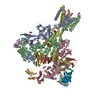
Structure of native tri-heteromeric GluN1-GluN2A-GluN2B NMDA receptor in rat cortex and hippocampus
Method: EM (single particle) / Resolution: 4.2 Å

EMDB-38452, PDB-8xll:
Structure of the native 2-oxoglutarate dehydrogenase complex (OGDHC) in the adult cortex and hippocampus
Method: EM (single particle) / Resolution: 3.1 Å

EMDB-61622, PDB-9jnn:
Structure of native di-heteromeric GluN1-GluN2B NMDA receptor in rat cortex and hippocampus
Method: EM (single particle) / Resolution: 5.4 Å

EMDB-61623: Structure of native di-heteromeric GluN1-GluN2A NMDA receptor in rat cortex and hippocampus
Method: EM (single particle) / Resolution: 9.8 Å

Chemicals

ChemComp-NAG:
2-acetamido-2-deoxy-beta-D-glucopyranose

ChemComp-7RC:
(2R)-4-(3-phosphonopropyl)piperazine-2-carboxylic acid

Source
  • rattus norvegicus (Norway rat)
  • mus musculoides (Temminck's mouse)
  • mus musculus (house mouse)
KeywordsCYTOSOLIC PROTEIN / Native glutamine synthetase / MEMBRANE PROTEIN/IMMUNE SYSTEM / MEMBRANE PROTEIN / native NMDA receptor / adult rat cartex & hippocampus / GluN2A / GluN2B / MEMBRANE PROTEIN-IMMUNE SYSTEM complex / TRANSFERASE / 2-oxoglutarate dehydrogenase complex (OGDHC)

+
About Yorodumi Papers

-
News

-
Feb 9, 2022. New format data for meta-information of EMDB entries

New format data for meta-information of EMDB entries

  • Version 3 of the EMDB header file is now the official format.
  • The previous official version 1.9 will be removed from the archive.

Related info.:EMDB header

External links:wwPDB to switch to version 3 of the EMDB data model

-
Aug 12, 2020. Covid-19 info

Covid-19 info

URL: https://pdbj.org/emnavi/covid19.php

New page: Covid-19 featured information page in EM Navigator.

Related info.:Covid-19 info / Mar 5, 2020. Novel coronavirus structure data

+
Mar 5, 2020. Novel coronavirus structure data

Novel coronavirus structure data

Related info.:Yorodumi Speices / Aug 12, 2020. Covid-19 info

External links:COVID-19 featured content - PDBj / Molecule of the Month (242):Coronavirus Proteases

+
Jan 31, 2019. EMDB accession codes are about to change! (news from PDBe EMDB page)

EMDB accession codes are about to change! (news from PDBe EMDB page)

  • The allocation of 4 digits for EMDB accession codes will soon come to an end. Whilst these codes will remain in use, new EMDB accession codes will include an additional digit and will expand incrementally as the available range of codes is exhausted. The current 4-digit format prefixed with “EMD-” (i.e. EMD-XXXX) will advance to a 5-digit format (i.e. EMD-XXXXX), and so on. It is currently estimated that the 4-digit codes will be depleted around Spring 2019, at which point the 5-digit format will come into force.
  • The EM Navigator/Yorodumi systems omit the EMD- prefix.

Related info.:Q: What is EMD? / ID/Accession-code notation in Yorodumi/EM Navigator

External links:EMDB Accession Codes are Changing Soon! / Contact to PDBj

+
Jul 12, 2017. Major update of PDB

Major update of PDB

  • wwPDB released updated PDB data conforming to the new PDBx/mmCIF dictionary.
  • This is a major update changing the version number from 4 to 5, and with Remediation, in which all the entries are updated.
  • In this update, many items about electron microscopy experimental information are reorganized (e.g. em_software).
  • Now, EM Navigator and Yorodumi are based on the updated data.

External links:wwPDB Remediation / Enriched Model Files Conforming to OneDep Data Standards Now Available in the PDB FTP Archive

-
Yorodumi Papers

Database of articles cited by EMDB/PDB/SASBDB data

  • Database of articles cited by EMDB, PDB, and SASBDB entries
  • Using PubMed data

Related info.:EMDB / PDB / SASBDB / Yorodumi / EMN Papers / Changes in new EM Navigator and Yorodumi

Read more