 Movie
Movie Controller
 Structure viewers
 About Yorodumi Papers


+Search query
-Structure paper
| Title | Doublet microtubule-associated tektins and enzymes differentially regulate sperm flagellar integrity and motility. |
|---|---|
| Journal, issue, pages | Nat Commun, Vol. 17, Issue 1, Year 2026 |
| Publish date | Feb 28, 2026 |
 Authors Authors | Qi Liu / Lunni Zhou / Xiaochen Liang / Pengyu Chen / Bo Li / Shuo Yang / Yuqi Liu / Haibo Zhao / Jin Hu / Shan Feng / Shanshan Xie / Jianping Wu / Miao Gui /  |
| PubMed Abstract | Doublet microtubule (DMT)-associated proteins assemble and drive sperm flagella, which are essential for successful fertilization. However, the exact roles of different DMT-associated proteins in ...Doublet microtubule (DMT)-associated proteins assemble and drive sperm flagella, which are essential for successful fertilization. However, the exact roles of different DMT-associated proteins in sperm function and the underlying molecular mechanisms remain elusive. Here, we generate four gene-knockout mice based on high-resolution structures targeting distinct DMT components: two intermediate filament-like tektins (TEKT1, TEKT5) and two enzymes (TSSK6, DUSP21). The depletion of TEKT1, shared by sperm flagella and motile cilia, causes male infertility characterized by impaired sperm motility and loss of the tektin bundle, whereas sperm-specific Tekt5 knockout (KO) mice remain fertile with largely normal flagellar function, indicating functional divergence within the tektin family. Tssk6 KO spermatozoa exhibit severely disturbed morphology and motility, resulting in homozygote infertility and heterozygote subfertility. Phosphoproteomics reveals dysregulated phosphorylation of axonemal proteins, highlighting the critical role of kinase-mediated signaling in regulating sperm motility. Conversely, Dusp21 KO mice display no fertility or sperm motility defects, suggesting compensatory phosphatase activity. Phenotypic comparisons between Tekt1 and Tssk6 KO mice suggest their involvement in distinct subtypes of asthenozoospermia. Overall, this study elucidates how filamentous and enzymatic DMT proteins govern sperm function through divergent mechanisms, which have implications for molecular diagnosis of male infertility. |
 External links External links | Nat Commun / PubMed:41764189 / PubMed Central |
| Methods | EM (single particle) |
| Resolution | 3.7 - 4.8 Å |
| Structure data |  EMDB-64623: Cryo-EM structure of the 48-nm repeat doublet microtubule from Tekt1 KO mouse sperm  EMDB-64624: Cryo-EM structure of the 48-nm repeat doublet microtubule from Tekt5 KO mouse sperm  EMDB-64625: Cryo-EM structure of the 48-nm repeat doublet microtubule from Tssk6 KO mouse sperm  EMDB-64626: Cryo-EM structure of the 48-nm repeat doublet microtubule from Dusp21 KO mouse sperm EMDB-64679, PDB-9v10: |
| Chemicals | 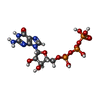 ChemComp-GTP:  ChemComp-MG: 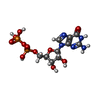 ChemComp-GDP: 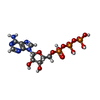 ChemComp-ATP: |
| Source |
|
 Keywords Keywords | STRUCTURAL PROTEIN / sperm flagellar doublet microtubules |


 mus musculus (house mouse)