[English] 日本語
Yorodumi Papers
- Database of articles cited by EMDB/PDB/SASBDB data -

+
Search query

Keywords
Structure methods
Author
Journal
IF

-
Structure paper

TitleStructural dynamics of the midnolin-proteasome during ubiquitin-independent substrate turnover.
Journal, issue, pagesNat Commun, Vol. 17, Issue 1, Year 2026
Publish dateMar 27, 2026
AuthorsChuanda Zhu / Lu Qin / Zonglin Dai / Peng Zuo / Ao Yang / Lijun Zhong / Zhiqiang Lin / Ling Liang /
PubMed AbstractThe 26S proteasome typically degrades proteins marked by ubiquitin chains. However, a distinct, ubiquitin-independent degradation pathway for nuclear proteins exists, mediated by the adaptor protein ...The 26S proteasome typically degrades proteins marked by ubiquitin chains. However, a distinct, ubiquitin-independent degradation pathway for nuclear proteins exists, mediated by the adaptor protein midnolin, yet its molecular mechanism remains poorly understood. Here, we present nine cryo-electron microscopy structures of the human 26S proteasome in complex with midnolin, which collectively delineate a near-complete catalytic cycle. Our structures reveal that midnolin binds to the proteasome via the RPN1 subunit by its C-terminal helix. Unexpectedly, its ubiquitin-like domain interacts with the RPN11 deubiquitinase in a non-catalytic role. This interaction positions the adjacent Catch domain, which is responsible for substrate binding, directly above the proteasomal entrance, potentially facilitating substrate entry into the proteasome. Furthermore, we observe four consecutive spiral staircase conformations of the AAA+ ATPase hexamer during substrate translocation. These findings provide insights into the mechanisms underlying ubiquitin-independent nuclear protein degradation and may help develop strategies for targeting nuclear proteins via direct proteasomal degradation.
External linksNat Commun / PubMed:41896529 / PubMed Central
MethodsEM (single particle)
Resolution2.75 - 4.23 Å
Structure data

EMDB-63725: Focused refinement of 19S in the substrate-engaged human 26S proteasome bound to midnolin with RPT1 at top of spiral staircase
Method: EM (single particle) / Resolution: 3.34 Å

EMDB-63726: Consensus map of substrate-engaged human 26S proteasome bound to midnolin with RPT1 at top of spiral staircase
Method: EM (single particle) / Resolution: 2.75 Å

EMDB-63727: Consensus map of substrate-engaged human 26S proteasome bound to midnolin with RPT5 at top of spiral staircase
Method: EM (single particle) / Resolution: 2.93 Å

EMDB-63728: Focused refinement of 19S in the substrate-engaged human 26S proteasome bound to midnolin with RPT5 at top of spiral staircase
Method: EM (single particle) / Resolution: 3.44 Å

EMDB-63751: Consensus map of substrate-engaged human 26S proteasome bound to midnolin with RPT2 at top of spiral staircase
Method: EM (single particle) / Resolution: 2.91 Å

EMDB-63752: Focused refinement of 19S in the substrate-engaged human 26S proteasome bound to midnolin with RPT2 at top of spiral staircase
Method: EM (single particle) / Resolution: 3.5 Å

EMDB-63775, PDB-9mbo:
Focused refinement of RPN1 and the C-terminal helix of midnolin in the substrate-engaged human 26S proteasome
Method: EM (single particle) / Resolution: 2.83 Å

EMDB-63776, PDB-9mbp:
Substrate-engaged human 26S proteasome bound to midnolin with RPT1 at top of spiral staircase
Method: EM (single particle) / Resolution: 2.75 Å

EMDB-63777, PDB-9mbq:
Substrate-engaged human 26S proteasome bound to midnolin with RPT5 at top of spiral staircase
Method: EM (single particle) / Resolution: 3.08 Å

EMDB-63817, PDB-9u3l:
Substrate-engaged human 26S proteasome bound to midnolin with RPT2 at top of spiral staircase
Method: EM (single particle) / Resolution: 2.91 Å

EMDB-63850, PDB-9u4m:
Focused refinement of 19S in the substrate-engaged human 26S proteasome bound to midnolin with RPT6 at top of spiral staircase
Method: EM (single particle) / Resolution: 4.14 Å

EMDB-63943, PDB-9u7r:
Substrate-free human 26S proteasome purified by midnolin, 20S proteasome, RPTs and RPN11 part
Method: EM (single particle) / Resolution: 3.17 Å

EMDB-65595, PDB-9w39:
Structure of human 26S proteasome complexed with midnolin, 19S proteasome with Ubl bound
Method: EM (single particle) / Resolution: 3.65 Å

EMDB-65839, PDB-9wbg:
Structure of human 26S proteasome complexed with midnolin, 19S proteasome with Ubl and Catch domain resolved
Method: EM (single particle) / Resolution: 4.23 Å

EMDB-68472, PDB-22mm:
Structure of human 26S proteasome complexed with midnolin(1-111+337-468)
Method: EM (single particle) / Resolution: 3.42 Å

Chemicals

ChemComp-ZN:
Unknown entry

ChemComp-ATP:
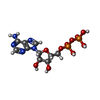
ADENOSINE-5'-TRIPHOSPHATE / ATP, energy-carrying molecule*YM

ChemComp-MG:
Unknown entry

ChemComp-ADP:
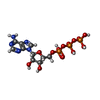
ADENOSINE-5'-DIPHOSPHATE / ADP, energy-carrying molecule*YM

ChemComp-LDZ:
N-[(benzyloxy)carbonyl]-L-leucyl-N-[(2S)-4-methyl-1-oxopentan-2-yl]-L-leucinamide

Source
  • homo sapiens (human)
  • purpureocillium lilacinum (fungus)
  • pseudotamlana agarivorans (bacteria)
  • synthetic construct (others)
  • escherichia coli str. k-12 substr. mg1655 (bacteria)

  • escherichia coli k-12 (bacteria)
KeywordsHYDROLASE / 26S proteasome / midnolin / Complex / proteasome

+
About Yorodumi Papers

-
News

-
Feb 9, 2022. New format data for meta-information of EMDB entries

New format data for meta-information of EMDB entries

  • Version 3 of the EMDB header file is now the official format.
  • The previous official version 1.9 will be removed from the archive.

Related info.:EMDB header

External links:wwPDB to switch to version 3 of the EMDB data model

-
Aug 12, 2020. Covid-19 info

Covid-19 info

URL: https://pdbj.org/emnavi/covid19.php

New page: Covid-19 featured information page in EM Navigator.

Related info.:Covid-19 info / Mar 5, 2020. Novel coronavirus structure data

+
Mar 5, 2020. Novel coronavirus structure data

Novel coronavirus structure data

Related info.:Yorodumi Speices / Aug 12, 2020. Covid-19 info

External links:COVID-19 featured content - PDBj / Molecule of the Month (242):Coronavirus Proteases

+
Jan 31, 2019. EMDB accession codes are about to change! (news from PDBe EMDB page)

EMDB accession codes are about to change! (news from PDBe EMDB page)

  • The allocation of 4 digits for EMDB accession codes will soon come to an end. Whilst these codes will remain in use, new EMDB accession codes will include an additional digit and will expand incrementally as the available range of codes is exhausted. The current 4-digit format prefixed with “EMD-” (i.e. EMD-XXXX) will advance to a 5-digit format (i.e. EMD-XXXXX), and so on. It is currently estimated that the 4-digit codes will be depleted around Spring 2019, at which point the 5-digit format will come into force.
  • The EM Navigator/Yorodumi systems omit the EMD- prefix.

Related info.:Q: What is EMD? / ID/Accession-code notation in Yorodumi/EM Navigator

External links:EMDB Accession Codes are Changing Soon! / Contact to PDBj

+
Jul 12, 2017. Major update of PDB

Major update of PDB

  • wwPDB released updated PDB data conforming to the new PDBx/mmCIF dictionary.
  • This is a major update changing the version number from 4 to 5, and with Remediation, in which all the entries are updated.
  • In this update, many items about electron microscopy experimental information are reorganized (e.g. em_software).
  • Now, EM Navigator and Yorodumi are based on the updated data.

External links:wwPDB Remediation / Enriched Model Files Conforming to OneDep Data Standards Now Available in the PDB FTP Archive

-
Yorodumi Papers

Database of articles cited by EMDB/PDB/SASBDB data

  • Database of articles cited by EMDB, PDB, and SASBDB entries
  • Using PubMed data

Related info.:EMDB / PDB / SASBDB / Yorodumi / EMN Papers / Changes in new EM Navigator and Yorodumi

Read more