 Movie
Movie Controller

[English] 日本語
 Yorodumi
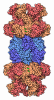
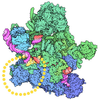
- PDB-9u7r: Substrate-free human 26S proteasome purified by midnolin, 20S pro... -
+ Open data

- Basic information
| Entry | Database: PDB / ID: 9u7r | |||||||||||||||||||||||||||
|---|---|---|---|---|---|---|---|---|---|---|---|---|---|---|---|---|---|---|---|---|---|---|---|---|---|---|---|---|
| Title | Substrate-free human 26S proteasome purified by midnolin, 20S proteasome, RPTs and RPN11 part | |||||||||||||||||||||||||||
 Components Components |
| |||||||||||||||||||||||||||
 Keywords Keywords | HYDROLASE / Midnolin / 26S proteasome / Complex | |||||||||||||||||||||||||||
| Function / homology |  Function and homology information Function and homology informationpositive regulation of inclusion body assembly / thyrotropin-releasing hormone receptor binding / nuclear proteasome complex / host-mediated perturbation of viral transcription / proteasome accessory complex / purine ribonucleoside triphosphate binding / cytosolic proteasome complex / positive regulation of proteasomal protein catabolic process / CD8-positive, alpha-beta T cell differentiation / CD8-positive, alpha-beta T cell homeostasis ...positive regulation of inclusion body assembly / thyrotropin-releasing hormone receptor binding / nuclear proteasome complex / host-mediated perturbation of viral transcription / proteasome accessory complex / purine ribonucleoside triphosphate binding / cytosolic proteasome complex / positive regulation of proteasomal protein catabolic process / CD8-positive, alpha-beta T cell differentiation / CD8-positive, alpha-beta T cell homeostasis / transcription factor binding / thymic T cell selection / Antigen processing: Ub, ATP-independent proteasomal degradation / proteasome-activating activity / proteasome regulatory particle, lid subcomplex / proteasome regulatory particle, base subcomplex / negative regulation of programmed cell death / negative regulation of regulatory T cell differentiation / T-helper 1 cell differentiation / protein K63-linked deubiquitination / metal-dependent deubiquitinase activity / Regulation of ornithine decarboxylase (ODC) / proteasome core complex / Proteasome assembly / cellular response to type I interferon / T-helper 17 cell differentiation / Cross-presentation of soluble exogenous antigens (endosomes) / retrograde vesicle-mediated transport, Golgi to endoplasmic reticulum / Somitogenesis / K63-linked deubiquitinase activity / flagellated sperm motility / sperm end piece / proteasome binding / myofibril / ciliary tip / proteasomal ubiquitin-independent protein catabolic process / general transcription initiation factor binding / proteasome storage granule / proteasome endopeptidase complex / protein deubiquitination / NF-kappaB binding / proteasome core complex, beta-subunit complex / endopeptidase activator activity / threonine-type endopeptidase activity / proteasome core complex, alpha-subunit complex / proteasome assembly / immune system process / regulation of G1/S transition of mitotic cell cycle / regulation of macroautophagy / positive regulation of interleukin-2 production / proteasome complex / response to type II interferon / inclusion body / TBP-class protein binding / : / regulation of proteasomal protein catabolic process / sarcomere / Regulation of activated PAK-2p34 by proteasome mediated degradation / negative regulation of inflammatory response to antigenic stimulus / Autodegradation of Cdh1 by Cdh1:APC/C / proteasomal protein catabolic process / APC/C:Cdc20 mediated degradation of Securin / N-glycan trimming in the ER and Calnexin/Calreticulin cycle / Asymmetric localization of PCP proteins / lipopolysaccharide binding / Ubiquitin-dependent degradation of Cyclin D / SCF-beta-TrCP mediated degradation of Emi1 / NIK-->noncanonical NF-kB signaling / AUF1 (hnRNP D0) binds and destabilizes mRNA / TNFR2 non-canonical NF-kB pathway / positive regulation of type II interferon production / Assembly of the pre-replicative complex / P-body / Vpu mediated degradation of CD4 / Cdc20:Phospho-APC/C mediated degradation of Cyclin A / Dectin-1 mediated noncanonical NF-kB signaling / Degradation of DVL / Degradation of AXIN / Degradation of CRY and PER proteins / meiotic cell cycle / Hh mutants are degraded by ERAD / Activation of NF-kappaB in B cells / G2/M Checkpoints / Degradation of GLI1 by the proteasome / Hedgehog ligand biogenesis / Autodegradation of the E3 ubiquitin ligase COP1 / Regulation of RUNX3 expression and activity / double-strand break repair via homologous recombination / Defective CFTR causes cystic fibrosis / GSK3B and BTRC:CUL1-mediated-degradation of NFE2L2 / response to virus / Negative regulation of NOTCH4 signaling / AMPK-induced ERAD and lysosome mediated degradation of PD-L1(CD274) / Hedgehog 'on' state / APC/C:Cdh1 mediated degradation of Cdc20 and other APC/C:Cdh1 targeted proteins in late mitosis/early G1 / Vif-mediated degradation of APOBEC3G / FBXL7 down-regulates AURKA during mitotic entry and in early mitosis / Degradation of GLI2 by the proteasome / GLI3 is processed to GLI3R by the proteasome / double-strand break repair via nonhomologous end joining Similarity search - Function | |||||||||||||||||||||||||||
| Biological species |  Homo sapiens (human) Homo sapiens (human) | |||||||||||||||||||||||||||
| Method | ELECTRON MICROSCOPY / single particle reconstruction / cryo EM / Resolution: 3.17 Å | |||||||||||||||||||||||||||
 Authors Authors | Zhu, C. / Qin, L. / Liang, L. | |||||||||||||||||||||||||||
| Funding support |  China, 1items China, 1items
| |||||||||||||||||||||||||||
 Citation Citation | Journal: Nat Commun / Year: 2026 Title: Structural dynamics of the midnolin-proteasome during ubiquitin-independent substrate turnover. Authors: Chuanda Zhu / Lu Qin / Zonglin Dai / Peng Zuo / Ao Yang / Lijun Zhong / Zhiqiang Lin / Ling Liang / Abstract: The 26S proteasome typically degrades proteins marked by ubiquitin chains. However, a distinct, ubiquitin-independent degradation pathway for nuclear proteins exists, mediated by the adaptor protein ...The 26S proteasome typically degrades proteins marked by ubiquitin chains. However, a distinct, ubiquitin-independent degradation pathway for nuclear proteins exists, mediated by the adaptor protein midnolin, yet its molecular mechanism remains poorly understood. Here, we present nine cryo-electron microscopy structures of the human 26S proteasome in complex with midnolin, which collectively delineate a near-complete catalytic cycle. Our structures reveal that midnolin binds to the proteasome via the RPN1 subunit by its C-terminal helix. Unexpectedly, its ubiquitin-like domain interacts with the RPN11 deubiquitinase in a non-catalytic role. This interaction positions the adjacent Catch domain, which is responsible for substrate binding, directly above the proteasomal entrance, potentially facilitating substrate entry into the proteasome. Furthermore, we observe four consecutive spiral staircase conformations of the AAA+ ATPase hexamer during substrate translocation. These findings provide insights into the mechanisms underlying ubiquitin-independent nuclear protein degradation and may help develop strategies for targeting nuclear proteins via direct proteasomal degradation. | |||||||||||||||||||||||||||
| History |
|
- Structure visualization
| Structure viewer | Molecule: MolmilJmol/JSmol |
|---|
- Downloads & links
-Download
| PDBx/mmCIF format | 9u7r.cif.gz | 1.8 MB | Display | PDBx/mmCIF format |
|---|---|---|---|---|
| PDB format | pdb9u7r.ent.gz | Display | PDB format | |
| PDBx/mmJSON format | 9u7r.json.gz | Tree view | PDBx/mmJSON format | |
| Others |  Other downloads Other downloads |
-Validation report
| Arichive directory | https://data.pdbj.org/pub/pdb/validation_reports/u7/9u7rftp://data.pdbj.org/pub/pdb/validation_reports/u7/9u7r | HTTPS FTP |
|---|
-Related structure data
| Related structure data |  63943MC  22mmC  9mboC  9mbpC  9mbqC  9u3lC  9u4mC  9w39C  9wbgC M: map data used to model this data C: citing same article ( |
|---|---|
| Similar structure data |


-Links
 PDBj
PDBj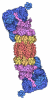

- Assembly
| Deposited unit | 
|
|---|---|
| 1 |
|
-Components
-Protein , 3 types, 4 molecules cELl
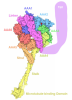
| #1: Protein | Mass: 34488.824 Da / Num. of mol.: 1 / Source method: isolated from a natural source / Source: (natural) Homo sapiens (human)References: UniProt: O00487, Hydrolases; Acting on peptide bonds (peptidases); Omega peptidases |
|---|---|
| #6: Protein | Mass: 45867.027 Da / Num. of mol.: 1 / Source method: isolated from a natural source / Source: (natural) Homo sapiens (human) / References: UniProt: A0A087X2I1 |
| #13: Protein | Mass: 30150.277 Da / Num. of mol.: 2 / Source method: isolated from a natural source / Source: (natural) Homo sapiens (human) / References: UniProt: P25786 |
-26S proteasome regulatory subunit ... , 5 types, 5 molecules ABCDF
| #2: Protein | Mass: 48700.805 Da / Num. of mol.: 1 / Source method: isolated from a natural source / Source: (natural) Homo sapiens (human) / References: UniProt: P35998 |
|---|---|
| #3: Protein | Mass: 49260.504 Da / Num. of mol.: 1 / Source method: isolated from a natural source / Source: (natural) Homo sapiens (human) / References: UniProt: P62191 |
| #4: Protein | Mass: 44852.121 Da / Num. of mol.: 1 / Source method: isolated from a natural source / Source: (natural) Homo sapiens (human) / References: UniProt: P62195 |
| #5: Protein | Mass: 47426.141 Da / Num. of mol.: 1 / Source method: isolated from a natural source / Source: (natural) Homo sapiens (human) / References: UniProt: P43686 |
| #7: Protein | Mass: 49266.457 Da / Num. of mol.: 1 / Source method: isolated from a natural source / Source: (natural) Homo sapiens (human) / References: UniProt: P17980 |
-Proteasome subunit alpha type- ... , 6 types, 12 molecules GgHhIiJjKkMm
| #8: Protein | Mass: 27301.262 Da / Num. of mol.: 2 / Source method: isolated from a natural source / Source: (natural) Homo sapiens (human) / References: UniProt: P60900#9: Protein | Mass: 25796.338 Da / Num. of mol.: 2 / Source method: isolated from a natural source / Source: (natural) Homo sapiens (human) / References: UniProt: P25787#10: Protein | Mass: 29394.648 Da / Num. of mol.: 2 / Source method: isolated from a natural source / Source: (natural) Homo sapiens (human) / References: UniProt: P25789#11: Protein | Mass: 27798.695 Da / Num. of mol.: 2 / Source method: isolated from a natural source / Source: (natural) Homo sapiens (human) / References: UniProt: O14818#12: Protein | Mass: 26304.779 Da / Num. of mol.: 2 / Source method: isolated from a natural source / Source: (natural) Homo sapiens (human) / References: UniProt: P28066#14: Protein | Mass: 28338.057 Da / Num. of mol.: 2 / Source method: isolated from a natural source / Source: (natural) Homo sapiens (human) / References: UniProt: P25788 |
|---|
-Proteasome subunit beta type- ... , 7 types, 14 molecules NnOoPpQqRrSsTt
| #15: Protein | Mass: 25246.455 Da / Num. of mol.: 2 / Source method: isolated from a natural source / Source: (natural) Homo sapiens (human)References: UniProt: P28072, proteasome endopeptidase complex #16: Protein | Mass: 29869.223 Da / Num. of mol.: 2 / Source method: isolated from a natural source / Source: (natural) Homo sapiens (human)References: UniProt: Q99436, proteasome endopeptidase complex #17: Protein | Mass: 22841.701 Da / Num. of mol.: 2 / Source method: isolated from a natural source / Source: (natural) Homo sapiens (human) / References: UniProt: P49720#18: Protein | Mass: 22864.277 Da / Num. of mol.: 2 / Source method: isolated from a natural source / Source: (natural) Homo sapiens (human) / References: UniProt: P49721#19: Protein | Mass: 28379.053 Da / Num. of mol.: 2 / Source method: isolated from a natural source / Source: (natural) Homo sapiens (human)References: UniProt: P28074, proteasome endopeptidase complex #20: Protein | Mass: 26391.201 Da / Num. of mol.: 2 / Source method: isolated from a natural source / Source: (natural) Homo sapiens (human) / References: UniProt: P20618#21: Protein | Mass: 29099.986 Da / Num. of mol.: 2 / Source method: isolated from a natural source / Source: (natural) Homo sapiens (human) / References: UniProt: P28070 |
|---|
-Non-polymers , 5 types, 17 molecules 
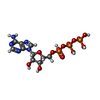

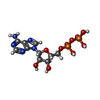

| #22: Chemical | ChemComp-ZN /  Mass: 65.409 Da / Num. of mol.: 1 / Source method: obtained synthetically / Formula: Zn / Feature type: SUBJECT OF INVESTIGATION Mass: 65.409 Da / Num. of mol.: 1 / Source method: obtained synthetically / Formula: Zn / Feature type: SUBJECT OF INVESTIGATION | ||||||
|---|---|---|---|---|---|---|---|
| #23: Chemical | ChemComp-ATP / 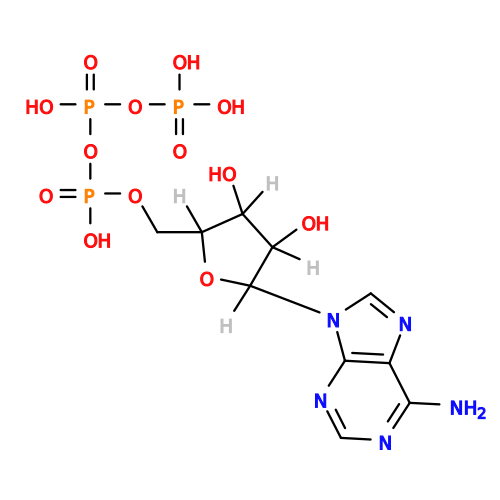 Mass: 507.181 Da / Num. of mol.: 4 / Source method: obtained synthetically / Formula: C10H16N5O13P3 / Feature type: SUBJECT OF INVESTIGATION / Comment: ATP, energy-carrying molecule*YM Mass: 507.181 Da / Num. of mol.: 4 / Source method: obtained synthetically / Formula: C10H16N5O13P3 / Feature type: SUBJECT OF INVESTIGATION / Comment: ATP, energy-carrying molecule*YM#24: Chemical | ChemComp-MG /  Mass: 24.305 Da / Num. of mol.: 4 / Source method: obtained synthetically / Formula: Mg / Feature type: SUBJECT OF INVESTIGATION Mass: 24.305 Da / Num. of mol.: 4 / Source method: obtained synthetically / Formula: Mg / Feature type: SUBJECT OF INVESTIGATION#25: Chemical | 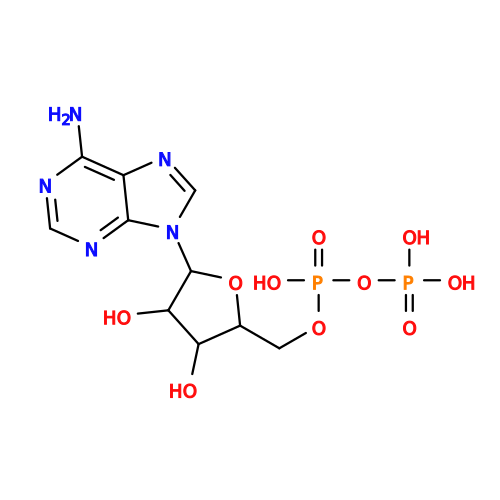 Mass: 427.201 Da / Num. of mol.: 2 / Source method: obtained synthetically / Formula: C10H15N5O10P2 / Feature type: SUBJECT OF INVESTIGATION / Comment: ADP, energy-carrying molecule*YM Mass: 427.201 Da / Num. of mol.: 2 / Source method: obtained synthetically / Formula: C10H15N5O10P2 / Feature type: SUBJECT OF INVESTIGATION / Comment: ADP, energy-carrying molecule*YM#26: Chemical | ChemComp-LDZ /  Type: Peptide-like / Class: Inhibitor / Mass: 475.621 Da / Num. of mol.: 6 / Source method: obtained synthetically / Formula: C26H41N3O5 / Feature type: SUBJECT OF INVESTIGATION Type: Peptide-like / Class: Inhibitor / Mass: 475.621 Da / Num. of mol.: 6 / Source method: obtained synthetically / Formula: C26H41N3O5 / Feature type: SUBJECT OF INVESTIGATIONReferences: N-[(BENZYLOXY)CARBONYL]-L-LEUCYL-N-[(2S)-4-METHYL-1-OXOPENTAN-2-YL]-L-LEUCINAMIDE Comment: inhibitor*YM |
-Details
| Has ligand of interest | Y |
|---|---|
| Has protein modification | Y |
-Experimental details
-Experiment
| Experiment | Method: ELECTRON MICROSCOPY |
|---|---|
| EM experiment | Aggregation state: PARTICLE / 3D reconstruction method: single particle reconstruction |
- Sample preparation
| Component | Name: 26S proteasome complexed with midnolin / Type: COMPLEX / Entity ID: #1-#21 / Source: MULTIPLE SOURCES |
|---|---|
| Source (natural) | Organism: Homo sapiens (human) |
| Source (recombinant) | Organism: Homo sapiens (human) |
| Buffer solution | pH: 7.4 |
| Specimen | Embedding applied: NO / Shadowing applied: NO / Staining applied: NO / Vitrification applied: YES |
| Vitrification | Cryogen name: ETHANE |
- Electron microscopy imaging
| Experimental equipment |  Model: Titan Krios / Image courtesy: FEI Company |
|---|---|
| Microscopy | Model: TFS KRIOS |
| Electron gun | Electron source:  FIELD EMISSION GUN / Accelerating voltage: 300 kV / Illumination mode: FLOOD BEAM FIELD EMISSION GUN / Accelerating voltage: 300 kV / Illumination mode: FLOOD BEAM |
| Electron lens | Mode: BRIGHT FIELD / Nominal defocus max: 1800 nm / Nominal defocus min: 1200 nm |
| Image recording | Electron dose: 40 e/Å2 / Film or detector model: GATAN K3 (6k x 4k) |
- Processing
| CTF correction | Type: PHASE FLIPPING AND AMPLITUDE CORRECTION |
|---|---|
| 3D reconstruction | Resolution: 3.17 Å / Resolution method: FSC 0.143 CUT-OFF / Num. of particles: 22379 / Symmetry type: POINT |
| Refinement | Cross valid method: NONE |
