 Movie
Movie Controller
 Structure viewers
 About Yorodumi Papers


+Search query
-Structure paper
| Title | Far-red chlorophyll d clusters extend photosystem I absorption toward the red limit. |
|---|---|
| Journal, issue, pages | Sci Adv, Vol. 12, Issue 24, Page eaed7355, Year 2026 |
| Publish date | Jun 12, 2026 |
 Authors Authors | Thomas J Oliver / Eduard Elias / Giovanni Consoli / Ho Fong Leong / Violeta Cordón-Preciado / Andrea Fantuzzi / Tanai Cardona / A William Rutherford / Roberta Croce /   |
| PubMed Abstract | Oxygenic photosynthesis is usually limited to visible light, but the marine cyanobacterium pushes this boundary by harvesting far-red photons with chlorophyll d. The best-studied strain, MBIC11017, ...Oxygenic photosynthesis is usually limited to visible light, but the marine cyanobacterium pushes this boundary by harvesting far-red photons with chlorophyll d. The best-studied strain, MBIC11017, unexpectedly lacks low-energy chlorophylls ("red forms") in photosystem I, limiting absorption beyond 740 nanometers. Here, we show that another strain, NIES-2412, has evolved a strategy to absorb far-red photons up to 760 nanometers. Combining time-resolved fluorescence spectroscopy with cryo-electron microscopy at 2.64-angstrom resolution, we identify two distinct classes of chlorophyll d red forms in its photosystem I. One class originates from classical charge-transfer-exciton mixing, while the other arises purely from excitonic interactions. Mapping all 96 chlorophylls d reveals the precise pigments responsible for these far-red states. We also uncover a previously unreported subunit, PsaX2, which stabilizes the photosystem I complex and shapes pigment geometry and energetics to enable the formation of red forms. Last, we show that the protein modifications responsible for binding and tuning these red forms are widespread across the genus but not within the model MBIC11017 strain. Far-red photons lie close to the energetic limit of oxygenic photosynthesis; their efficient use therefore requires fine-tuning of the photosynthetic machinery. To our knowledge, our findings provide the structural and mechanistic basis of one of the most red-shifted photosystem I complexes identified to date, highlighting a distinct adaptive strategy in far-red light environments and offering design principles for extending photosynthesis in crops into the infrared. |
 External links External links | Sci Adv / PubMed:42268959 / PubMed Central |
| Methods | EM (single particle) |
| Resolution | 2.44 - 2.63 Å |
| Structure data | EMDB-54627, PDB-9s6p: EMDB-54956, PDB-9sk3: |
| Chemicals |  ChemComp-CL7:  ChemComp-PHO:  ChemComp-PQN: 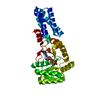 PDB-1jpj:  ChemComp-LMG:  ChemComp-SF4:  ChemComp-LHG:  ChemComp-G9R:  ChemComp-HOH: |
| Source |
|
 Keywords Keywords | ELECTRON TRANSPORT / Photosystem I / Chlorophyll d / long wavelength |


 acaryochloris marina (bacteria)