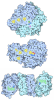
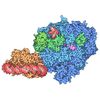
- EMDB-54627: Local refinement of a PSI monomer of A. marina NIES-2412 -
+
Open data
ID or keywords:
Loading...
-
Basic information
Entry
Database: EMDB / ID: EMD-54627
Title
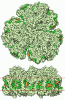
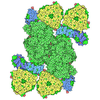
Local refinement of a PSI monomer of A. marina NIES-2412
Map data
Sample
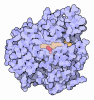
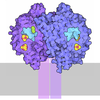
Complex: Photosystem I
Protein or peptide: x 12 types
Ligand: x 9 types
Keywords
Photosystem I / Chlorophyll d / long wavelength / ELECTRON TRANSPORT
Function / homology
Function and homology information
photosystem I reaction center / photosystem I / photosynthetic electron transport in photosystem I / photosystem I / plasma membrane-derived thylakoid membrane / photosynthesis / 4 iron, 4 sulfur cluster binding / electron transfer activity / magnesium ion binding Similarity search - Function
Photosystem I reaction center subunit PsaK / Photosystem I reaction centre subunit PsaK / Photosystem I reaction centre subunit PsaK superfamily / Photosystem I reaction center subunit V/PsaK / Photosystem I psaG / psaK / Photosystem I reaction centre subunit VIII superfamily / Photosystem I PsaF, reaction centre subunit III / Photosystem I PsaF, reaction centre subunit III superfamily / Photosystem I reaction centre subunit III / Photosystem I PsaD ...Photosystem I reaction center subunit PsaK / Photosystem I reaction centre subunit PsaK / Photosystem I reaction centre subunit PsaK superfamily / Photosystem I reaction center subunit V/PsaK / Photosystem I psaG / psaK / Photosystem I reaction centre subunit VIII superfamily / Photosystem I PsaF, reaction centre subunit III / Photosystem I PsaF, reaction centre subunit III superfamily / Photosystem I reaction centre subunit III / Photosystem I PsaD / Photosystem I, reaction centre subunit PsaD superfamily / PsaD / Photosystem I PsaE, reaction centre subunit IV / Photosystem I reaction centre subunit IV / PsaE / Photosystem I PsaJ, reaction centre subunit IX superfamily / Photosystem I PsaJ, reaction centre subunit IX / Photosystem I reaction centre subunit IX / PsaJ / Photosystem I protein PsaC / Photosystem I PsaA / Photosystem I PsaB / Photosystem I PsaA/PsaB, conserved site / Photosystem I psaA and psaB proteins signature. / : / Photosystem I PsaA/PsaB / Photosystem I PsaA/PsaB superfamily / Photosystem I psaA/psaB protein / Electron transport accessory-like domain superfamily / 4Fe-4S dicluster domain / 4Fe-4S ferredoxin, iron-sulphur binding, conserved site / 4Fe-4S ferredoxin-type iron-sulfur binding region signature. / 4Fe-4S ferredoxin-type iron-sulfur binding domain profile. / 4Fe-4S ferredoxin-type, iron-sulphur binding domain Similarity search - Domain/homology
Photosystem I P700 chlorophyll a apoprotein A2 / Photosystem I reaction center subunit PsaK / Photosystem I P700 chlorophyll a apoprotein A1 / Photosystem I reaction center subunit IV / Photosystem I reaction center subunit II / Psa27 protein / Photosystem I reaction center subunit III / Photosystem I reaction center subunit IX / Photosystem I iron-sulfur center Similarity search - Component
Netherlands, European Union, United Kingdom, 6 items
Organization
Grant number
Country
Netherlands Organisation for Scientific Research (NWO)
714.018.001
Netherlands
European Research Council (ERC)
European Union
Biotechnology and Biological Sciences Research Council (BBSRC)
BB/R001383/1
United Kingdom
Biotechnology and Biological Sciences Research Council (BBSRC)
BB/V002015/1
United Kingdom
Biotechnology and Biological Sciences Research Council (BBSRC)
BB/R00921X
United Kingdom
Biotechnology and Biological Sciences Research Council (BBSRC)
BB/Z516740/1
United Kingdom
Citation
Journal: Sci Adv / Year: 2026 Title: Far-red chlorophyll d clusters extend photosystem I absorption toward the red limit. Authors: Thomas J Oliver / Eduard Elias / Giovanni Consoli / Ho Fong Leong / Violeta Cordón-Preciado / Andrea Fantuzzi / Tanai Cardona / A William Rutherford / Roberta Croce / Abstract: Oxygenic photosynthesis is usually limited to visible light, but the marine cyanobacterium pushes this boundary by harvesting far-red photons with chlorophyll d. The best-studied strain, MBIC11017, ...Oxygenic photosynthesis is usually limited to visible light, but the marine cyanobacterium pushes this boundary by harvesting far-red photons with chlorophyll d. The best-studied strain, MBIC11017, unexpectedly lacks low-energy chlorophylls ("red forms") in photosystem I, limiting absorption beyond 740 nanometers. Here, we show that another strain, NIES-2412, has evolved a strategy to absorb far-red photons up to 760 nanometers. Combining time-resolved fluorescence spectroscopy with cryo-electron microscopy at 2.64-angstrom resolution, we identify two distinct classes of chlorophyll d red forms in its photosystem I. One class originates from classical charge-transfer-exciton mixing, while the other arises purely from excitonic interactions. Mapping all 96 chlorophylls d reveals the precise pigments responsible for these far-red states. We also uncover a previously unreported subunit, PsaX2, which stabilizes the photosystem I complex and shapes pigment geometry and energetics to enable the formation of red forms. Last, we show that the protein modifications responsible for binding and tuning these red forms are widespread across the genus but not within the model MBIC11017 strain. Far-red photons lie close to the energetic limit of oxygenic photosynthesis; their efficient use therefore requires fine-tuning of the photosynthetic machinery. To our knowledge, our findings provide the structural and mechanistic basis of one of the most red-shifted photosystem I complexes identified to date, highlighting a distinct adaptive strategy in far-red light environments and offering design principles for extending photosynthesis in crops into the infrared.
In the structure databanks used in Yorodumi, some data are registered as the other names, "COVID-19 virus" and "2019-nCoV". Here are the details of the virus and the list of structure data.
Jan 31, 2019. EMDB accession codes are about to change! (news from PDBe EMDB page)
EMDB accession codes are about to change! (news from PDBe EMDB page)
The allocation of 4 digits for EMDB accession codes will soon come to an end. Whilst these codes will remain in use, new EMDB accession codes will include an additional digit and will expand incrementally as the available range of codes is exhausted. The current 4-digit format prefixed with “EMD-” (i.e. EMD-XXXX) will advance to a 5-digit format (i.e. EMD-XXXXX), and so on. It is currently estimated that the 4-digit codes will be depleted around Spring 2019, at which point the 5-digit format will come into force.
The EM Navigator/Yorodumi systems omit the EMD- prefix.
Related info.:Q: What is EMD? / ID/Accession-code notation in Yorodumi/EM Navigator
Yorodumi is a browser for structure data from EMDB, PDB, SASBDB, etc.
This page is also the successor to EM Navigator detail page, and also detail information page/front-end page for Omokage search.
The word "yorodu" (or yorozu) is an old Japanese word meaning "ten thousand". "mi" (miru) is to see.
Related info.:EMDB / PDB / SASBDB / Comparison of 3 databanks / Yorodumi Search / Aug 31, 2016. New EM Navigator & Yorodumi / Yorodumi Papers / Jmol/JSmol / Function and homology information / Changes in new EM Navigator and Yorodumi
 Movie
Movie Controller


 Open data
 Basic information
 Map data
 Sample
 Keywords
 Function and homology information
 Acaryochloris marina (bacteria) /
  Authors
 Netherlands, European Union,
  United Kingdom, 6 items
  Citation
 Structure visualization
 Downloads & links
 emd_54627.png
 https://data.pdbj.org/pub/emdb/structures/EMD-54627


 Z (Sec.)
 Y (Row.)
 X (Col.)


 Sample components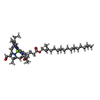

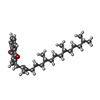
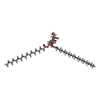
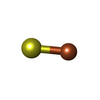

 Processing
 Electron microscopy
 FIELD EMISSION GUN

