[English] 日本語
Yorodumi Papers
- Database of articles cited by EMDB/PDB/SASBDB data -

+
Search query

Keywords
Structure methods
Author
Journal
IF

-
Structure paper

TitleCDK2 heterobifunctional degraders co-degrade CDK2 and cyclin E resulting in efficacy in CCNE1-amplified and overexpressed cancers.
Journal, issue, pagesCell Chem Biol, Vol. 32, Issue 4, Page 556-569.e24, Year 2025
Publish dateApr 17, 2025
AuthorsNicholas Kwiatkowski / Tong Liang / Zhe Sha / Philip N Collier / Annan Yang / Murugappan Sathappa / Atanu Paul / Lijing Su / Xiaozhang Zheng / Robert Aversa / Kunhua Li / Revonda Mehovic / Christina Kolodzy / Susanne B Breitkopf / Dapeng Chen / Charles L Howarth / Karen Yuan / Hakryul Jo / Joseph D Growney / Matthew Weiss / Juliet Williams /
PubMed AbstractCCNE1 amplification drives aberrant CDK2-cyclin E1 activity in cancer. Despite activity of CDK2 inhibitors, their therapeutic margins are limited by poor CDK selectivity. We developed a degrader with ...CCNE1 amplification drives aberrant CDK2-cyclin E1 activity in cancer. Despite activity of CDK2 inhibitors, their therapeutic margins are limited by poor CDK selectivity. We developed a degrader with high selectivity for CDK2 over CDK1 that also unexpectedly led to cyclin E1 degradation and potent and complete suppression of RB phosphorylation at concentrations with low CDK2 occupancy and negligible CDK1 degradation. Co-depletion of CDK2 and cyclin E1 also resensitized palbociclib-adapted breast cancer cells to cell cycle blockade. Overall, the improved potency and selectivity of the degrader for CDK2 over small-molecule inhibitors drives antiproliferative activity with greater specificity for CCNE1 cancer cells and RB dependency. Using an orally administered degrader, we demonstrate deep and sustained RB pathway suppression, which is needed to induce stasis in CCNE1 tumors. These results highlight the potential of this modality to target CDK2 potently and selectivity in this biomarker-defined patient population with high unmet need.
External linksCell Chem Biol / PubMed:40250405
MethodsEM (single particle) / X-ray diffraction
Resolution2.54 - 2.95 Å
Structure data

EMDB-46464, PDB-9d0w:
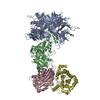
Cryo-EM structure of CDK2/CyclinE1 in complex with CRBN/DDB1 and Cpd 4
Method: EM (single particle) / Resolution: 2.95 Å

EMDB-46465, PDB-9d0x:
Cryo-EM structure of CDK2/CyclinE1 in complex with CRBN/DDB1 and Cpd 4 (local mask)
Method: EM (single particle) / Resolution: 2.84 Å

PDB-9d0u:
Crystal structure of CDK2 in complex with Cpd 2
Method: X-RAY DIFFRACTION / Resolution: 2.6 Å

PDB-9d0v:
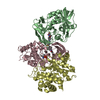
Crystal structure of CDK2/CyclinE1 in complex with Cpd 2
Method: X-RAY DIFFRACTION / Resolution: 2.54 Å

Chemicals

PDB-1a1h:
QGSR (ZIF268 VARIANT) ZINC FINGER-DNA COMPLEX (GCAC SITE)

ChemComp-HOH:
WATER

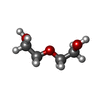
ChemComp-PEG:
DI(HYDROXYETHYL)ETHER

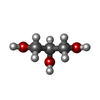
ChemComp-GOL:
GLYCEROL

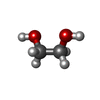
ChemComp-EDO:
1,2-ETHANEDIOL

ChemComp-ZN:
Unknown entry

PDB-1a1i:
RADR (ZIF268 VARIANT) ZINC FINGER-DNA COMPLEX (GCAC SITE)

Source
  • homo sapiens (human)
KeywordsCELL CYCLE / kinase / degrader / inhibitor / CDK2 / ternary complex

+
About Yorodumi Papers

-
News

-
Feb 9, 2022. New format data for meta-information of EMDB entries

New format data for meta-information of EMDB entries

  • Version 3 of the EMDB header file is now the official format.
  • The previous official version 1.9 will be removed from the archive.

Related info.:EMDB header

External links:wwPDB to switch to version 3 of the EMDB data model

-
Aug 12, 2020. Covid-19 info

Covid-19 info

URL: https://pdbj.org/emnavi/covid19.php

New page: Covid-19 featured information page in EM Navigator.

Related info.:Covid-19 info / Mar 5, 2020. Novel coronavirus structure data

+
Mar 5, 2020. Novel coronavirus structure data

Novel coronavirus structure data

Related info.:Yorodumi Speices / Aug 12, 2020. Covid-19 info

External links:COVID-19 featured content - PDBj / Molecule of the Month (242):Coronavirus Proteases

+
Jan 31, 2019. EMDB accession codes are about to change! (news from PDBe EMDB page)

EMDB accession codes are about to change! (news from PDBe EMDB page)

  • The allocation of 4 digits for EMDB accession codes will soon come to an end. Whilst these codes will remain in use, new EMDB accession codes will include an additional digit and will expand incrementally as the available range of codes is exhausted. The current 4-digit format prefixed with “EMD-” (i.e. EMD-XXXX) will advance to a 5-digit format (i.e. EMD-XXXXX), and so on. It is currently estimated that the 4-digit codes will be depleted around Spring 2019, at which point the 5-digit format will come into force.
  • The EM Navigator/Yorodumi systems omit the EMD- prefix.

Related info.:Q: What is EMD? / ID/Accession-code notation in Yorodumi/EM Navigator

External links:EMDB Accession Codes are Changing Soon! / Contact to PDBj

+
Jul 12, 2017. Major update of PDB

Major update of PDB

  • wwPDB released updated PDB data conforming to the new PDBx/mmCIF dictionary.
  • This is a major update changing the version number from 4 to 5, and with Remediation, in which all the entries are updated.
  • In this update, many items about electron microscopy experimental information are reorganized (e.g. em_software).
  • Now, EM Navigator and Yorodumi are based on the updated data.

External links:wwPDB Remediation / Enriched Model Files Conforming to OneDep Data Standards Now Available in the PDB FTP Archive

-
Yorodumi Papers

Database of articles cited by EMDB/PDB/SASBDB data

  • Database of articles cited by EMDB, PDB, and SASBDB entries
  • Using PubMed data

Related info.:EMDB / PDB / SASBDB / Yorodumi / EMN Papers / Changes in new EM Navigator and Yorodumi

Read more