 Movie
Movie Controller
 Structure viewers
 About Yorodumi Papers


+Search query
-Structure paper
| Title | Structural basis of tethered agonism and G protein coupling of protease-activated receptors. |
|---|---|
| Journal, issue, pages | Cell Res, Vol. 34, Issue 10, Page 725-734, Year 2024 |
| Publish date | Jul 12, 2024 |
 Authors Authors | Jia Guo / Yun-Li Zhou / Yixin Yang / Shimeng Guo / Erli You / Xin Xie / Yi Jiang / Chunyou Mao / H Eric Xu / Yan Zhang /  |
| PubMed Abstract | Protease-activated receptors (PARs) are a unique group within the G protein-coupled receptor superfamily, orchestrating cellular responses to extracellular proteases via enzymatic cleavage, which ...Protease-activated receptors (PARs) are a unique group within the G protein-coupled receptor superfamily, orchestrating cellular responses to extracellular proteases via enzymatic cleavage, which triggers intracellular signaling pathways. Protease-activated receptor 1 (PAR1) is a key member of this family and is recognized as a critical pharmacological target for managing thrombotic disorders. In this study, we present cryo-electron microscopy structures of PAR1 in its activated state, induced by its natural tethered agonist (TA), in complex with two distinct downstream proteins, the G and G heterotrimers, respectively. The TA peptide is positioned within a surface pocket, prompting PAR1 activation through notable conformational shifts. Contrary to the typical receptor activation that involves the outward movement of transmembrane helix 6 (TM6), PAR1 activation is characterized by the simultaneous downward shift of TM6 and TM7, coupled with the rotation of a group of aromatic residues. This results in the displacement of an intracellular anion, creating space for downstream G protein binding. Our findings delineate the TA recognition pattern and highlight a distinct role of the second extracellular loop in forming β-sheets with TA within the PAR family, a feature not observed in other TA-activated receptors. Moreover, the nuanced differences in the interactions between intracellular loops 2/3 and the Gα subunit of different G proteins are crucial for determining the specificity of G protein coupling. These insights contribute to our understanding of the ligand binding and activation mechanisms of PARs, illuminating the basis for PAR1's versatility in G protein coupling. |
 External links External links | Cell Res / PubMed:38997424 / PubMed Central |
| Methods | EM (single particle) |
| Resolution | 3.0 - 3.2 Å |
| Structure data | EMDB-38538, PDB-8xor: EMDB-38539, PDB-8xos: |
| Chemicals | 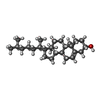 ChemComp-CLR: |
| Source |
|
 Keywords Keywords | MEMBRANE PROTEIN / GPCR / protease-activated receptor |


 rattus (rats)
 bos taurus (domestic cattle)
 homo sapiens (human)
 mus musculus (house mouse)