 Movie
Movie Controller
 Structure viewers
 About Yorodumi Papers


+Search query
-Structure paper
| Title | Structural basis of antimicrobial membrane coat assembly by human GBP1. |
|---|---|
| Journal, issue, pages | Nat Struct Mol Biol, Vol. 32, Issue 1, Page 172-184, Year 2025 |
| Publish date | Oct 11, 2024 |
 Authors Authors | Tanja Kuhm / Clémence Taisne / Cecilia de Agrela Pinto / Luca Gross / Evdokia A Giannopoulou / Stefan T Huber / Els Pardon / Jan Steyaert / Sander J Tans / Arjen J Jakobi /   |
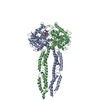
| PubMed Abstract | Guanylate-binding proteins (GBPs) are interferon-inducible guanosine triphosphate hydrolases (GTPases) mediating host defense against intracellular pathogens. Their antimicrobial activity hinges on ...Guanylate-binding proteins (GBPs) are interferon-inducible guanosine triphosphate hydrolases (GTPases) mediating host defense against intracellular pathogens. Their antimicrobial activity hinges on their ability to self-associate and coat pathogen-associated compartments or cytosolic bacteria. Coat formation depends on GTPase activity but how nucleotide binding and hydrolysis prime coat formation remains unclear. Here, we report the cryo-electron microscopy structure of the full-length human GBP1 dimer in its guanine nucleotide-bound state and describe the molecular ultrastructure of the GBP1 coat on liposomes and bacterial lipopolysaccharide membranes. Conformational changes of the middle and GTPase effector domains expose the isoprenylated C terminus for membrane association. The α-helical middle domains form a parallel, crossover arrangement essential for coat formation and position the extended effector domain for intercalation into the lipopolysaccharide layer of gram-negative membranes. Nucleotide binding and hydrolysis create oligomeric scaffolds with contractile abilities that promote membrane extrusion and fragmentation. Our data offer a structural and mechanistic framework for understanding GBP1 effector functions in intracellular immunity. |
 External links External links | Nat Struct Mol Biol / PubMed:39394410 / PubMed Central |
| Methods | EM (single particle) / EM (tomography) |
| Resolution | 3.7 Å |
| Structure data | EMDB-16794, PDB-8cqb:  EMDB-16813: Tomogram of GBP1 coatomers assembled on brain polar lipid-derived small unilamellar vesicles. 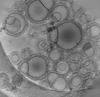 EMDB-16814: Tomogram of GBP1 coatomers assembled on brain polar lipid-derived small unilamellar vesicles. 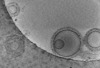 EMDB-16815: Tomogram of GBP1 coatomers assembled on brain polar lipid-derived small unilamellar vesicles. |
| Chemicals | 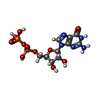 ChemComp-GDP: 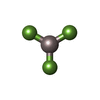 ChemComp-AF3:  ChemComp-MG: |
| Source |
|
 Keywords Keywords | IMMUNE SYSTEM / Cell-autonomous immunity / intracellular pathogens / GTPase |
 homo sapiens (human)