[English] 日本語
Yorodumi Papers
- Database of articles cited by EMDB/PDB/SASBDB data -

+
Search query

Keywords
Structure methods
Author
Journal
IF

-
Structure paper

TitleMolecular mechanisms of receptor recognition and antibody neutralization of coxsackievirus A6.
Journal, issue, pagesNat Commun, Vol. 17, Issue 1, Page 934, Year 2025
Publish dateDec 18, 2025
AuthorsXianliang Ke / Xue Li / Zeyu Liu / Kexin Liu / Weichi Liu / Xingyu Yan / Bo Shu / Chao Zhang /
PubMed AbstractCoxsackievirus A6 (CVA6), a major cause of hand, foot, and mouth disease, lacks approved vaccines or drugs. KRM1 is its only known receptor, but its precise role remains unclear. This study ...Coxsackievirus A6 (CVA6), a major cause of hand, foot, and mouth disease, lacks approved vaccines or drugs. KRM1 is its only known receptor, but its precise role remains unclear. This study investigates CVA6's entry mechanism and antibody neutralization. Cryo-EM shows CVA6 clinical strain HeB primarily exists as mature virions. KRM1 binding within the canyon triggers conversion to uncoating intermediate, defining KRM1 as an uncoating receptor for CVA6. However, KRM1 knockout reduces CVA6 infectivity without affecting attachment. Conversely, disrupting heparan sulfate proteoglycan (HSPG) impairs both viral attachment and infectivity, and CVA6 virions bind heparin directly. These results support a two-receptor entry model for CVA6: HSPG mediates viral attachment, while KRM1 induces uncoating. Additionally, we develop two CVA6-specific protective antibodies (1F4 and 3H7), targeting a new antigenic site near the three-fold axis of the viral capsid. These antibodies sterically block KRM1 binding and function post-attachment, consistent with KRM1's role. The findings elucidate CVA6 entry and offer a basis for antibody interventions.
External linksNat Commun / PubMed:41413343 / PubMed Central
MethodsEM (single particle)
Resolution2.11 - 3.33 Å
Structure data

EMDB-65030, PDB-9vfp:
Structure of CVA6 empty particle
Method: EM (single particle) / Resolution: 3.33 Å

EMDB-65031, PDB-9vfq:
Structure of mature CVA6 virus
Method: EM (single particle) / Resolution: 2.23 Å

EMDB-65032, PDB-9vfr:
Structure of mature Coxsackievirus A6 virion complexed with its receptor KREMEN1
Method: EM (single particle) / Resolution: 2.55 Å

EMDB-65034, PDB-9vfs:
Structure of Coxsackievirus A6 Altered-particles
Method: EM (single particle) / Resolution: 2.49 Å

EMDB-65036, PDB-9vft:
Structure of mature CVA6 virus complexed with 3H7 Fab
Method: EM (single particle) / Resolution: 2.59 Å

EMDB-65038, PDB-9vfu:
Structure of mature CVA6 virus complexed with 1F4 Fab
Method: EM (single particle) / Resolution: 2.11 Å

EMDB-65043, PDB-9vg1:
Structure of CVA6 empty capsid complexed with 3H7 Fab
Method: EM (single particle) / Resolution: 3.26 Å

Chemicals

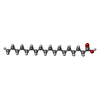
ChemComp-STE:
STEARIC ACID

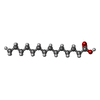
ChemComp-MYR:
MYRISTIC ACID

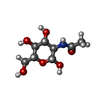
ChemComp-NAG:
2-acetamido-2-deoxy-beta-D-glucopyranose

Source
  • homo sapiens (human)
  • coxsackievirus a6
  • mus musculus (house mouse)
KeywordsVIRUS / coxsackievirus A6 / KRM1 / receptor

+
About Yorodumi Papers

-
News

-
Feb 9, 2022. New format data for meta-information of EMDB entries

New format data for meta-information of EMDB entries

  • Version 3 of the EMDB header file is now the official format.
  • The previous official version 1.9 will be removed from the archive.

Related info.:EMDB header

External links:wwPDB to switch to version 3 of the EMDB data model

-
Aug 12, 2020. Covid-19 info

Covid-19 info

URL: https://pdbj.org/emnavi/covid19.php

New page: Covid-19 featured information page in EM Navigator.

Related info.:Covid-19 info / Mar 5, 2020. Novel coronavirus structure data

+
Mar 5, 2020. Novel coronavirus structure data

Novel coronavirus structure data

Related info.:Yorodumi Speices / Aug 12, 2020. Covid-19 info

External links:COVID-19 featured content - PDBj / Molecule of the Month (242):Coronavirus Proteases

+
Jan 31, 2019. EMDB accession codes are about to change! (news from PDBe EMDB page)

EMDB accession codes are about to change! (news from PDBe EMDB page)

  • The allocation of 4 digits for EMDB accession codes will soon come to an end. Whilst these codes will remain in use, new EMDB accession codes will include an additional digit and will expand incrementally as the available range of codes is exhausted. The current 4-digit format prefixed with “EMD-” (i.e. EMD-XXXX) will advance to a 5-digit format (i.e. EMD-XXXXX), and so on. It is currently estimated that the 4-digit codes will be depleted around Spring 2019, at which point the 5-digit format will come into force.
  • The EM Navigator/Yorodumi systems omit the EMD- prefix.

Related info.:Q: What is EMD? / ID/Accession-code notation in Yorodumi/EM Navigator

External links:EMDB Accession Codes are Changing Soon! / Contact to PDBj

+
Jul 12, 2017. Major update of PDB

Major update of PDB

  • wwPDB released updated PDB data conforming to the new PDBx/mmCIF dictionary.
  • This is a major update changing the version number from 4 to 5, and with Remediation, in which all the entries are updated.
  • In this update, many items about electron microscopy experimental information are reorganized (e.g. em_software).
  • Now, EM Navigator and Yorodumi are based on the updated data.

External links:wwPDB Remediation / Enriched Model Files Conforming to OneDep Data Standards Now Available in the PDB FTP Archive

-
Yorodumi Papers

Database of articles cited by EMDB/PDB/SASBDB data

  • Database of articles cited by EMDB, PDB, and SASBDB entries
  • Using PubMed data

Related info.:EMDB / PDB / SASBDB / Yorodumi / EMN Papers / Changes in new EM Navigator and Yorodumi

Read more