






 9ZCB
9ZCB
1-methyl-pseudouridine twist corrected RNA origami 6-helix bundle type-1 dimer
これはPDB形式変換不可エントリーです。
9ZCB の概要
| エントリーDOI | 10.2210/pdb9zcb/pdb |
| EMDBエントリー | 74033 |
| 分子名称 | 1-methyl-pseudouridine twist corrected RNA origami 6-helix bundle (1 entity in total) |
| 機能のキーワード | rna, homodimer, 1-methyl-pseudouridine |
| 由来する生物種 | synthetic construct |
| タンパク質・核酸の鎖数 | 2 |
| 化学式量合計 | 475478.19 |
| 構造登録者 | |
| 主引用文献 | Yadav, D.K.,Yang, H.,Lee, S.,McRae, E.K.S. Base modifications shift tertiary structure and activity in synthetic RNA origami and a natural ribozyme. Nat Commun, 17:-, 2026 Cited by PubMed Abstract: Modified nucleotide bases like 5-methylcytosine (m5C) and N1-methyl-pseudouridine (m1Ψ) are widely used to enhance stability and reduce immunogenicity in therapeutic RNAs, yet their impact on RNA tertiary structure remains unclear. Here we investigate how these modifications influence folding and function in both a synthetic RNA origami nanostructure and the natural Tetrahymena ribozyme. Using cryo-EM, FRET, and biochemical assays, we find that modified bases impede proper maturation of RNA origami by stabilizing alternative coaxial stacking at key junctions, leading to dimerization. In the ribozyme, modifications shift the equilibrium between open and closed conformations, altering catalytic activity in a temperature-dependent manner. These effects arise primarily from changes in base-stacking energetics rather than base pairing. Our findings reveal that base modifications reshape RNA folding landscapes and structure-function relationships, underscoring the need to consider structural consequences when designing modified RNAs for synthetic biology and therapeutic applications. PubMed: 42128887DOI: 10.1038/s41467-026-72891-x 主引用文献が同じPDBエントリー |
| 実験手法 | ELECTRON MICROSCOPY (11.5 Å) |
構造検証レポート
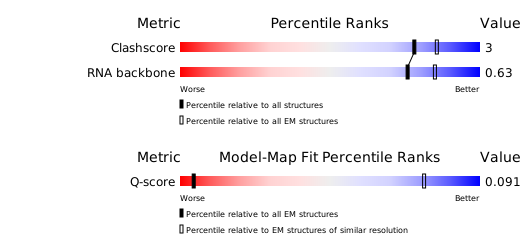
検証レポート(詳細版) をダウンロード
をダウンロード


