






 9YAH
9YAH9YAH の概要
| エントリーDOI | 10.2210/pdb9yah/pdb |
| 分子名称 | Copper chaperone PCu(A)C, COPPER (II) ION, GLYCEROL (3 entities in total) |
| 機能のキーワード | metallochaperone, metal binding protein |
| 由来する生物種 | Neisseria meningitidis serogroup A |
| タンパク質・核酸の鎖数 | 1 |
| 化学式量合計 | 17225.99 |
| 構造登録者 | Jobichen, C.,Kobe, B.,Dalton, H.Y.N.,Denis, T.,Karrera, D. (登録日: 2025-09-15, 公開日: 2026-03-25, 最終更新日: 2026-05-20) |
| 主引用文献 | Firth, S.,Earl, W.,Thaqi, D.,Hong, Y.,O'Hern, C.,Luscombe, G.,Ngu, D.H.Y.,Luo, Z.,Jobichen, C.,Kobe, B.,McEwan, A.,Djoko, K. AccA from Neisseria gonorrhoeae provides a new framework for understanding periplasmic copper metallochaperones. Chem Sci, 17:9270-9284, 2026 Cited by PubMed Abstract: Many bacteria use copper (Cu) to drive key redox reactions and energy metabolism, and they often rely on metallochaperones to deliver Cu to Cu-dependent enzymes. However, why delivery by metallochaperones is needed, and why Cu cannot transfer directly from cellular pools to the target enzymes, is not well understood. Here, we show that the PCuC-family metallochaperone AccA from the periplasm of delivers Cu to the Cu-dependent nitrite reductase AniA, enabling growth and nitrite respiration in O-limiting conditions. Although purified AccA binds both Cu(i) and Cu(ii) ions, only the Cu(i)-binding site is essential for activating AniA in cells. Unexpectedly, the Cu(i)-binding affinity of AniA is >50 times weaker than that of AccA, suggesting that Cu delivery occurs against a favourable affinity gradient. We propose that AccA is needed because AniA cannot compete with the periplasmic milieu for binding Cu, providing a new framework to understand why some Cu-dependent enzymes need metallochaperones to deliver Cu. PubMed: 41877990DOI: 10.1039/d5sc08738d 主引用文献が同じPDBエントリー |
| 実験手法 | X-RAY DIFFRACTION (2.9 Å) |
構造検証レポート
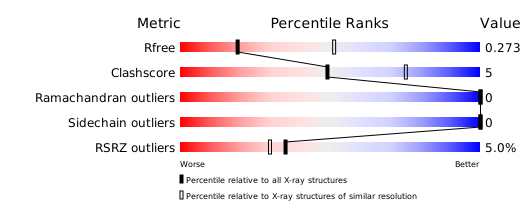
検証レポート(詳細版) をダウンロード
をダウンロード


