






 9YA2
9YA2
Cryo-EM structure of intraconoidal microtubule 1 (ICMT1) from Toxoplasma gondii (8-nm repeat)
これはPDB形式変換不可エントリーです。
9YA2 の概要
| エントリーDOI | 10.2210/pdb9ya2/pdb |
| EMDBエントリー | 72718 |
| 分子名称 | Microtubule associated protein SPM1, MAGNESIUM ION, GUANOSINE-5'-DIPHOSPHATE, ... (11 entities in total) |
| 機能のキーワード | tubulin, microtubule, microtubule inner protein, microtubule-associated protein, toxoplasma gondii, conoid, conoid fiber, intraconoidal microtubule, icmt, structural protein |
| 由来する生物種 | Toxoplasma gondii 詳細 |
| タンパク質・核酸の鎖数 | 99 |
| 化学式量合計 | 5030084.04 |
| 構造登録者 | |
| 主引用文献 | Zeng, J.,Fu, Y.,Qian, P.,Huang, W.,Niu, Q.,Beatty, W.L.,Brown, A.,Sibley, L.D.,Zhang, R. Atomic models of the Toxoplasma cell invasion machinery. Nat.Struct.Mol.Biol., 33:157-170, 2026 Cited by PubMed Abstract: Apicomplexan parasites, responsible for toxoplasmosis, cryptosporidiosis and malaria, invade host cells through a unique gliding motility mechanism powered by actomyosin motors and a dynamic organelle called the conoid. Here, using cryo-electron microscopy, we determined structures of four essential complexes of the Toxoplasma gondii conoid: the preconoidal P2 ring, tubulin-based conoid fibers, and the subpellicular and intraconoidal microtubules. Our analysis identified 40 distinct conoid proteins, several of which are essential for parasite lytic growth, as revealed through genetic disruption studies. Comparative analysis of the tubulin-containing complexes sheds light on their functional specialization by microtubule-associated proteins, while the structure of the preconoidal ring pinpoints the site of actin polymerization and initial translocation, enhancing our mechanistic understanding of gliding motility and, therefore, parasite invasion. PubMed: 41366525DOI: 10.1038/s41594-025-01728-w 主引用文献が同じPDBエントリー |
| 実験手法 | ELECTRON MICROSCOPY (3.34 Å) |
構造検証レポート
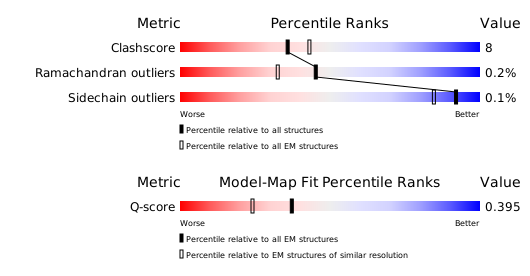
検証レポート(詳細版) をダウンロード
をダウンロード


