






 9VTP
9VTP
Target DNA-bound type I-F3 TniQ-Cascade of Vibrio parahaemolyticus in partial R-loop state
9VTP の概要
| エントリーDOI | 10.2210/pdb9vtp/pdb |
| EMDBエントリー | 65338 |
| 分子名称 | crRNA from Vibrio parahaemolyticus, Target strand DNA from Vibrio alginolyticus K08M03 plasmid pL300, Non-target strand DNA from Vibrio alginolyticus strain K08M3 plasmid pL300, ... (8 entities in total) |
| 機能のキーワード | crispr-associated transposon, dna binding protein |
| 由来する生物種 | Vibrio parahaemolyticus RIMD 2210633 詳細 |
| タンパク質・核酸の鎖数 | 13 |
| 化学式量合計 | 491156.67 |
| 構造登録者 | |
| 主引用文献 | Ishihara, K.,Matsumoto, S.,Gerle, C.,Gopalasingam, C.C.,Shigematsu, H.,Shirai, T.,Numata, T. Sequential structural rearrangements at the PAM-distal site of a type I-F3 CRISPR-Cas effector enabling RNA-guided DNA transposition. Nucleic Acids Res., 54:-, 2026 Cited by PubMed Abstract: Some prokaryotes carry CRISPR-associated transposons (CASTs), Tn7-like elements that incorporate genes encoding CRISPR-Cas effectors. CAST insertion is directed by CRISPR-Cas effectors through RNA-guided DNA binding and interactions with transposition-associated proteins. Although efficient sequence-specific DNA integration requires both precise target DNA recognition and coordinated interactions between effectors and transposition-associated proteins, the underlying mechanism remains elusive. Here, we determined three cryo-EM structures of target DNA-bound type I-F3 TniQ-Cascade from Vibrio parahaemolyticus, revealing how Cas8/5 recognizes the protospacer adjacent motif (PAM) and identifying a key residue responsible for the cytidine preference at position -2 of the PAM. We revealed mismatch tolerance at the PAM-proximal site. Structural analyses showed that correct base pairing at the PAM-distal site correlates with conformational changes in the Cas8/5 helical bundle and TniQ, bending the DNA to guide its downstream region toward the transposition machinery. Together, these dynamic rearrangements at the PAM-distal region provide insights into the licensing mechanism of type I-F3 CAST transposition and highlight its potential for genome engineering applications. PubMed: 41495894DOI: 10.1093/nar/gkaf1415 主引用文献が同じPDBエントリー |
| 実験手法 | ELECTRON MICROSCOPY (2.68 Å) |
構造検証レポート
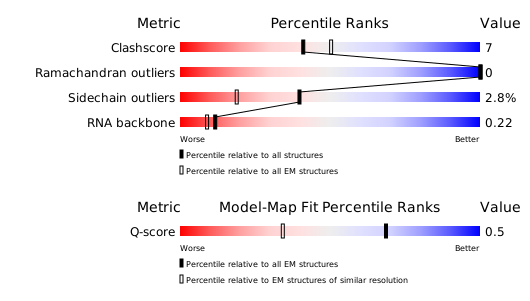
検証レポート(詳細版) をダウンロード
をダウンロード


