






 9VPY
9VPY
Crystal structure of the C131A mutant of Trypanosoma brucei DHODH in FMN-reduced, fumarate-bound form
9VPY の概要
| エントリーDOI | 10.2210/pdb9vpy/pdb |
| 分子名称 | Dihydroorotate dehydrogenase (fumarate), 1-DEOXY-1-(7,8-DIMETHYL-2,4-DIOXO-3,4-DIHYDRO-2H-BENZO[G]PTERIDIN-1-ID-10(5H)-YL)-5-O-PHOSPHONATO-D-RIBITOL, FUMARIC ACID, ... (5 entities in total) |
| 機能のキーワード | ping-pong reaction mechanism, substrate/product-enzyme interactions., flavoprotein |
| 由来する生物種 | Trypanosoma brucei brucei TREU927 |
| タンパク質・核酸の鎖数 | 4 |
| 化学式量合計 | 141186.61 |
| 構造登録者 | |
| 主引用文献 | Tani, O.,Kubota, T.,Yamasaki, T.,Hirokawa, T.,Furukawa, K.,Yamasaki, K. Structural Basis of Redox-Dependent Affinities of Dihydroorotate Dehydrogenase for Its Substrates and Products. J.Mol.Biol., 438:169544-169544, 2025 Cited by PubMed Abstract: Dihydroorotate dehydrogenase (DHODH), containing a cofactor, flavin mononucleotide (FMN), catalyzes the oxidation of dihydroorotate to orotate. In Trypanosoma brucei, the causative parasite of African trypanosomiasis, the DHODH enzyme (TbDHODH) couples this reaction with the reduction of fumarate to succinate. These reactions occur successively in the same catalytic site through a ping-pong bi-bi mechanism. FMN is reduced in the first step and re-oxidized in the second one. Here, we investigated how the redox state of FMN influences the binding of substrates and products to TbDHODH by NMR analyses of a catalytically impaired mutant. The affinities for the substrates, dihydroorotate and fumarate, were redox-dependent: dihydroorotate preferred the oxidized state, whereas fumarate preferred the reduced state. One of the products, succinate, exhibited no detectable binding to either of the redox states, suggesting its efficient product release. In contrast, the product of the first-half reaction, orotate, showed stronger binding to the oxidized state, suggesting that product inhibition may occur unless orotate is rapidly consumed in the subsequent biosynthetic step. The structural basis of these findings was elucidated by crystallography of the complexes with the above ligands in both redox states, along with quantitative analyses of the interactions using quantum chemical calculations. Upon reduction, the FMN isoalloxazine ring gains two additional hydrogens and becomes more bent at its center. These changes perturb the interactions among the ligands, flavin, and surrounding residues (notably Lys44, Asn68, and Asn195), primarily in the electrostatic term, which quantitatively explains the difference in binding affinities. PubMed: 41241202DOI: 10.1016/j.jmb.2025.169544 主引用文献が同じPDBエントリー |
| 実験手法 | X-RAY DIFFRACTION (2.48 Å) |
構造検証レポート
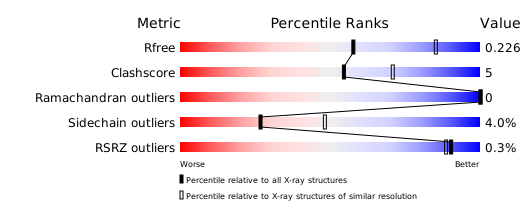
検証レポート(詳細版) をダウンロード
をダウンロード


