






9UTA
The transmembrane domains of human sweet taste receptor TAS1R2 and TAS1R3 in the apo state
9UTA の概要
| エントリーDOI | 10.2210/pdb9uta/pdb |
| EMDBエントリー | 64486 |
| 分子名称 | Taste receptor type 1 member 2,Engineered red fluorescent protein mScarlet3, Taste receptor type 1 member 3,mNeonGreen (2 entities in total) |
| 機能のキーワード | gpcr, taste, tas1r2, tas1r3, signaling protein |
| 由来する生物種 | Homo sapiens (human) 詳細 |
| タンパク質・核酸の鎖数 | 2 |
| 化学式量合計 | 247097.83 |
| 構造登録者 | |
| 主引用文献 | Shi, Z.,Xu, W.,Wu, L.,Yue, X.,Liu, S.,Ding, W.,Zhang, J.,Meng, B.,Zhao, L.,Liu, X.,Liu, J.,Liu, Z.J.,Hua, T. Structural and functional characterization of human sweet taste receptor. Nature, 645:801-808, 2025 Cited by PubMed Abstract: Sweet taste perception influences dietary choices and metabolic health. The human sweet taste receptor, a class C G protein-coupled receptor (GPCR) heterodimer composed of TAS1R2-TAS1R3, senses a wide range of sweet compounds - including natural sugars, artificial sweeteners and sweet proteins - impacting metabolic regulation beyond taste. However, the lack of three-dimensional structures hinders our understanding of its precise working mechanism. Here, we present cryo-EM structures of the full-length human sweet taste receptor in apo- and sucralose-bound states. These structures reveal a distinct asymmetric heterodimer architecture, with sucralose binding exclusively to the Venus flytrap domain of TAS1R2. Combining mutagenesis and molecular dynamics simulations, this work delineates the sweeteners recognition modes in TAS1R2. Structural comparisons further uncover the conformational changes upon ligand binding and unique activation mechanism. These findings illuminate the signal transduction mechanisms of chemosensory receptors in class C GPCRs and provide molecular basis for new-generation sweetener design. PubMed: 40555359DOI: 10.1038/s41586-025-09302-6 主引用文献が同じPDBエントリー |
| 実験手法 | ELECTRON MICROSCOPY (3.77 Å) |
構造検証レポート
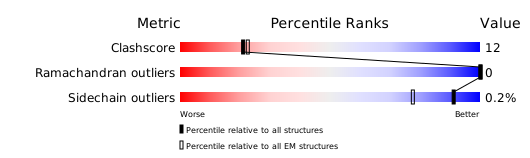
検証レポート(詳細版) をダウンロード
をダウンロード


