






 9UGB
9UGB
Cryo-EM structure of the Pma1 with ordered N-terminal extension in the activated state
9UGB の概要
| エントリーDOI | 10.2210/pdb9ugb/pdb |
| EMDBエントリー | 64135 |
| 分子名称 | Plasma membrane ATPase 1 (1 entity in total) |
| 機能のキーワード | pma1, activated state, proton transport |
| 由来する生物種 | Saccharomyces cerevisiae (strain ATCC 204508 / S288c) (brewer's yeast) |
| タンパク質・核酸の鎖数 | 2 |
| 化学式量合計 | 199428.05 |
| 構造登録者 | |
| 主引用文献 | You, Z.L.,Ni, Y.R.,Song, Y.,Li, H.,Liu, K.Z.,Wang, L.X.,Zhao, C.R.,Zhao, P.,Chen, D.D.,Wang, L.,Wang, K.,Xia, P.,Gu, Y.C.,Yun, C.,Bai, L. Assembly and cooperative mechanism of the hexameric fungal plasma membrane H + -ATPase. Cell Rep, 44:115753-115753, 2025 Cited by PubMed Abstract: The fungal plasma membrane H+-ATPase Pma1 hydrolyzes ATP to pump protons out of the cell to maintain the intracellular pH and membrane potential. Pma1 is unique among the P-type ATPases as it functions as a hexamer, although the underlying mechanism has been unclear. Here, we show that the Pma1 hexamer functions cooperatively, and the cooperativity is mediated by the domain-swapped N-terminal extension (NTE). The NTE of one Pma1 subunit binds to the nucleotide-binding domain of a neighboring subunit and, thus, couples the conformational changes of two neighboring subunits, enabling inter-subunit cooperativity of the ATPase activity by the hexamer. We further demonstrate that the NTE is essential for Pma1's cooperative activity and physiological function. Therefore, our work suggests that Pma1 assembles a hexamer to promote a more efficient proton-pumping activity, perhaps to rapidly respond to environmental changes, and may facilitate antifungal drug development targeting Pma1. PubMed: 40413744DOI: 10.1016/j.celrep.2025.115753 主引用文献が同じPDBエントリー |
| 実験手法 | ELECTRON MICROSCOPY (3.25 Å) |
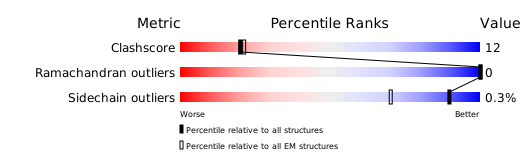
構造検証レポート
検証レポート(詳細版) をダウンロード
をダウンロード


