






 9UE9
9UE9
Heptameric pore structure of Vibrio cholerae Cytolysin (VCC) embedded in lipid bilayer
9UE9 の概要
| エントリーDOI | 10.2210/pdb9ue9/pdb |
| EMDBエントリー | 31972 |
| 分子名称 | HlyA (2 entities in total) |
| 機能のキーワード | vibrio cholerae cytolysin (vcc), pore-forming toxin, toxin |
| 由来する生物種 | Vibrio cholerae |
| タンパク質・核酸の鎖数 | 7 |
| 化学式量合計 | 452235.69 |
| 構造登録者 | |
| 主引用文献 | Singh, M.,Chatterjee, A.,Nayak, A.,Naskar, P.,Kaur, G.,Mondal, J.,Dutta, S.,Chattopadhyay, K. Cradle loop regulates beta-barrel pore-formation mechanism of Vibrio cholerae cytolysin. Structure, 34:157-, 2026 Cited by PubMed Abstract: Vibrio cholerae cytolysin (VCC) is a β-barrel pore-forming toxin (β-PFT). The membrane insertion of its pore-forming "pre-stem" motif is the most crucial step in the pore-formation mechanism. In the soluble monomeric form, pre-stem remains clamped against the central cytolysin domain by the so-called cradle loop. In the course of oligomeric pore-formation in the target membranes, the cradle loop gets detached from the pre-stem and reorients, thus allowing the pre-stem to extend and insert into the membrane. Here, we show that the specific cradle loop residue(s) play crucial roles in governing the pore-formation mechanism of VCC by establishing decisive interactions with the neighboring structural domains/modules. The alteration of the cradle loop residue, Y194 in particular, compromises the membrane-insertion of the pre-stem, and tends to arrest the membrane-bound toxin in the pre-pore-like oligomeric states. Our study suggests that the native cradle loop architecture, with its intact contacts with the surrounding interaction partners, is essential for VCC pore-formation. PubMed: 41202807DOI: 10.1016/j.str.2025.10.013 主引用文献が同じPDBエントリー |
| 実験手法 | ELECTRON MICROSCOPY (4 Å) |
構造検証レポート
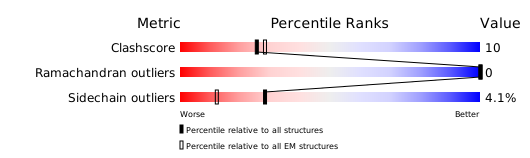
検証レポート(詳細版) をダウンロード
をダウンロード


