






 9UDT
9UDT9UDT の概要
| エントリーDOI | 10.2210/pdb9udt/pdb |
| 分子名称 | Single-chain Fv antibody of C6, 6-[2-(4-hydroxy-3,5-dinitrophenyl)acetamido]hexanoic acid, ACETATE ION, ... (4 entities in total) |
| 機能のキーワード | antigen binding, affinity maturation, somatic hypermutation, immune system |
| 由来する生物種 | Mus musculus |
| タンパク質・核酸の鎖数 | 1 |
| 化学式量合計 | 26531.26 |
| 構造登録者 | Yoshida, M.,Hanazono, Y.,Numoto, N.,Ito, N.,Oda, M. (登録日: 2025-04-07, 公開日: 2025-11-05, 最終更新日: 2026-04-22) |
| 主引用文献 | Yoshida, M.,Hanazono, Y.,Numoto, N.,Yabuno, S.,Ito, N.,Azuma, T.,Oda, M. Structural basis of affinity maturation of anti-(4-hydroxy-3-nitrophenyl)acetyl antibodies. Arch.Biochem.Biophys., 775:110665-110665, 2026 Cited by PubMed Abstract: The phenomenon in which the antibody affinity for T cell-dependent antigens increases through multiple rounds of somatic hypermutation (SHM) is referred to as affinity maturation. The elucidation of the structural and physical properties of antibodies obtained at various stages of the affinity maturation process can help us understand the molecular recognition mechanism of proteins in general. For this purpose, we used anti-(4-hydroxy-3-nitrophenyl)acetyl (NP) single-chain (scFv) antibodies, prepared from the parent antibodies F8, B2, C6, and E11, and analyzed the crystal structures either in the absence or presence of NP or (4-hydroxy-3,5-dinitrophenyl)acetyl (NNP). Comparison of the structures revealed that the antibodies shared a common antigen recognition architecture consisting of residues with basic side chains, Arg50 and Lys58/Arg58, in addition to those at the junctional positions of gene segments, Trp96 and Tyr95 or His100B. These residues are responsible for the recognition of antigenic determinants, nitro-, hydroxyl- and phenylacetyl-groups, through hydrogen bond formation. Second, the Trp33 to Leu33 mutation seemed to strengthen the interaction because the antigen was closer to the combining site. Finally, analysis of NP and NNP complexes showed little difference in the antigen recognition modes and in the overall structures of the complementarity-determining regions between C6 and E11 scFvs. It was suggested that the replacement of residues by SHM provided a unique binding site for each antibody by fine tuning the microenvironment without disturbing specificity. PubMed: 41161463DOI: 10.1016/j.abb.2025.110665 主引用文献が同じPDBエントリー |
| 実験手法 | X-RAY DIFFRACTION (1.08 Å) |
構造検証レポート
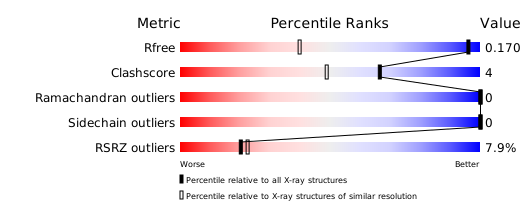
検証レポート(詳細版) をダウンロード
をダウンロード


