






 9TDU
9TDU
Structure of Fructofuranosidase from Purpureocilum lilacinum
9TDU の概要
| エントリーDOI | 10.2210/pdb9tdu/pdb |
| 分子名称 | Invertase, alpha-D-mannopyranose-(1-2)-alpha-D-mannopyranose-(1-2)-alpha-D-mannopyranose-(1-3)-[alpha-D-mannopyranose-(1-3)-[alpha-D-mannopyranose-(1-6)]alpha-D-mannopyranose-(1-6)]beta-D-mannopyranose-(1-4)-2-acetamido-2-deoxy-beta-D-glucopyranose-(1-4)-2-acetamido-2-deoxy-beta-D-glucopyranose, SULFATE ION, ... (5 entities in total) |
| 機能のキーワード | fructooligosaccharides (fos) glycosyl hydrolase beta-fructofuranosidase family gh32 transfructosylation, hydrolase |
| 由来する生物種 | Komagataella phaffii CBS 7435 |
| タンパク質・核酸の鎖数 | 2 |
| 化学式量合計 | 130610.95 |
| 構造登録者 | |
| 主引用文献 | Narmontaite, E.,Ruiz-Nunez, M.,Plou, F.J.,Fernandez-Lobato, M.,Sanz-Aparicio, J. Structural and mechanistic insights into a novel beta-fructofuranosidase from Purpureocillium lilacinum with high transfructosylating activity and an atypical tetrameric assembly. Int.J.Biol.Macromol., 345:150552-150552, 2026 Cited by PubMed Abstract: β-Fructofuranosidases are key biocatalysts in the synthesis of fructooligosaccharides (FOS), prebiotics whose biological properties depend on the specific arrangement of β-(2 → 1) and/or β-(2 → 6) fructosyl linkages. Tailoring FOS structures therefore requires enzymes with adjustable specificities. In this work, we characterize the structural and functional features of the novel β-fructofuranosidase PlINV from Purpureocillium lilacinum, aiming to enhance its utility in the production of bioactive compounds. Purified PlINV exhibits broad substrate specificity, preferring sucrose but also acting on fructose-based polymers with diverse linkage types. It displays wide acceptor promiscuity in transfructosylation reactions, generating several trisaccharides from sucrose. The three-dimensional structure, solved at 2.1 Å, reveals a previously unreported tetrameric assembly within the GH32 family and a relatively occluded active site. Structures of various enzyme-substrate complexes identify residues governing substrate recognition and highlight substantial conformational plasticity, including numerous water-mediated interactions. Structure-guided mutagenesis within the active-site cleft generated variants with altered hydrolytic activity and distinct FOS profiles, confirming the functional importance of the identified residues. Substitutions Q259A and P207N increased overall FOS yield, whereas N289T selectively enriched neokestose within a broader product mixture. PlINV also efficiently fructosylated the polyphenols hydroxytyrosol and piceid-this latter reaction being described for the first time-validated by HPLC-MS analyses. Docking simulations suggest that polyphenol accommodation relies mainly on hydrophobic contacts, complemented by limited polar interactions. Collectively, these results provide a robust structural and mechanistic framework for engineering PlINV to fine-tune its biocatalytic properties, enabling the targeted production of specific FOS and other bioactive compounds for biotechnological applications. PubMed: 41617004DOI: 10.1016/j.ijbiomac.2026.150552 主引用文献が同じPDBエントリー |
| 実験手法 | X-RAY DIFFRACTION (2.1 Å) |
構造検証レポート
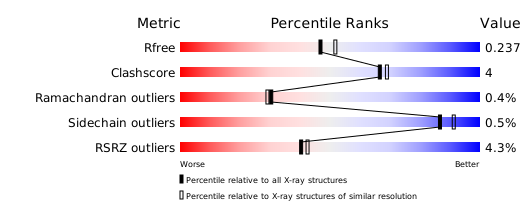
検証レポート(詳細版) をダウンロード
をダウンロード


