






9SH9
Thermus thermophilus asparaginyl-tRNA synthetase dimer with bound ATP
Summary for 9SH9
| Entry DOI | 10.2210/pdb9sh9/pdb |
| Descriptor | Asparagine--tRNA ligase, MAGNESIUM ION, ADENOSINE-5'-TRIPHOSPHATE, ... (4 entities in total) |
| Functional Keywords | rna binding protein enzyme, synthetises asparaginyl-adenylate from asparagine and atp, translation |
| Biological source | Thermus thermophilus HB8 |
| Total number of polymer chains | 2 |
| Total formula weight | 102877.90 |
| Authors | Cusack, S.,Seignovert, L.,Leberman, R.,Berthet-Colominas, C. (deposition date: 2025-08-25, release date: 2025-09-17) |
| Primary citation | Berthet-Colominas, C.,Seignovert, L.,Haertlein, M.,Grotli, M.,Cusack, S.,Leberman, R. The crystal structure of asparaginyl-tRNA synthetase from Thermus thermophilus and its complexes with ATP and asparaginyl-adenylate: the mechanism of discrimination between asparagine and aspartic acid. EMBO J, 17:2947-2960, 1998 Cited by PubMed Abstract: The crystal structure of Thermus thermophilus asparaginyl-tRNA synthetase has been solved by multiple isomorphous replacement and refined at 2.6 A resolution. This is the last of the three class IIb aminoacyl-tRNA synthetase structures to be determined. As expected from primary sequence comparisons, there are remarkable similarities between the tertiary structures of asparaginyl-tRNA synthetase and aspartyl-tRNA synthetase, and most of the active site residues are identical except for three key differences. The structure at 2.65 A of asparaginyl-tRNA synthetase complexed with a non-hydrolysable analogue of asparaginyl-adenylate permits a detailed explanation of how these three differences allow each enzyme to discriminate between their respective and very similar amino acid substrates, asparagine and aspartic acid. In addition, a structure of the complex of asparaginyl-tRNA synthetase with ATP shows exactly the same configuration of three divalent cations as previously observed in the seryl-tRNA synthetase-ATP complex, showing that this a general feature of class II synthetases. The structural similarity of asparaginyl- and aspartyl-tRNA synthetases as well as that of both enzymes to the ammonia-dependent asparagine synthetase suggests that these three enzymes have evolved relatively recently from a common ancestor. PubMed: 9582288DOI: 10.1093/emboj/17.10.2947 PDB entries with the same primary citation |
| Experimental method | X-RAY DIFFRACTION (2.95 Å) |
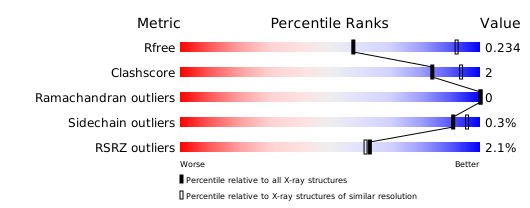
Structure validation
Download full validation report


