






 9SDS
9SDS
Structure of native leukocyte myeloperoxidase in complex with a truncated version of the Staphylococcal Peroxidase Inhibitor SPIN and chloride at pH 5.5
9SDS の概要
| エントリーDOI | 10.2210/pdb9sds/pdb |
| 分子名称 | Myeloperoxidase light chain, 2-acetamido-2-deoxy-beta-D-glucopyranose, Myeloperoxidase inhibitor SPIN, ... (11 entities in total) |
| 機能のキーワード | innate immunity, enzyme substrate complex, inhibitor, oxidoreductase |
| 由来する生物種 | Staphylococcus aureus 詳細 |
| タンパク質・核酸の鎖数 | 6 |
| 化学式量合計 | 151526.54 |
| 構造登録者 | |
| 主引用文献 | Leitgeb, U.,Crha, R.,Fegerl, I.,Furtmuller, P.G.,Oostenbrink, C.,Pfanzagl, V. Halide binding by myeloperoxidase is regulated by access channel dynamics and charge interactions. Int.J.Biol.Macromol., 330:148038-148038, 2025 Cited by PubMed Abstract: The heme enzyme myeloperoxidase is a key player in the innate immune defense. It uses hydrogen peroxide to produce bactericidal hypohalous acids from (pseudo)halides, foremost chloride, and thiocyanate in the neutrophil phagosome. However, the available structural data on the halide-binding site, the marked pH dependence of halide oxidation, and the atypical pK of an active-site histidine 261 fail to fully account for the mechanism of halide oxidation by myeloperoxidase. In the present study, crystal structures of myeloperoxidase-halide complexes show that halides can integrate into the hydrogen-bonding network formed by conserved water molecules, without directly interacting with the deprotonated histidine at both acidic and neutral pH. Molecular dynamics simulations reveal that protonation of histidine 261 decreases active site rigidity and increases the flexibility of arginine 405. Together with the terminal residues of the myeloperoxidase heavy and light chains, arginine 405 contributes to halide transport into the active site. Kinetic analyses and simulations further demonstrate that sodium ions play a critical role as charge shields, enabling halides to traverse the negatively charged access channel, which represents a key bottleneck for halide binding. Thus, halide access to the active site is governed by a complex interplay of electrostatic interactions involving both solvent ions and charged amino acid residues. PubMed: 41043752DOI: 10.1016/j.ijbiomac.2025.148038 主引用文献が同じPDBエントリー |
| 実験手法 | X-RAY DIFFRACTION (2.49 Å) |
構造検証レポート
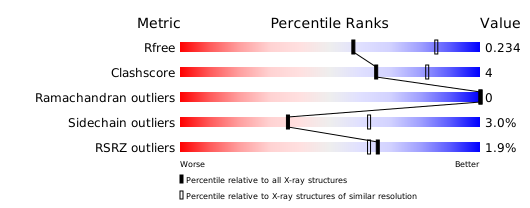
検証レポート(詳細版) をダウンロード
をダウンロード


