






 9SD3
9SD3
Crystal structure of Methanocaldococcus infernus Malate dehydrogenase
9SD3 の概要
| エントリーDOI | 10.2210/pdb9sd3/pdb |
| 関連するPDBエントリー | 9S3K |
| 分子名称 | Malate dehydrogenase (NADP(+)), NADPH DIHYDRO-NICOTINAMIDE-ADENINE-DINUCLEOTIDE PHOSPHATE, ACETATE ION, ... (6 entities in total) |
| 機能のキーワード | malate dehydrogenase, nadp binding domain, oxidoreductase |
| 由来する生物種 | Methanocaldococcus infernus |
| タンパク質・核酸の鎖数 | 8 |
| 化学式量合計 | 285112.48 |
| 構造登録者 | |
| 主引用文献 | Pereira, C.S.,Coquille, S.,Brochier-Armanet, C.,Sterpone, F.,Madern, D. Unraveling the Link Between Thermal Adaptation and Latent Allostery in Malate Dehydrogenase From Methanococcales. J.Mol.Biol., 438:169552-169552, 2026 Cited by PubMed Abstract: Malate dehydrogenase (MalDH) (EC.1.1.1.37) is an enzyme engaged in the central metabolism of cells, catalyzing the interconversion between oxaloacetate and malate using NADH or NADPH as coenzyme. These enzymes are particularly interesting models for studying how proteins adapt to physical and chemical environmental constraints. In this study, we investigated the molecular mechanisms that have enabled MalDHs to adapt to changes in temperature, using Methanococcales archaea as a model organism. We solved the crystal structure of ancestral MalDHs in these archaea. Structural comparison with present-day MalDHs such as those from Methanocaldococcus infernus (M. inf) and Methanocaldococcus jannaschii (M. jan), highlights the role salt-bridges in thermal adaptation. We also found that present-day MalDHs from M. inf and M. jan, show structural features that resemble the extended or compact states typical of allosteric lactate dehydrogenases. To test hypotheses about a possible link between thermal adaptation and the emergence of allosteric regulation, we characterized structurally two M. jan MalDH mesophilic-like mutants. Molecular dynamics simulations using the Wt M. jan and mutant MalDHs were used to rationalize the experimental data. The results indicate that uncompetent and competent catalytic site configurations are in an equilibrium that depends on temperature conditions. At low temperature the Wt M. jan MalDH select non-competent conformers, whereas high temperature favors active conformers. In contrast, the M. jan MalDH mutants explore competent conformers for catalysis at a lowest temperature, a phenomenon that fits well with their biochemical behavior. Our work reveals that thermal adaptation and evolution of allostery are strongly linked via the modulation of the protein conformational landscape. PubMed: 41274549DOI: 10.1016/j.jmb.2025.169552 主引用文献が同じPDBエントリー |
| 実験手法 | X-RAY DIFFRACTION (2.2 Å) |
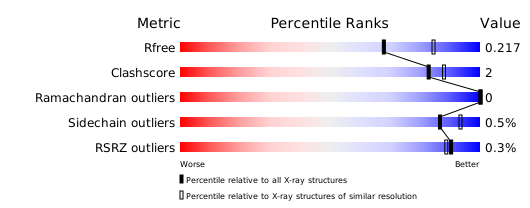
構造検証レポート
検証レポート(詳細版) をダウンロード
をダウンロード


