






9S01
PYCR1 in complex with L-tartrate
9S01 の概要
| エントリーDOI | 10.2210/pdb9s01/pdb |
| 分子名称 | Isoform 3 of Pyrroline-5-carboxylate reductase 1, mitochondrial, L(+)-TARTARIC ACID, 1,2-ETHANEDIOL, ... (4 entities in total) |
| 機能のキーワード | delta-1-pyrroline-5-carboxylate reductase, pycr1, cancer, crystallographic fragment screening (xfs), molecular docking, proline metabolism, oxidoreductase |
| 由来する生物種 | Homo sapiens (human) |
| タンパク質・核酸の鎖数 | 5 |
| 化学式量合計 | 181075.80 |
| 構造登録者 | |
| 主引用文献 | Ragin-Oh, W.,Czerwonka, D.,Tran, L.H.,Forlani, G.,Ruszkowski, M. Crystallographic fragment screening reveals new starting points for PYCR1 inhibitor design. Bioorg.Chem., 165:109024-109024, 2025 Cited by PubMed Abstract: Pyrroline-5-carboxylate (P5C) reductase catalyzes the final step in proline biosynthesis. Human P5C reductase isoform 1 (PYCR1) has emerged as a key metabolic enzyme supporting cancer progression through its roles in redox homeostasis, collagen production, and the proline-P5C cycle. Despite its relevance as a therapeutic target, structural and chemical efforts to inhibit PYCR1 remain limited and have largely focused on proline analogs. Here, we report the first crystallographic fragment screening (XFS) campaign against PYCR1, employing a chemically diverse library of 96 compounds. We solved twelve co-crystal structures, featuring ligands occupying the P5C and NADH binding pockets, including dual-site ligands that span both regions. Among the newly identified moieties, sulfonamide and sulfamate groups emerged as notable isosteric replacements for the carboxylate group in the PYCR1 active site. Aromatic substituents in several compounds revealed a cryptic subpocket near the nicotinamide-binding site. Interestingly, halogen-substituted aromatic rings, often present in known PYCR1 inhibitors, exhibited distinct binding orientations, reflecting the flexibility and diversity of interactions in the binding subpockets. High-resolution structures revealed ligand-induced conformational changes in PYCR1, some involving significant rearrangements. Molecular dynamics simulations indicated that these conformations are accessible in the ligand-free enzyme, underscoring the intrinsic plasticity of PYCR1's active site. PubMed: 41016381DOI: 10.1016/j.bioorg.2025.109024 主引用文献が同じPDBエントリー |
| 実験手法 | X-RAY DIFFRACTION (1.65 Å) |
構造検証レポート
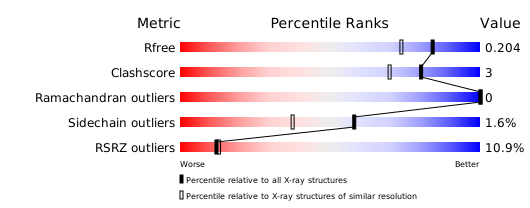
検証レポート(詳細版) をダウンロード
をダウンロード


