






 9RYU
9RYU9RYU の概要
| エントリーDOI | 10.2210/pdb9ryu/pdb |
| EMDBエントリー | 54392 |
| 分子名称 | 6,7-dimethyl-8-ribityllumazine synthase, PHOSPHATE ION (3 entities in total) |
| 機能のキーワード | protein cage, protein engineering, self-assembly, geometry, pentamer, encapsulation, biosynthetic protein |
| 由来する生物種 | Aquifex aeolicus VF5 |
| タンパク質・核酸の鎖数 | 60 |
| 化学式量合計 | 1090776.00 |
| 構造登録者 | |
| 主引用文献 | Koziej, L.,Pankowski, J.,Stefanska, M.,Jankowski, D.,Gawin, A.,Malolan, V.V.,Huiskonen, J.T.,Kosugi, T.,Azuma, Y. A molecular basis for stoichiometric enzyme encapsulation in the vitamin B2 biosynthesis compartment. Nat Commun, 17:-, 2026 Cited by PubMed Abstract: Encapsulating metabolic enzymes within protein cages enhances catalytic efficiency through substrate channeling. The vitamin B2 biosynthesis system, in which a dodecahedral lumazine synthase (LS) cage encapsulates a homotrimeric riboflavin synthase (RS), exemplifies this strategy, yet the molecular basis for this stoichiometric enzyme encapsulation has remained elusive. Here, cryogenic electron microscopy structures reveal a hierarchical assembly mechanism that ensures the defined host-guest ratio. RS C-terminal cage-localization signal peptides anchor at LS pentamer-pentamer interfaces early during assembly, stabilizing open intermediates that, together with delayed later-stage cage closure, extend the loading window until guest incorporation is complete. RS spatial occupancy avoids overloading, while a molecular lock upon final closure prevents disassembly. The elucidated anchoring mechanism enabled structure-based phylogenetic analysis across diverse organisms, suggesting multiple independent evolutionary origins of this modular encapsulation strategy. This naturally occurring architecture provides design principles for engineering synthetic catalytic compartments with programmable stoichiometric control. PubMed: 42143052DOI: 10.1038/s41467-026-73260-4 主引用文献が同じPDBエントリー |
| 実験手法 | ELECTRON MICROSCOPY (1.71 Å) |
構造検証レポート
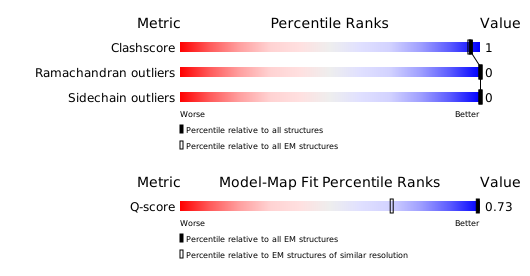
検証レポート(詳細版) をダウンロード
をダウンロード


